This recipe is a no-brainer. It doesn’t take long and doesn’t involve making your own fish stock but you wouldn’t even know.
It’s healthy, hearty, warm, and delicious. A provincial stable from humble beginnings; the undisputed king of fish stews just got a whole lot easier.
Ingredients
For the stock
6 c fish stock 1tsp aniseed 2 bay leaves 1tsp saffron threads
For the base
8 tomatoes cut into small cubes 6 cloves of garlic minced 2 onions thinly diced 2 salmon fillets (no skin) cubed 2 white fish fillets (no skin) cubed handful of raw and peeled prawns 1 large bunch parsley chopped
Method
Add the fish stock ingredients to a pan and bring to a boil.
On medium heat, paint olive oil on the bottom of a heavy-based pot and put in tomatoes, garlic and onions.
Lay the seafood on top of the tomatoes, garlic, and onions and leave for about 3 mins (enough to heat up the pot).
Ladle the boiling fish stock into the pot and cover the seafood.
Sprinkle half the parsley on top and cover. Bring to a soft boil for about 10 mins until seafood is cooked.
Sprinkle the remaining parsley on top and serve with warm crusty bread.
This really is a dish that tells you that vegetables really are better than meat.
Line it up against a chicken parmigiana and hands down the eggplant wins. Even without the shallow fried-breadcrumb.
The basil. The ricotta. The Parmesan. The toasted breadcrumbs.
Brilliant.
I don’t often cook a dish twice in quick succession, though this is now in the repertoire. Make the sauce a few days ahead, the aubergine mixture in the afternoon and bam, with a salad of greens, you’ll have just a marvellous dinner on your hands.
90gm fresh breadcrumbs (preferably sourdough) 4 aubergines (eggplants) roughly cut into 2 1/2cm cubes (1kg) 150ml olive oil, plus extra for shaping 100gm ricotta 75gm Parmesan, finely grated, plus extra to serve 10gm parsley, finely chopped 1 egg, plus 1 yolk 1 1/2 tbsp plain flour 6 garlic cloves, crushed 15gm basil leaves, roughly chopped 1 1/2 x 400gm tins of peeled plum tomatoes, blitzed until smooth (600gm) 1 1/2 tsp tomato paste 1 1/2 tsp caster sugar 1/4 tsp chilli flakes 3/4 tsp paprika 2 tsp fresh oregano leaves, finely chopped 45gm pitted Kalamata olives, roughly torn in half Salt and black pepper
Method
Preheat the oven to 160c. Spread the breadcrumbs on a baking tray and bake for 12 minutes, until lightly browned and dried out. Set aside to cool and turn the oven temperature up to 220c.
On a large, parchment-lined tray, toss the aubergines with 75ml of oil, 1/2 tsp of salt and a good grind of black pepper. Spread out as much as possible and bake for 30 minutes, tossing halfway through, until golden brown.
Roughly chop the aubergines not a chunky mash, then transfer to a large bowl and refrigerate for 20 minutes, or until cool. Once cool, add the ricotta, Parmesan, parsley, egg, yolk, flour, breadcrumbs, a third of the garlic, 10gm of the basil, 1/4 tsp of salt and a good grind of black pepper. Mix well, then with lightly oiled hands, shape the mixture into 16 golf-ball-sized dumplings, about 55gm each, compressing them as you go so they hold together.
Put 2 tbsp of oil into a large non-stick frying pan on a medium-high heat. In two batches, fry the dumplings for 3-4 minutes, turning them until golden-brown all over. Adjust the heat if they’re browning too much. Add another 1 tbsp of oil and fry the remaining dumplings in the same way. Transfer to a plate and set aside.
Preheat the oven to 180c. Put the remaining 2 tbsp of oil into a large sauté pan on a medium-high heat. Add the remaining garlic and cook for 1 minute until fragrant, then add the tinned tomatoes, tomato paste, sugar, chilli flakes, paprika, oregano, 1 tsp of salt and a good grind of black pepper and cook for 8 minutes or until thickened slightly, stirring occasionally. Pour 400ml of water, bring to a simmer, then lower the heat to medium and simmer for another 10 minutes.
Pour the sauce into a medium baking dish, top with the dumplings and bake for 20 minutes, until bubbling. Remove from the oven, scatter over the olives, the remaining basil and a grating of Parmesan, and serve.
Tis the season of soup: four days into winter and I don’t think we have managed to get over 10 degrees in Sydney.
Cue the long line of winter soups and we’re not sad about it.
This one is a winner: its thick, warming, healthy and kids love it – Tom Tom went in successively for four bowls.
And it’s sophisticated enough to serve as a starter at a lunch over the next few months. This really is French bistro.
Bring on winter. And extra Parmesan.
Ingredients
For the roasted vegetables
4 tbsp olive oil 2 carrots 1 capsicum 1 broccoli 1 red onion 1 head of garlic (or about 6 cloves) 4 tbsp tomato paste 1 tbsp balsamic vinegar
For the stew base
2 tbsp olive oil 1 red onion, finely chopped 2 cloves of garlic minced 1 tsp dried thyme 1 tsp dried oregano 2 bay leaves 2 cans tomatoes 4 cups chicken stock 2 cups of vegetable stock 100g of green beans, trimmed and cut 0.5cm pieces 1 cup French lentils Parmesan soup
Method
Roasted vegetables
Turn on oven to 180C. Chop up vegetables (don’t bother peeling the carrots) and drizzle with olive oil and toss so the veges are evenly coated.
Wrap the garlic in foil and drizzle with olive oil and seal in a bundle. Put in the oven with the tray of vegetables.
Roast for about 30-40 mins.
Stew base
In a large pot on medium heat cook the onion and garlic until it is soft and translucent.
Add the oregano, thyme, bay leaves, canned tomatoes, stock, beans and lentils. Bring to the boil and let simmer for about 15 mins or until the lentils are cooked, stirring so the lentils don’t stick to the pot.
When the vegetables have finished roasting put them in a blender with roasted garlic, balsamic, tomato paste and a couple of big spoons of the soup. Blend to combine.
Mix the blended vegetables into the soup base and simmer for another 5-10 mins depending on how thick you want the soup.
This is probably one of the most comfortable pastas I have ever eaten, though calling it comfortable is an understatement.
It’s simplicity is its sophistication.
This is 2-hat sort of stuff. And yet, so simple.
Nat served this as the first course of a slow, Sunday afternoon of pastas and wow.
She adapted the dough slightly and I cooked the mushrooms for longer because mushrooms only improve with time in the pan.
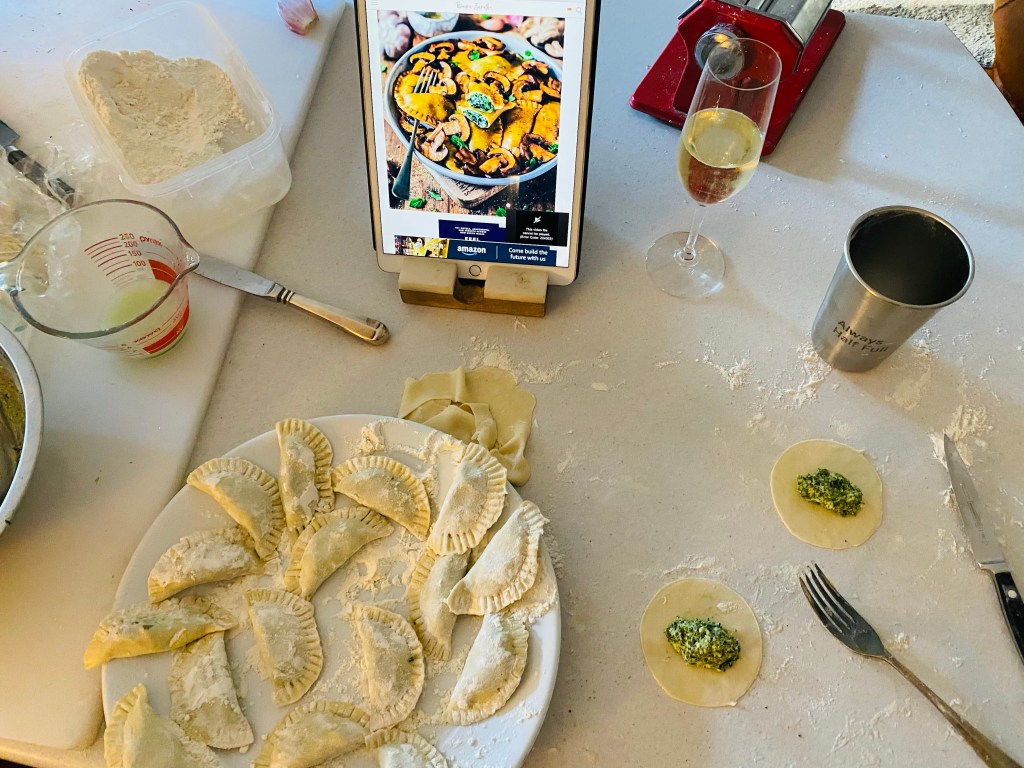
We discovered some time ago that pasta assembly is best accompanied with a few flutes of good Champagne. A celebration of sorts that you have hit the final straight!
As the first course for a late autumn lunch, people would be blown away. A crisp Pinot Grigio, a fire and some good music and here you have all the pieces to start a very good afternoon.
Well done Nat.
Ingredients
For the Ravioli
1 3/4 cups plain flour 1/2 00 flour 1/4 semolina flour 1/2 tsp salt 3/4 c water 2 tsp extra virgin olive oil
For the Spinach Filling
225gm frozen spinach, thawed 125gm cream cheese 5 tbsp Parmesan Cheese, grated Salt and pepper to taste
For the Mushrooms
2 garlic cloves, roughly chopped 1 tbsp extra virgin olive oil 300gm brown mushrooms, sliced 3 tbsp soy sauce Salt and pepper to taste Fresh herbs and/or grated Parmesan to serve
Method
Pasta Dough
Mix the flours, semolina and salt. Heap into a pile and press a well into the centre. Pour in water and olive oil and knead to a smooth dough. (We used the dough hook on a KitchenAid.)
Shape the dough into a ball, wrap in cling foil and place in the fridge for at least 1/2 hour.
Spinach filling
Squeeze the spinach to remove all excess water and chop.
Add the Parmesan, cream cheese, season and mix until combined.
To make the Ravioli
Roll out the prepared pasta dough thinly on a lightly floured surface. (We used a pasta roller down to setting 2.)
Cut out 7cm circles with a round form.
Place approximately 1 tbsp of the spinach filling in the centre of each circle. Brush the sides with a bit of water and fold over the filling into semicircles. Carefully seal with your finer and then press down lightly with a fork.
Bring salted water to the boil in a large pot. Let the ravioli slide in a simmer for 3 – 4 minutes until they have floated to the surface.
Remove with a slotted spoon and drain.
Fried Mushrooms
Heat the olive oil in a pan and fry the mushrooms until browned and all the liquid has evaporated.
Add the chopped garlic and sauté for a few minutes. Deglaze with the soy sauce and sauté for at least a few more minutes.
Serve with the drained ravioli. Season and garnish with fresh herbs and/or grated Parmesan.
I love a simple recipe that comes good and this one simply delivers.
It’s a bake (✅), it’s reasonably healthy (✅) and it’s easy (✅).
Though it’s the richness of wonderful Mediterranean flavour that truly gets it over the line. (✅).
It is better than the seeming sum of its parts and bravo for it.
The richness of the reserved stock, the break apart chicken… and those olives.
This is a mid-week meal that will set the clock forward to Friday when the cooking can commence. It’s just that good, that fun and that successful.
Paired with a salad of greens, red onion, tomato, maybe some cucumber and plenty of oregano and a good vinaigrette: I reckon only a bottle of chilled red along-side could better it.
Lock next Wednesday evening in and the road to the weekend just got much easier.
And chill that red.
Ingredients
8 chicken thighs (ideally skin-on and bone in) Salt and freshly cracked pepper 1/2 tsp red pepper flakes 6 garlic cloves, minced 1/2 tsp crushed fennel seeds 1 tbsp roughly chopped rosemary 1 tbsp olive oil 2 lemons, cut into 8 wedges each 1 c olives, black and green pitted 1 c chicken stock 3 tbsp chopped parsleyto serve
Method
Pat chicken thighs dry with paper towels. Season well with salt and pepper and place in a baking dish one layer, (skin) side up. Sprinkle with red pepper, garlic, fennel and rosemary and drizzle with olive oil. Rub seasoning on all sides. Tuck lemon wedges here and there, marinating for 15 minutes. Heat the oven to 190c.
Put the baking dish in the oven for 20 minutes uncovered (or until the skin, if you have it, starts to brown). Scatter olives over evenly and then pour over the stock. Cover tightly and bake for 1 hour.
Remove thighs and lemon wedges and arrange on a platter and keep warm. Pour pan juices into a saucepan and quickly skim fat from the surface. Over high heat, simmer rapidly until reduced by half. Spoon juices over the chicken, sprinkle with parsley and serve.
Recently we have cooked this Ragùtwice and it is just as wonderful.
Simple like Ragù is, though just as rich as an amazing Ragù is and should be.
For me, a long Italian lunch in the sun – one white pasta, one red pasta – is the absolute definition of heaven.
I commend this Ragù to your next such session.
Have a medium-bodied Chianti Classico ready to go and it is bliss.
Ingredients
2kg boneless veal shoulder, cut into large chunks* Salt and freshly ground pepper All-purpose flour, for dusting 1/2 c extra virgin olive oil 1 large white onion, finely chopped 4 garlic cloves, minced 1 1/2 tsp ground coriander 1 1/2 tsp ground fennel 1 1/2 c dry red wine 4 c chicken or veal stock 1 1/2 tbsp minced rosemary 1kg fresh pappardelle Freshly grated Parmigiano-Reggiano to serve Chopped, fresh Italian Parsley to serve
Method
Season the veal with salt and pepper and dust with flour, tapping off the excess. In a large, heavy casserole, heat 1/4 of the olive oil. Add the veal and cook over a moderately high heat until browned all over. Transfer the veal to a plate and do in batches if need be.
Turn the heat down to low, add the remaining 1/4 c oil to the casserole. Stir in the onion, garlic, coriander and fennel and cook for 5 minutes until softened. Add the wine and boil until reduced to 1/3 c. Add the tomatoes and cook over a moderately high heat for 5 minutes. Add the stock and rosemary and bring to a boil. Add the veal, cover partially and cook over a low heat until falling apart and thickened. 3 – 5 hours.
Cook the Pappardelle in a large pot of boiling, salted water until al dente. Drain, add the Ragù and toss over a low heat until the pasta is coated. Serve with the cheese and parsley.
* I’ve found it increasingly hard to source veal, which could be in-line with questions about the ethics of its consumption. I persevered and got there in the end. One butcher told me the issue is that he wouldn’t sell veal if he couldn’t verify it. Not sure what the answer is. We used veal chuck which broke down beautifully after 5 hours, twice.
We were booked for lunch at Alberto’s Lounge, a totally hip Italian joint in the middle of the Sydney CBD.
No kids, long-lunch, no deadlines. A perfect Saturday lunch.
And then the text lobbed in on Friday night. I was a casual contact at my new gym: get tested and isolate until you have a result.
Bugger.
So Nat said Alberto’s was coming to our place and whilst I was getting tested, Nat was procuring veal shoulder for a ragu and all the ingredients for this wonderful involtini.
The last time I had involtini, Nat also cooked it though with veal and during a long weekend in the Hunter Valley. I really wish I had typed that dish up; a mistake I was not going to make with this involtini.
I mean, thousands of 5-star reviews on NYTimes Cooking are unlikely to be wrong.
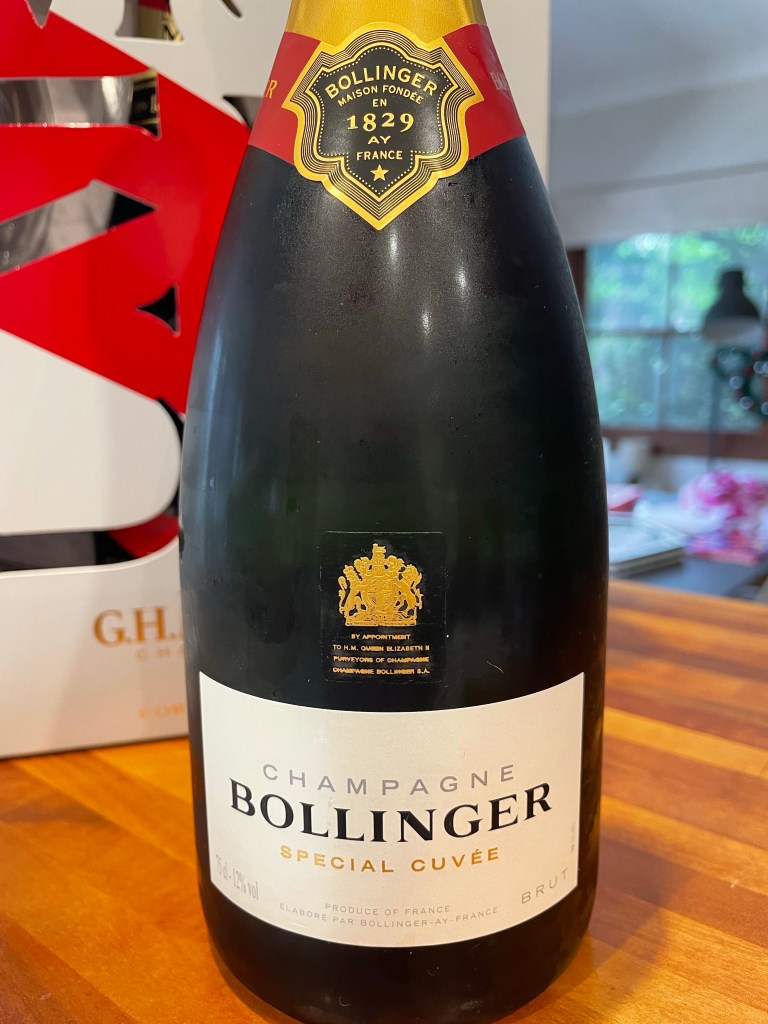
Open the Champagne and decant some solid wines!
In fairness, I don’t really know if this is what Alberto’s would have dished up, though if it was to be excellent, home-cooked Italian, then this involtini would have been on the cards.
Ingredients
3 eggplants, about 500gm each, trimmed and cut into 1cm thick slices; about 16 slices 3/4 c extra virgin olive oil 225gm feta cheese, crumbled 1/2 c pine nutes 1/3 c raisins, soaked in hot water for 10 minutes until plump, then drained 1/4 c extra virgin olive oil, more for drizzling 2 tbsp (fresh) breadcrumbs 1 garlic clove, peeled and minced Finely grated zest of 1 lemon 1 1/2 tsp dried mint 2 tbsp chopped Italian parsley leaves plus some to serve 1 large egg, beaten Salt and freshly ground black pepper 2 1/2 c canned crushed tomatoes 1 large ball fresh mozzarella, torn into pieces
Method
Heat oven to 180c. Place a ridged cast-iron skillet over a medium-high heat and working in batches, brush eggplant slices on both sides with extra virgin olive oil and cook, turning until soft and crisscrossed with grid marks. Set aside and allow to cool.
In a large bowl, combine feta, pine nuts, raisins, 1/4 c extra virgin olive oil, breadcrumbs, garlic, lemon zest, mint and parsley. Mix in egg and season well.
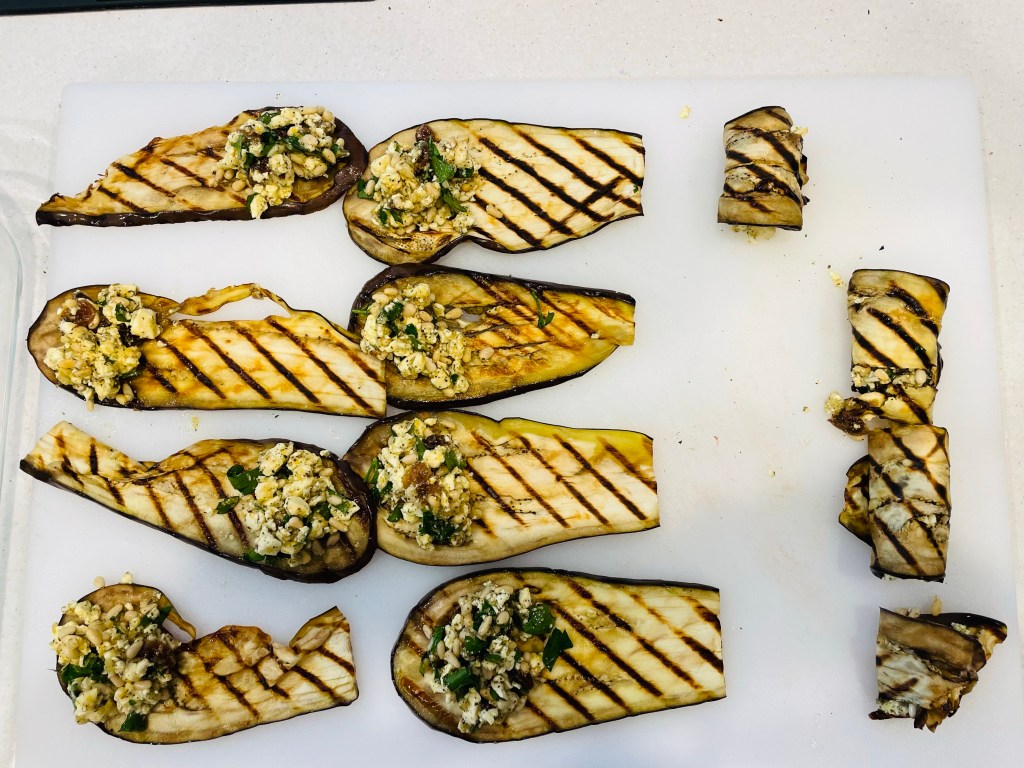
Spread eggplant slices on a surface and divide stuffing evenly among them, placing 1 to 2 tbsp at one end of each slice. Roll up slices tightly to secure filling and place in a baking dish large enough to fit snugly in a single layer.
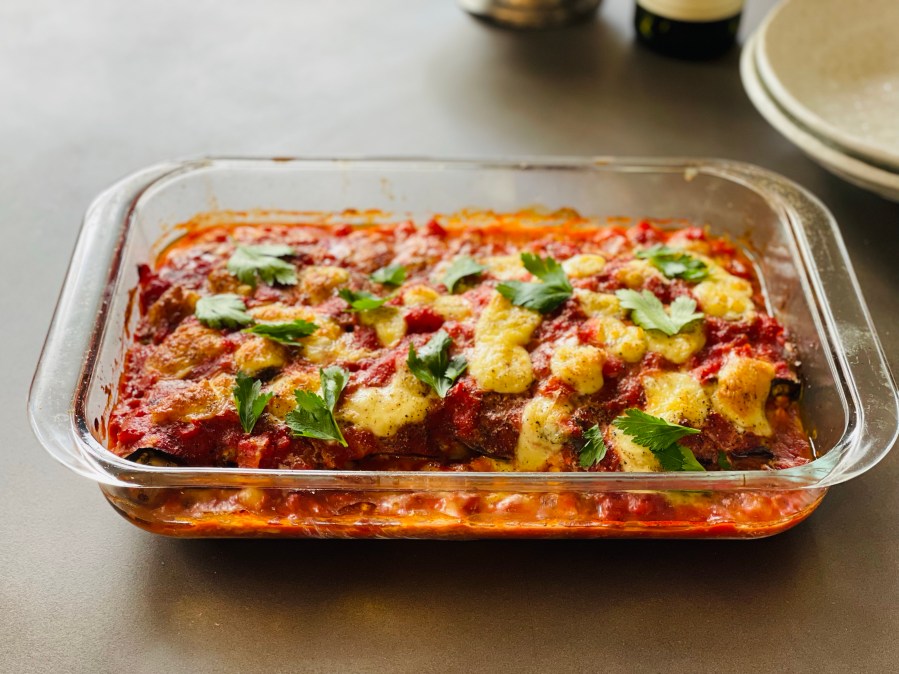
Pour crushed tomatoes on top of the eggplant rolls and arrange the mozzarella slices in a line lengthwise down the centre of the pan. Drizzle extra virgin olive oil evenly over the pan and season well.
Bake until the cheese has melted and eggplant is bubbling and fragrant; about 30 minutes. Remove from the oven, stand for 10 minutes and serve hot.
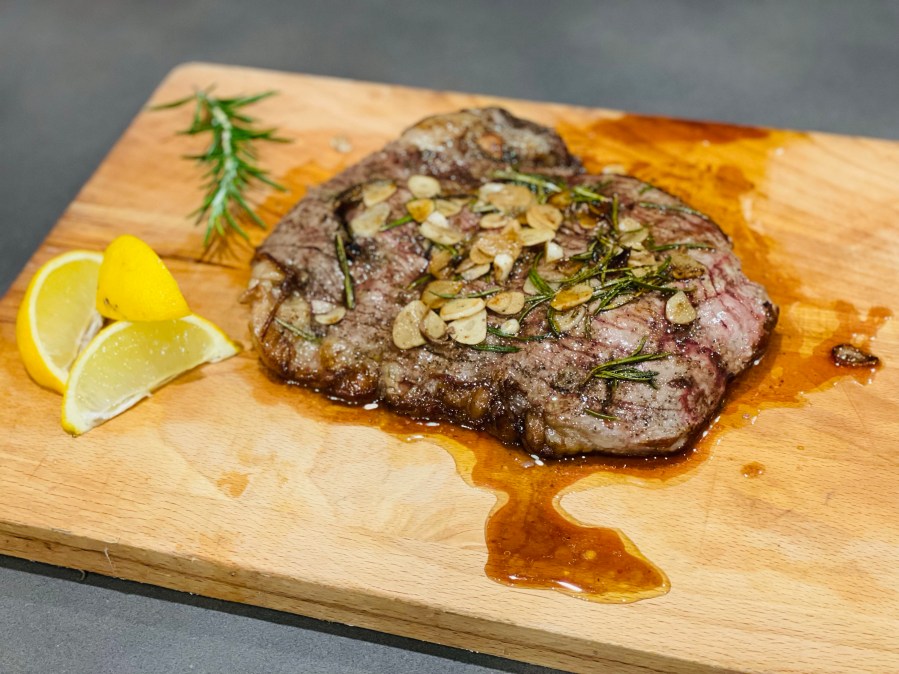
One of Sydney’s best restaurants is Bistecca where they serve only one main: a medium-rare t-bone cooked over wood, beaten with bushes of rosemary and lashed with olive oil.
It is not only a brilliant cut of meat. The whole thing is a brilliant experience.
This dish by NY chef David Tanis is close, with the hints of rosemary that make Bistecca so good. And then that garlic.
With the side salad of rocket and Parmesan: this is simple, primal yet sophisticated Italian.
We also did a cracking Nigella Salad.
Just get that pan as hot as you can and seal it as best you can.
What a mid-week treat.
Ingredients
Lay flank steak on a baking sheet and season on both sides with salt. Coarsely crush the peppercorns in a mortar and pestle. Measure 1 tbsp of crushed pepper and sprinkle on both sides of the steak. Strip leaves from the rosemary and sprinkle meat evenly on both sides with rosemary and garlic slices. Drizzle with 4 tbsp olive oil, then massage with your hands to distribute, pressings pepper, rosemary and garlic into the surface. Leave at room temperature for an hour.
Heat the oven to 220c. Place a cast iron skillet large enough to hold the steak on the upper rack and heat for at least 30 minutes.
Carefully put the flank steak in open and close the oven. After 5 minutes flip the steak and cook for another 3 – 4 minutes until the juices appear on the surface of the steak. Remove the steak and rest for 10 minutes.
Cut meat on a diagonal, against the grain into thin slices, Arrange sliced meat on a platter surrounded by rocket. Shave over Parmesan, drizzle with olive oil and garnish with lemon wedges.
Method
1 flank steak, approximately 900gm Sea Salt Black peppercorns 1 small bunch rosemary 6 garlic cloves, sliced Extra virgin olive oil 150gm rocket Parmesan or Pecorino for shaving 1 lemon, cut into wedges
Nat found it in my mother’s collection of recipes and alongside a focaccia Nat cooked, nobody ate a better lunch in our part of town that day.
I love the cooking of the potatoes with the pasta. Which together with the wonderfully simple pesto and the prosciutto, it just so wonderfully rustic.
Just add plenty of Parmesan, open a bottle of white and there you have it… classic.
Ingredients
Dried linguini or tagliatelle 6 small baby potatoes, peeled and sliced thinly 100gm baby green beans, trimmed Grated Parmesan Thinly sliced prosciutto 2 c tightly packed basil leaves 50gm pine nuts 2 cloves garlic, roughly chopped 150ml olive oil Sea salt and freshly cracked black pepper
Method
Process the basil, pine nuts and garlic to a paste, stir in the olive oil and 100gm Parmesan: season.
Cook the pasta in salted water and 5 minutes before the cooking time is done, add the potatoes.
Just before draining, add the beans and cook briefly. Drain, retaining 100ml of the pasta water.
Add a generous amount of the pesto to the pasta water together with some additional Parmesan, toss together all the ingredients and serve with prosciutto slices draped over.
And this dish is just that. Like, screw you clever. Like, why didn’t I bloody think of that clever.
Like one-pot-pasta clever, though cleverer than the first batch of one-pot-pastas we were all inundated with five years back.
It’s the simplicity. The rusticity. And the various textures of the spaghetti, from soft to crunchy: the caramelised chicken.
Look at that spaghetti!
And it is fun to dish and eat.
Screw you clever.
It is a weeknight meal though served on a Saturday night with friends, it would absolutely not look out of place.
It is just that fun… and good.
Ingredients
2 tbsp olive oil 1kg skin-on chicken thighs (4-6) Sea salt and freshly cracked black pepper 1 large yellow onion, cut into 1cm dice 3 tbsp tomato paste 3 garlic cloves, finely chopped 2 tbsp fresh thyme leaves 2 c boiling water 230gm spaghetti, broken into thirds 1/3 c lightly packed finely grated Parmesan 3 tbsp fresh breadcrumbs 1/2 c finely chopped fresh parsley 1 1/2 tsp freshly grated lemon zest
Method
Heat the oven to 220c.
Add 1 tbsp oil to a large, ovenproof lidded skillet and heat over high. Season the chicken with 3/4 tsp salt and 1/2 tsp pepper, then add to the hot oil, skin down. Cook for 7 minutes, without turning, to brown well.
Turn down to medium-high, stir in the onion and turn over the chicken; cook for 5 minutes until the onion has softened and is slightly browned. Add the tomato paste, garlic and 1 tbsp thyme and cook, stirring the paste into the onions for 2 minutes or until fragrant and all browned.
Add the boiling water, 1/2 tsp salt and 1/4 tsp pepper, then add the spaghetti, stirring to submerge and evenly distribute. Lift the chicken pieces so that sit on top of the spaghetti, skin side up. Bring to a simmer, cover with a lid and transfer to the oven for 30 minutes.
In a small bowl, mix together the Parmesan, breadcrumbs, parsley, lemon zest and remaining thyme.
After the pasta has baked for 30 minutes, remove from the oven and turn the oven to its highest setting and get the grill on. Sprinkle the Parmesan mixture evenly over the chicken, drizzle with the remaining oil and grill for a few minutes until nicely browned and crisp. Set aside for a few minutes and serve straight from the pan.




 Robby Dog Cooks