I’m not sure Pushpesh is behind paneer, though this two ingredient recipe is in his book and every time we cook Indian (which is all the time), Nat asks me to pull down his book which proudly states – in print – that is is 1.5kg.
So this is more a reference for Nat who makes paneer for so much of the Indian cooking we do.
All I can say is that freshly made paneer is so superior to store bought that it’s only an emergency when we… store bought.
Here you go babe. Never stop.
Ingredients
2 ltr whole milk 2 tbsp lemon juice
Method
Heat the milk in a pan over a medium heat. When boiling, add the lemon juice.
As the milk curdles the whey will separate. Strained the curdled milk through a piece of clean muslin, catching all the solids. Bring up and tie the edges of the muslin to form a pouch around the solids. Do not squeeze the muslin.
Hang the pouch over a container and leave until all the water has been drained. Transfer the solids, still covered with the muslin, to the sink and weigh down for 2 – 3 hours to produce a block of paneer that can be cut to the desired shape.
We had our second trip to India a few months ago and our first destination was Fort Kochi, a historic, coastal neighbourhood of wider Cochin, Kerala.
Portuguese, Dutch and British influences: gorgeous streets with churches incredible buildings dating back almost 500 years.
We staying in a Portuguese house built in 1600!Fort Kochi at night.
We visited the incredible Jew Street – a quarter settled in the 1500s – by Cochin Jews: wonderful arts, antiques and book stores And among other things, we picked up the cook book ‘Paachakam – Heritage of Cuisine of Kerala’.
What we loved were the chapters dedicated to the different cooking styles and influences: The Syrian Christians, the Cochin Jews, the Nairs.
Interesting Kerala is one of the few states in India where beef is consumed: this isn’t a recipe you would find anywhere near Delhi!
And wow do they love their ‘frys’ in Kerala: fish, prawn, pork, lamb and beef. (And coconut: it is Kerala after all.)
Which is why the first dish we cooked from this book was a beef fry.
Sounds underwhelming, though it isn’t. Quite the opposite – incorporating vinegar – another European influence that seeps into so much of the food.
This beef fry is just joy. It completely hits the spot: robust yet subtle, spicy yet tamed by the coconut.
The fry comes at the end with the tempering and wow doesn’t the whole dish take a turn and complete itself.
Nat absolutely loved this. Even Maxy (8) thought it was wonderful as he drank a quart of milk.
Kerala was a uniquely beautiful place and we were lucky enough to do much of it including the backwaters.
Though Jew Street was such a highlight. We even visited twice.
500gm mutton, pork or beef cut into 3cm cubes 1 1/2 tsp salt, or to taste 4 c hot water 1/2 c coconut slivers 1 tsp vinegar (red or white)
Tempering
2 tbsp coconut oil 1 tsp mustard seeds 3/4 c shallot, sliced into thin long strips 1 tsp fresh ginger, peeled and julienned 6 garlic cloves, sliced
Method
To make the spice paste: in a blender or food processor, combine the spice paste ingredients. Grind into a paste.
To make the meat: season the meat with salt. In a large pot over high heat, cook the meat, adding the hot water and spice paste. Bring to a boil, lower the heat and cook for 45 minutes to an hour, until tender, adding more water as necessary. Cook down.
Add the coconut slivers. Cook for 7 minutes more and stir in the vinegar.
To make the tempering: in another large skillet over medium heat, heat the coconut oil. Add the mustard seeds, shallot,, ginger and garlic and cook until the mustard seeds begin to crackle and the shallots turn pale brown.
Add the meat mixture to the tempering and sauté to brown the meat and dry fry. If you would like gravy, add a little more hot water and cook until it blends with the masala and meat.
Secondly, this spicy mince is going in a buttery roti with hot sauce and shredded cheese as a late Saturday, tequila (or whatever you prefer) shot hit-the-spot dinner.
Turn the lights down, turn the music up and dance in the kitchen sort of food that’s going to get you well past midnight.
800gm pork mince 3 tbsp coconut oil 1 tsp brown mustard seeds 10 fresh curry leaves 2 onions, finely chopped 2 tomatoes, finely chopped 2 bay leaves Salt Juice of one lime Rotis, hot sauce and shredded cheese to wrap it all up
Ingredients
Place all the marinade ingredients in a blender and and blend to a paste.
Using your hands, mix the marinade with the meat and refrigerate for 30 minutes or ideally, overnight.
When ready to cook, heat the oil over a high heat in a heavy pan. When visibly hot, add the mustard seeds and when they begin to pop, stir in the curry leaves and fry for about 30 seconds until fragrant.
Stir in the chopped onion and fry until soft and translucent.
Then add the chopped tomatoes and the marinated meat (with all the marinade). Brown the meat, stirring regularly until it is all cooked through. Cook until all of the liquid has been reduced.
Check for seasoning and add salt to taste: and the lime juice.
Serve on top of hot rotis (chapattis): add grated cheese and hot sauce and thank me later.
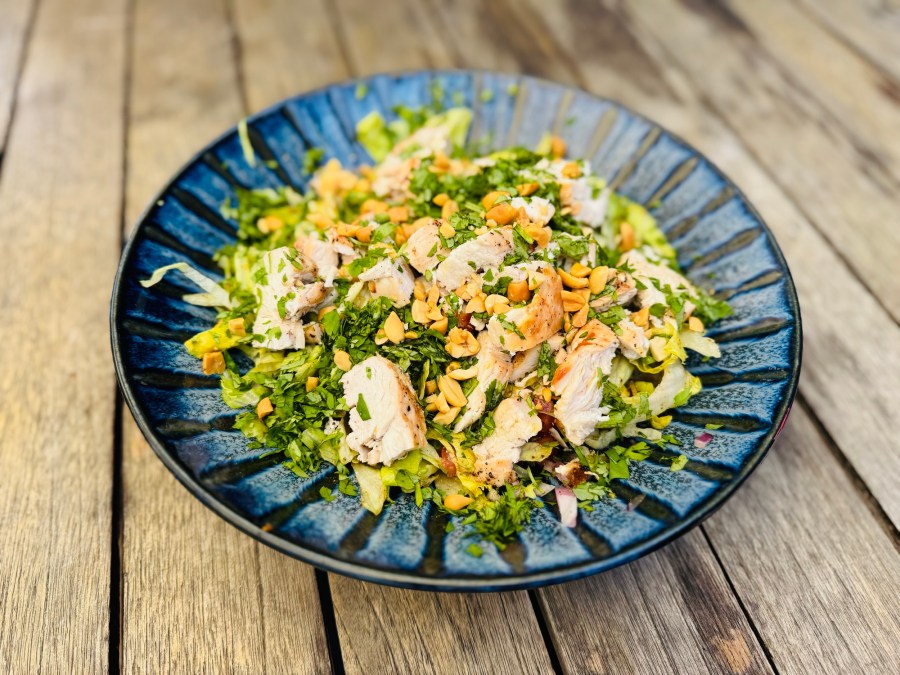
1 large chicken breast 2 tbsp extra virgin olive oil plus extra to serve Salt and freshly ground pepper 1 large garlic clove, finely grated 1 tsp roasted and ground cumin seeds Good fistful of coriander (stems and leaves), finely chopped 1 1/2 tbsp lemon juice 1 medium tomato, cut into 1cm cubes 1 ripe avocado, cut into 1cm cubes 1/2 small red onion, finely diced Two good handfuls of chopped lettuce* 1 1/2 tsp chaat masala 1/2 green chilli, deseeded and finely sliced 2 tbsp salted peanuts, lightly chopped
Method
Marinate the chicken in 1 tbsp olive oil, seasoning and garlic for at least 30 minutes.
Heat a griddle pan, add the chicken breast and cook for 5 – 6 minutes each side until done.
Meanwhile, mix together the remaining 1 tbsp olive oil, more seasoning, roast cumin and a little of the lemon juice and coriander.
Place the tomato, avocado, onion and lettuce in a bowl. Add the chaat masala, chilli and most of the dressing and toss. Taste, season and add more lemon juice as necessary.
Thinly slice the cooked chicken and place on top of the salad, drizzle with the remaining dressing, coriander and peanuts. Drizzle with more olive oil and serve… with Champagne.
* Nat has a ban on iceberg lettuce in our house on account of its nutritional deficiency. Though we served these Neil Perry Prawn Cocktails as part of a Christmas Eve dinner and we had iceberg lettuce left over.
We both agreed, this was the way to go. It’s New Year’s Day and the feeling was right. Go the iceberg.
The braised chicken thigh in the spices and yoghurt and the wonderful whole green chillies, finished with the crispy shallots on rice: kill me now.
This is what dreams are made of.
I ended up cooking the gravy down longer than the recipe prescribed though other than that, what you see is what you should cook.
Marinate the chicken overnight, get those onions golden and the rest is pretty set-and-forget.
With a glass of wine, two of my favourite things in life were consecutively ticked off!
Update: our best friends Woodles and Billy just had baby #2. A little girl Izzy. Nat is rumoured to get to see the little girl tomorrow and so I’ve doubled this and can confirm it works: as a small dinner gift.
So excited for you guys! Can’t wait for the next looooooong lunch! 🥴
The always wonderful Woodles! (With Nat.)
Ingredients
Chicken marinade
1kg boneless chicken thighs, skinned and cut into large pieces 1/2 tsp salt 2 tsp garlic, finely chopped 2 tsp ginger, finely chopped (I used 4 tsp ginger garlic paste) 1/4 tsp black pepper, crushed 2 tsp Kashmiri chilli powder 2 tsp lemon juice 1 c Greek yoghurt 1/2 tsp cumin powder
Sauce
5 tbsp mustard oil 3 medium onions, finely sliced 1 tsp salt 6 cardamom pods 1 cinnamon stick 2 bay leaves 8 cloves 1 tsp ground coriander 1/2 tsp cumin powder 1/2 tsp turmeric powder 6 green chillies
To garnish
1 handful crispy shallots 4 green chillies, split lengthways
Method
Place the chicken in a bowl with all the marinade ingredients, mix well and chill in the fridge for at least 2 – 3 hours and preferably overnight. Remove the chicken from the fridge an hour before cooking.
Heat the mustard oil in a large saucepan over a medium-high heat. Add the onions, salt, bay leaves and whole spices and cook until golden brown. Add 125ml of water and bring to a simmer. Turn the heat to low and cook for 10 minutes, stirring occasionally.
When the onion mixture is soft and caramelised, add the ground spices.n Turn up the heat to medium and sauté for a minute or two to cook out the spices. Add the green chillies and marinated chicken mixture together with 50ml of water and stir to combine.
Set the pan back over a low heat and cover. Cook for 40 minutes, stirring occasionally. Uncover the pan and continue to cook until you have a thick gravy with a little oil rising to the surface. Serve with crispy shallots and a split chilli.
And yes, I know Indian and Bangladeshi cuisines are different, though these two paired perfectly.
Ingredients
1 1/2 tsp coriander seeds 1/2 c vegetable oil 1 pinch powdered asafoetida 1 tsp cumin seeds 1kg cauliflower, cut into small florets with long stems attached 1 tsp salt 1/2 tsp chilli powder 3cm piece fresh ginger, peeled and sliced thinly 1/2 tsp ground turmeric 1/2 tsp garam masala 1 tbs fresh lemon juice 2 tbsp plain whole-milk yoghurt 2 tbsp fresh coriander, chopped
Method
In a spice grinder, grind coriander seeds. Set aside.
In a wok or deep frying pan, heat oil over medium heat. When oil is hot, add asafoetida and cumin and cook, stirring for 20 seconds. Add cauliflower florets, cover and cook until they start to soften.
Uncover and cook, stirring for 2 minutes. Then cover and cook until florets start to brown. Once again, uncover and cook, stirring, for 2 minutes. Finally, cover and cook for 1 – 2 minutes more. (The cauliflower should be golden-brown.)
Reduce heat to low and add salt, chilli powder, ginger, ground coriander, turmeric, garam masala, lemon juice and yoghurt. Mix well and cook, tossing for 2 minutes to blend the flavours.
Zaafran used to be one of Sydney’s best Indian restaurants. My best mate Giles and I would often go there for lunch, overlooking Darling Harbour and the city.
As Darling Harbour (now demolished) slowly merged from a stylish shopping centre and destination to a tourist trap full of ugg boot and opal sellers, Giles and I stopped visiting. Though what great memories and food: nothing beats a midweek lunch and a bottle of cold white.
This is the second Vikrant Kapoor recipe I have cooked. The first was this tremendous barramundi, something that was simply 5-star.
This chickpea curry’s simplicity is deceptive. The clarity of the flavours is just awesome and it was just a perfect side to this Pushpesh Pant Chicken with Fenugreek Leaves.
Arguably, it was much more than a side. Brilliant.
Ingredients
1 large potato, unpeeled 1 tbsp ghee 1 large onion, chopped 1 large tomato, puréed 2 tsp ginger garlic paste 1/2 tsp ground cumin 1/2 tsp ground coriander 1/2 tsp ground turmeric 1/2 tsp chilli powder 450gm canned chickpeas, drained 1 tsp salt Coriander leaves, to garnish
Method
Cook the potato in a pan of boiling water for about 10 minutes or until tender. Drain and allow to cool, then peel and cut into cubes. Set aside.
Heat the ghee in a frying pan, add the onion, tomato, ginger garlic paste, cumin, coriander, turmeric and chilli powder and cook for 2 minutes. Add the potatoes and chickpeas and 1/2 c lukewarm water and cook for 5 minutes or until hot. Garnish with coriander.
When I told the owner of our local Indian grocer I wanted fresh fenugreek leaves, he asked why. I explained that I was cooking this curry and he was totally confused by the quantity asked for and doubted it would work.
(It turns out it is also easier to buy frozen fenugreek leaves rather than fresh, though the result is of course the same.)
This curry was superb: it absolutely worked. Served alongside this chickpea curry, it was just a brilliant meal.
The marinade can be made the night before, perfect for a mid-week treat. Open a good red and thoroughly enjoy.
Ingredients
2 tsp ginger garlic paste 2 onions, sliced 2 tbsp natural yoghurt, whisked 1 tsp chilli powder 1/2 tsp ground turmeric 1 medium-sized chicken, cut into pieces (I substituted 1kg chicken thigh) 3/4 c vegetable oil 2 large cardamom pods 1 cinnamon stick 3 green chillies, de-seeded and chopped 1/2 tsp ground caraway seeds 2 c fenugreek leaves, chopped Juice of 1 lime Salt
Method
To make the marinade, combine the ginger garlic paste, 1 onion, the yoghurt, chilli powder and turmeric together in a large, shallow bowl and season with salt. Add the chicken and turn to coat well, then cover and set aside in the refrigerator for 20 minutes.
Heat half of the oil in a large, heavy-based pan over low heat, add the marinated chicken and cook for 8 – 10 minutes, or until the chicken is slightly browned. Pour in 3 1/4 c water and cook for about 30 minutes, or until 2/3 of the water has evaporated and the chicken is cooked.
Heat the rest of the oil in a frying pan over medium heat, add the cardamom pods, cinnamon, chillies, ground caraway seeds and the remaining onion and fry for 1 – 2 minutes or until the cardamom swell. Add the chopped fenugreek leaves and fry for 3 – 4 minutes. Add the cooked chicken and simmer together until the leaves are fragrant, then squeeze over the lime juice.
The effort in this fish is not to be sneezed at, what with the preparation of tomato kasundi pickle.
Something I am not necessarily entirely convinced you need, though we were left with a jar the pickle and Nat made one of the world’s best cheese toasties the next night with a slathering of the pickle.
The end result of this curry is remarkable, however.
The flavours are gentle and yet so full of layers of flavour. This is not your cheat’s Tuesday night coastal Indian curry.
The evidence of the prep and time in this curry is clear.
This curry is a special keeper. Worth every minute.
3 tomatoes, grated 1 tbsp tomato kasundi pickle (see below) 3 tsp sea salt flakes 1 tbsp caster sugar 100ml vegetable oil 2 tsp coriander seeds, roasted and ground 2 tsp cumin seeds, roasted and ground 1 c fish stock 1 tbsp chickpea flour 1/2 c thick plain yoghurt 50ml cream 6 x 150gm mulloway cutlets* 1 tbsp mustard oil 25ml lime juice 2 tbsp chopped coriander leaves 1/2 long green chilli, finely sliced
Mustard Cashew Masala
2 tsp brown mustard seeds 1 tsp ground turmeric 1 tsp chilli powder 60gm grated fresh coconut 1 tbsp minced ginger 4 garlic cloves, chopped 3 small green chillies, chopped 1 brown onion, chopped 2 tbsp raw cashews, chopped 1 tbsp mustard oil
Tomato Kasundi Pickle (Makes 600gm)
1 tbsp brown mustard seeds 160ml malt vinegar 1 tbsp chopped fresh ginger 6 garlic cloves 8 small red chillies, minced 100ml mustard oil 1 tbsp cumin seeds, toasted and ground 1/2 tsp ground cloves 2 tsp ground turmeric 1kg ripe tomatoes, peeled and roughly chopped 50gm brown sugar 1 tbsp sea salt flakes
Kasundi Pickle: heat a frying pan over a low heat. Add the mustard seeds and vinegar and cook for 5 minutes, taking care not to evaporate the vinegar. Set aside to cool.
Place the mustard seed vinegar, ginger, garlic and chilli in a food processor until a smooth paste forms.
Heat the oil in a heavy-based frying pan over a medium-low heat. Add the ground spices and cook for 15 seconds or until just fragrant. Add the mustard paste and tomato, stir to combine and cook, stirring occasionally for 45 minutes or until the tomato has broken down. Add the sugar and salt, stir to combine and cook for a further 5 minutes. Taste and adjust seasoning, if necessary. Transfer to a food processor and pulse briefly to form a coarse paste. Pour into a sterilised glass jar and seal with a tight-fitting lid. Store in the pantry for up-to 1 month and refrigerate once opened.
To make the mustard cashew masala, place all the ingredients together in a food processor and blend to form a paste. Set aside.
Place the tomato and tomato kasundi pickle in a frying pan over a medium heat and cook for 8-10 minutes or until reduced by half. Add 2 tsp of the salt and the sugar, stir to combine and set aside.
Heat the vegetable oil in a wide-based pan over a low heat. Add the ground coriander and cumin and cook for 30 seconds or until fragrant. Immediately stir in the mustard cashew masala, increase heat to medium, and continue stirring for 5 minutes or until aromatic and starting to colour. Add the reduced tomato and the stock and cook for 10 minutes, Reduce heat to low.
Meanwhile, combine the chickpea flour and yoghurt in a bowl, this prevents the yoghurt from splitting during cooking, and stir into the masala sauce. Add the cream and cook for 5 minutes. Remove from the heat while you cook the fish.
To cook the fish, preheat the oven to 200c. Brush the fish skin with mustard oil and sprinkle with a little sea salt. Heat a heavy-based, ovenproof frying pan over medium heat. Add the fish skin-side down, and cook for 3 minutes or until golden and crisp. Turn the fish over, pour the mustard cashew sauce around the fish, transfer to the oven and cook for 4 – 5 minutes depending on the thickness of the fish, or until cooked through. Rest for 2 minutes to allow juices to settle.
Carefully lift the fish from the pan and place on serving plates. Add the lime juice, remaining 1 tsp of salt, coriander and chilli to the sauce in the pan and stir to combine. Spoon sauce over the fish and serve with steamed basmati rice.
* Any deep-sea, firm-flesh fish will do, such as kingfish trevally, trumpeter or groper.
You can point blindfolded to any Christine Manfield recipe and know it will be a knockout.
French, Asian, Contemporary Australian.
My first experience of her cooking was at her extraordinary Sydney restaurant, Paramount. And that would have to have been 25 years ago.
I was then lucky enough to do a Christine Manfield cooking class at the Seafood Markets with my mother, something I still remember well. (Also probably 25 years back!)
To make the Chettinad masala paste, place the poppy seeds in a frying pan and cook over low heat for 20 seconds or until lightly toasted. Remove from the pan and soak in 1 tbsp water for 20 minutes. Add the chillies to the pan and cook for 2 minutes or until fragrant. Allow to cool before grinding into a fine powder in a spice grinder. Place the poppy seed mixture, coconut, ground chilli and other spices in a food processor or blender and process to a fine paste.
Heat the oil in a frying pan over medium heat. Add the onion and cook for 4 minutes or until golden. Add the ginger garlic paste and cook for 2 minutes. Stir in the spiced coconut paste and cook, stirring to combine, for 4 – 5 minutes. If the mixture becomes too dry, add a splash of water to prevent it from burning. Set aside to cool.
To cook the chicken, melt the ghee in a wide-based pan over a medium-high heat. Add the onion and cook for 4 minutes or until softened. Add the ginger garlic paste and minced chilli and cook, stirring to combine, for 30 seconds. Add the curry leaves and cook, stirring, for 30 seconds or until crisp. Add the ground chilli and 3 tbsp of the Chettinad masala paste and cook, stirring to combine, for 2 – 3 minutes. Add the chicken and cook, turning once to ensure the pieces are evenly coated in the paste, for 5 minutes. Add the tomato and cook for another 4 minutes. Add the stock, reduce heat to low, cover and simmer for 10 minutes or until the chicken is tender. Season with salt and lime juice. Scatter with coriander and serve with steamed rice.





 Robby Dog Cooks