Think a good lashing of a wonderful, oily paste on a thick piece of ocean trout (or salmon), roasted at a high temperature.
Served hot with a drizzle of coconut cream and a squeeze of lime, this is what you would call vibrant. I mean, ocean trout in any setting is the finest of the fish, though add this wonderful paste and this is just moorish.
It would be just as good with barramundi or even chicken breast.
Just make sure you have a glass of cold, crisp white ready to go!
Ingredients
4 fillets of ocean trout Coconut cream, for drizzling Lime wedges and steamed rice, to serve
Spice paste
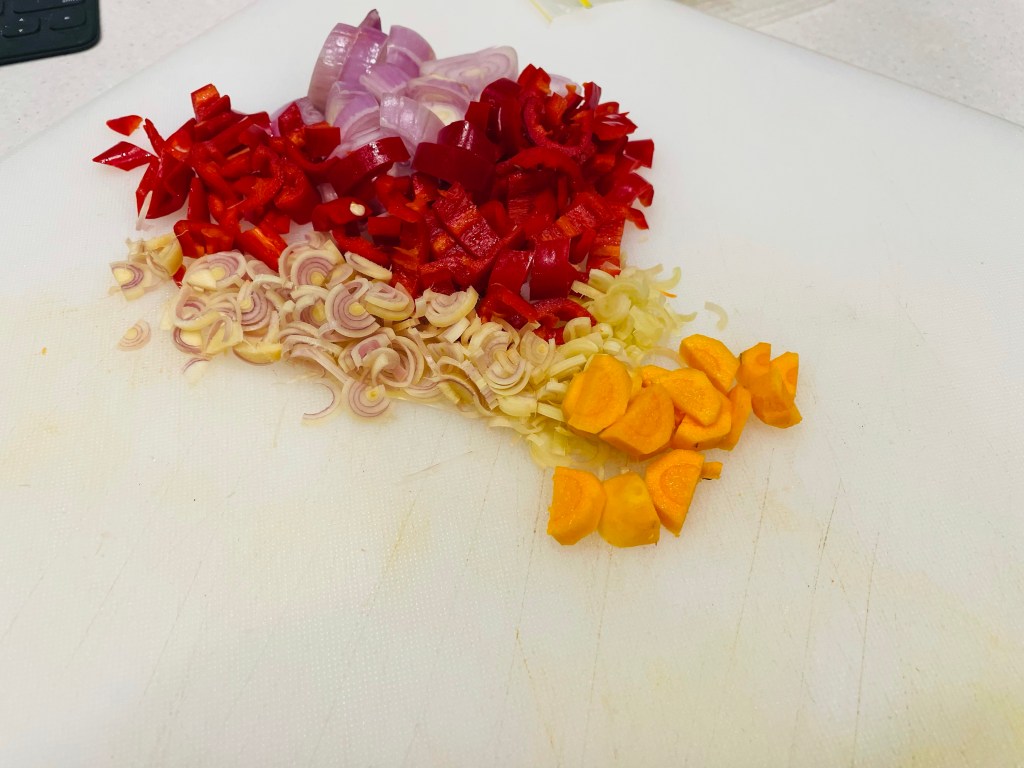
4 long red chillies, seeds removed 1 lemongrass stalk, white part, finely chopped 10gm piece of turmeric, coarsely chopped 1 small golden shallot 2 tsp dry-roasted, coarsely ground coriander seeds 1/4 c olive oil
Method
Preheat oven to 240C. For spice paste, using a hand-blender, blitz ingredients with a pinch of salt until smooth.
Heat a small frying pan over a medium heat. Add spice paste and stir until lightly roasted (1 – 2 minutes), then set aside to cool.
Spread spice paste over fish and bake until just cooked through (8 minutes for medium-rare). To finish, drizzle fish with coconut cream and squeezed lime juice. Serve with rice.
We are big fans of Gourmet Traveller and I always have a backlog of their magazines and recipes to get through.
Their various collections of recipes are always successful. Hand on heart, I have never been disappointed by a GT recipe.
Nat found this recipe in what presumably was an Easter edition and it was simply great. It’s origins are in three other hot cross bun recipes that GT was sampling, this being the culmination.
This is by no means the easiest hot cross bun recipe out there.
Though we all know that you get what you pay for: the fruits soaked overnight in the sherry, the orange juice and the vanilla bean in the glaze.
I mean, this is luxury and a case of very much getting what you paid for.
Odd time to post a hot cross bun recipe given we are equidistant periods away from Easter at the time I post, though I mentioned the backlog: bookmark these for Easter.
They’re smashing.
Ingredients
100gm currants 100gm sultanas Juice of 1 orange 40ml Pedro Ximenez (sherry) 50gm candied orange peel, finely chopped 200ml milk 3 tsp dried yeast 470gm strong baker’s flour 2 1/2 tsp ground cinnamon 1 1/2 stop ground nutmeg 3/4 tsp ground allspice 1/2 tsp ground gloves 60gm light brown sugar 1 egg 60gm softened unsalted butter, plus extra for greasing Finely grated zest of 1/2 orange 1/2 tsp sunflower oil
Glaze
2/3 c caster sugar Juice of 1 orange Scraped seeds from 1/2 vanilla bean
Method
Combine currants and sultanas in a bowl with orange juice and Pedro Ximenez, cover and soak overnight. Stir through candied peel and set aside.
Warm half the milk in a saucepan over low heat until just lukewarm, then combine with yeast in a bowl and stir to combine.
Place 420gm flour, combined spices (reserve 1/4 tsp spice mixture), sugar, egg, yeast mixture, remaining milk and 3/4 tsp salt in an electric mixer fitted with a dough hook and mix on low speed until combined (5 minutes). Add butter, zest and oil and mix until combined. Drain soaked fruit (reserving the liquid). Stir fruit through dough just until incorporated. Place dough in a bowl lightly greased with butter. Cover and set aside to prove until dough has doubled in size (2 hours).
Line a baking tray with baking paper. Knock back dough, divide into 12 pieces, then roll each into a smooth ball, dusting with a little flour if needed to prevent dough sticking (do not add too much as dough will become tough). Place buns on tray in even rows, leaving a 2cm gap. Set aside to prove until doubled in size (30 – 40 minutes).
Preheat the oven to 180C. Combine remaining flour and reserved spice mixture into a small bowl with 40ml water and mix to a paste. Transfer paste to a piping bag, snip the end and pipe crosses over buns: bake until golden and cooked through (25 – 30 mins).
For glaze, combine ingredients and 1 – 2 tbsp reserved fruit liquid in a saucepan over low heat, stirring until sugar dissolves and a syrup forms (2 – 3 minutes). While buns are hot, brush syrup over liberally, then set aside to cool slightly. Serve hot cross buns warm or at room temperature.
Or halve, toast and serve with good butter like we did!
Which when combined, begs the question, just how good was Antonio Carluccio?
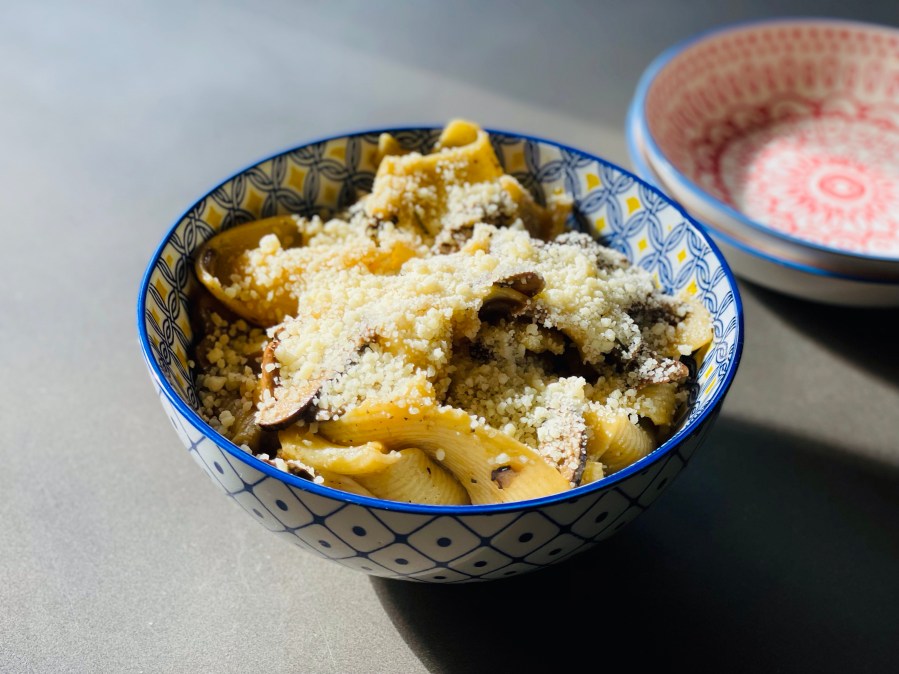
I absolutely love mushrooms and cooked down slowly, with just a bit of olive oil and rosemary; the addition of the porcini stock, butter and then Parmesan. My word.
Toast me something and pile those mushrooms on that! Polenta equally so!
Again, it’s simple, though cook those mushrooms as slowly as possible and live the Northern Italian life.
(We did the white sauce… which is not what you might expect.)
Ingredients
25gm dried porcini mushrooms 150ml water 8 tbsp extra virgin olive oil 1 sprig fresh rosemary 1 garlic clove, finely chopped 400gm fresh mushrooms (mix it up!) Sea salt and freshly ground black pepper Parmesan to serve
Soak the dried porcini in tepid water for 30 minutes and squeeze dry, reserving the soaking liquor.
Heat the oil and fry the rosemary and garlic for 20 seconds. If you are making the red sauce, add the extra virgin olive oil at this point. Add the fresh mushrooms and soaked dried mushrooms and continue to slowly cook for no less than 15 minutes, stirring from time to time. (I cooked for 45 minutes and wow!)
Cook your pasta, reserving a small amount of pasta water for the sauce.
For the white sauce, stir in the soaking liquor and the butter and cook for another 15 minutes. Add some of the pasta water and check the seasoning.
Serve with the pasta and a good amount of Parmesan.
This salad is a triumph of flavours: the combination of cooked and raw vegetables, the tuna, the whole thing.
(Yes, it is a summer salad and we had it in the tail of winter, though the sun was out and we had some good Italian wines to try.)
With a bit of toasted bread, this is a meal on its own.
Though next time I serve this, I hope it is part of a long Italian feast welcoming our family and friends back into our home.
That’s when the really good Italian whites and reds are coming out.
Bookmark this one. It is beautiful. And lockdown will end one way or the other!
Ingredients
300gm young zucchinis (around 4 small) 200gm green beans, trimmed (about a big handful) Salt and freshly ground black pepper 200gm tomatoes (around 2 tomatoes) 1 red pepper 1 red onion 150gm good canned tuna in oil, drained 8 anchovy fillets in oil, drained 8 basil leaves, torn 1 tsp dried oregano 1 – 3 red chillies, chopped 6 tbsp extra virgin olive oil 2 tbsp white wine vinegar
Method
Quarter the zucchinis lengthways, then cut into chunks. Cook the beans until al dente, drain and cool. Repeat with the zucchinis.
Cut the tomatoes into wedges and remove the seeds. Halve, core and deseed the pepper, then cut into long, thin strips. Finely slice the red onion.
Put the zucchinis, beans, tomatoes, red pepper and onion into a bowl. Break the tuna into little chunks and add to the salad with the anchovies, herbs and as much fresh chilli as you can take! Toss everything together, adding the olive oil, followed by the wine vinegar. Season and serve at room temperature.
I was a bit perplexed when Nat said that the people reading this blog wouldn’t really want to cook Son-In-Law-Eggs.
I think they are just beautiful. And they’re not complicated.
Perhaps it needs a broader Thai menu behind it? Perhaps deep-fried eggs comes across odd if you’re not in the know?
Because Son-In-Law-Eggs are just essential Royal Thai cooking and by that definition, have to be wonderful. All Royal Thai is! Especially given the Chin Chin twist.
Key is to boil as quickly as possible and then to cool as quickly as possible to keep them as runny as possible. Though don’t worry either way.
They are amazing either way.
Ingredients
Sweet Tamarind (Makes 2 cups) *
120gm palm sugar 1 c tamarind water 1/4 cup fish sauce 2 tbs aromats (chilli, lime leaf, lemongrass scraps)
Chilli Jam (Makes about 1kg) **
10 red birds eye chillies 8 red banana chillies 2 red capsicums 6 red onions 1 stalk lemongrass (pale part only) 1 knob ginger 5 cloves garlic, peeled 1 cup vegetable oil 250gm palm sugar 3 tbs tamarind water 1/2 cup fish sauce
Eggs
4 eggs at room temperature Vegetable oil for frying 2 sprigs Thai basil, leaves picked 1 large red chilli, sliced
Method
Mix 2 – 3 tbsp of the tamarind and 1 tbs of the chilli jame to make a sauce. Set aside.
Fill a bowl with ice and water. Place eggs in a small saucepan and just cover with water. Bring the water to a rapid boil and cook for 5 minutes. Remove the eggs from the boiling water and put them straight into the iced water to stop the cooking process. When they’ve cooled off, gently roll and tap each egg on a chopping board to break the shell then peel off the shell using your thumb. Gently does it.
Heat a good quantity of oil – enough to deep fry – in a wok to medium (about 180c) and fry the eggs for 4 minutes or until crisp and golden. Drain on absorbent paper.
To serve, arrange the eggs on a serving platter and bruise them gently so that the yolk just starts to ooze out. Drizzle with the sauce and garnish with basil leaves and chilli.
* You need far less than two cups unless you are operating a restaurant. Reduce accordingly.
When shopping for Agave Nectar last week – a key ingredient for this cocktail – I remarked to the lady at Dan Murphy’s (a big chain of liquor outlets in Australia) that we had reached the stage of lockdown where we were now investing in more complex cocktails.
“You’re pretty late to it” she said, walking me over to a part of the shop which really showed how late to the party we were. Lordy.
Empty shelves.
Nat made this cocktail and it is bloody wonderful. Seconds were definitely a requirement.
It isn’t exactly the cocktail from Chiswick though we are claiming it. It’s damn close.
And as I said. It is bloody wonderful.
Ingredients
90ml Patron Silver Blanco Tequila 30ml Cointreau 30ml fresh lime juice 30ml Agave Nectar 4 fresh passion fruits 4 slices red chilli Ice Mint sprigs to serve Shave of orange peel to serve
Equipment
Shaker Muddler Strainer Fine sieve Jigger
Method
Scoop the passion fruit into your shaker.
Add the chilli slices and muddle.
Add the rest of the ingredients except those to serve.
Every Saturday during this endless Sydney lockdown, we treat ourselves to a food kit from a Sydney restaurant.
We keep it local week one to support local business and then dial it up week two to support ourselves.
Restaurant Hubert is a brilliant French, Sydney institution. The chef is Daniel Pepperell.
Last week, we did their food kit and based on eight weeks of lockdown, it was the best we have had. The theatre of adding a link to their playlist, dimming the lights, decantering a cracking wine, putting the kids to bed… and then thoroughly enjoying a two course, absolutely cracking French meal.
Days blur into weeks, wines like these are starting to blur into days…
I could get used to this lockdown. (And I guess I am 😕.)
Anyway, this kimchi gratin was a pearler. We merely heated it, though here is the recipe and as an alternative to a potato gratin, wow it’s great. Sure, there are plenty of cabbage gratins out there, though this is the one I am typing.
Heat olive oil in a saucepan over medium heat and sauté onions, stirring often, until softened and lightly caramelised: about 25 – 30 minutes.
Add the kimchi and cook, stirring occasionally until warmed through: about 5 minutes. Add the cream and reduce until the mixture thickens slightly: about 3 – 5 minutes. Remove from the heat and cool. Whilst warm but not hot, stir in 3/4 of the Gruyère and transfer to a baking dish or individual shallow gratin dishes.
Heat grill to high. Combine panko crumbs and remaining Gruyère and Parmesan in a bowl, then sprinkle evenly over kimchi, dot with butter, then grill until gratin is golden and bubbling: 2 – 4 minutes, Serve hot.
This is the best tagine I have had. Nat also thinks so. Ditto her sister Court to whom we dropped a meal pack during the intersection of Sydney’s lockdown and the birth of her first child, Ella.
Ella, I am the uncle you come to first.Not socially distanced, though I am a carer, fully vaccinated, in a park and with one other person from another household. Also, I don’t care. This is my new niece.
Hello there Ella. You’re beautiful and as lucky as your parents are.
Anyway, back to this tagine.
It starts with a classic Neil Perry Chermoula that I have used so many times for his beef tagine and chicken tagine.
What makes it just that more interesting is firstly the fish which is so much nuanced than beef: and then the wonderful baby vegetables including the kipfler potatoes which are a totally new tagine element for me.
It does colour concerningly red fairly early on thanks to the baby beetroots, though hold the course.
Served with a couscous tossed with chicken stock, currents and flaked almonds, this tagine just hits you. (Or try this amazing couscous.)
It will be the dish of your week.
Ingredients
1kg bar rock cod, skinned, pin-boned and cut into 3-4cm cubes 6 baby beetroots, trimmed 3 bulbs baby fennel, trimmed and quartered 12 baby carrots, trimmed 12 small kipfler potatoes 1 1/2 cups Chermoula* 3 tbsp honey 1 1/2 tsp salt flakes 60gm blanched almonds 80gm green olives 1 preserved lemon, rind rinsed and thinly sliced Juice of 1 1/2 lemons, strained Couscous to serve
Chermoula
1 red onion, roughly chopped 4 cloves garlic, roughly chopped 1 bunch coriander, stalks and leaves, roughly chopped 1 bunch flat leaf parsley, stalks and leaves, roughly chopped 1 1/2 tsp salt flakes 1 tbsp ground cumin 1 tbsp ground coriander 1 1/2 tbsp chilli powder 1 tbsp ground turmeric 2 tsp smoked paprika 1 1/2 tbsp ras el hanout 185ml extra virgin olive oil Juice of 1 lemon, strained
Method
To make the Chermoula: place the onion, garlic, coriander, parsley, salt, ground cumin and coriander, chilli, turmeric, paprika and ras el hanout in a food processor and process for 1 minute. With the motor running, slowly pour in the oil to form a thick paste. Stir through the lemon juice.
Combine the beetroot, fennel, carrot, potato, 1ltr of water, 1 1/2 c Chermoula, honey, salt, almonds and olives in a tagine or large saucepan and bring to the boil. Reduce the heat and simmer for about 1 hour, covered, until the vegetables are well cooked.
Stir the fish and preserved lemons through the vegetables. Simmer, uncovered, for a few minutes, until the fish is just cooked through, stirring very gently from time to time. Stir in the lemon juice and remove from the heat.
Divide among bowls and serve with the couscous.
* You will have leftover Chermoula. We marinated and grilled chicken breasts with the leftover Chermoula and you should too.
His pastas are always unique, always simple and always 1-hat. We can never fault them, especially the fact that you can start cooking at midday and serve lunch at one.
This pasta is wonderful.
And absurdly simple to make.
With a green salad and a glass of cold vino, it really doesn’t get better.
I have slightly adapted this recipe.
Ingredients
500gm broccoli florets 60gm smoked, streaky bacon, finely chopped 4 tbsp olive oil 3 garlic cloves, sliced 200ml heated milk 400gm Sardinian gnocchetti (I used Casarecce which seemed close) A little hot water from cooking the pasta (this is important) 1/2 c freshly grated Parmesan cheese Salt and freshly ground black pepper
Method
Cook the broccoli, drain and process in a food processor until finely chopped. Set aside.
In a large pan, start to fry the bacon in the olive oil. Once it begins to brown, add the slices of garlic, which should not be allowed to colour. Add the broccoli and the milk and cook for 10 – 15 minutes over a medium heat, stirring every now and then. At the end of this time, the broccoli should be reduced to a creamy texture.
Cook the gnocchetti until al denote, drain (reserving some of the water), then our the pasta into the pan with the broccoli mixture, adding the Parmesan, salt and pepper. Add a spoonful or two of cooking water so the mixture is creamy rather than stiff. Stir well over a moderate flame for a few minutes or so and serve.
This is an incredible curry. Hall of fame sort of stuff.
It’s from Dan Toombs’ latest book – The Curry Guy Bible – recommended to me by my mate Rich and what a great book.
There is literally nothing I don’t want to try and based on this dry meat curry cooked by Nat, I am going to cook it all.
I’ve typed up a few dry curries and they are my favourite. Cooking the sauce down until you really don’t have sauce at all.
For many, I appreciate that this defeats the purpose of a curry, though just trust me.
With this particular curry, once the meat is tender and at the point of starting to breakdown, together with the spices, the fried onions and the reduced marinade, my word. Read through the method and get excited.
Add then add this dry meat curry to your cooking shortlist and prepare to be blown away.
Ingredients
900gm lamb leg meat, cut into bite sized pieces 3/4 c ghee (we used 2 tbsp to be healthy) 3 medium onions, thinly sliced 2 tbsp garam masala 2 tsp Kashmiri chilli powder* 1 tbsp fenugreek leaves** Salt, to taste 4 tbsp chopped coriander to garnish 3 limes, quartered, to serve
For the marinade
1/4 c white vinegar 1/2 c Greek yoghurt 1 1/2 tsp (chickpea) flour 2 tbsp garlic and ginger paste*** 8 (green) bird’s eye chillies, blended to a paste with a drop of water 2 tbsp mustard oil****
Method
Whisk all the marinade ingredients together in a large mixing bowl until creamy smooth. Add the meat and mix well with your hands to ensure it is nicely coated and marinate for 3 hours or overnight – the longer the better.
When ready to start cooking, bring 1 litre of water to the boil and add the lamb chunks with all the marinade and stir well. Reduce the heat and simmer for about 1 hour until the lamb is tender. You want to be left with a cup of cooking stock at the end of the step. Tip the cooked meat and remaining liquid into a bowl.
Now, using the same pan, melt the ghee over a high heat and add the onions. Fry for about 15 minutes or until the onions are a deep brown. Using a slotted spoon, transfer half the onions to a separate bowl.
Reduce the meat to medium high and stir in the garam masala and chilli powder and return the set aside onions to the pan. Now add the meat and remaining broth to the pan and cook until the broth has almost evaporated. Turn up the heat to high and flash fry the meat until it is crispy and the ghee is starting to separate from the other ingredients.
Add the fenugreek leaves by rubbing the leaves between your fingers into the pan and season with salt. When you are testing the meat for seasoning, it is very easy to continue snacking, so try not to do that too much! Garnish with coriander and serve with lime wedges.
* Much more subtle than chilli powder so hunt it out. ** Order from Herbies. *** Blend equal parts garlic and chilli with a little water. **** Worth the investment.







 Robby Dog Cooks