Damien Pignolet’s Tiny Omelette of Goat’s Cheese & Pine Nuts

Serves: 1

Nat and I had a simple French lunch a Sunday or two ago and I cooked this omelette from Damien Pignolet’s book, ‘french’.

It’s a book I have had for years and it’s just lovely 80s and 90s French from his various restaurants. (If you haven’t, Bistro Moncur in Woollahra is a wonderful long lunch!)

This omelette is predictable delicate and just a lovely way to kick things off; I doubled it so that we had a small omelette each.

Enjoy.

Ingredients

1 whole egg
1 egg yolk
2 tsp crème fraîche
2 tsp pine nuts, toasted until pale golden
1/4 tsp thyme leaves
1 tsp unsalted butter
2 tsp rosemary oil (below)
1 tbsp rindless mature goat’s cheese, broken into small pieces

Method

  1. Place the egg, egg yolk, crème fraîche, and pine nuts in a small bowl for each omelette. Season with a tiny pinch of salt, freshly cracked black pepper and thyme leaves. Using a fork, break the eggs and yolks, lightly mixing the ingredients so that streaks of white and yolk are still visible – this ensures lightness of texture in the omelette.
  2. Heat the butter and rosemary oil in a blini pan, pour in the egg mixture, wait a moment for it to set, then shake the pan and, using a spatula or fork, draw the cooked egg away to allow the raw mixture to flow underneath and cook. While the omelette is still quite moist, add the goat’s cheese, flip half the omelette over and turn out onto a warm plate.

Rosemary oil

To make the rosemary oil, put 4 tbsp of olive oil in a small ovenproof bowl with 2 tbsp rosemary leaves and place in a 150c oven for 10 minutes. Allow to cool then strain into a bowl or storage jar; the oil will keep for several days. This quantity is enough for 9 tiny omelettes. Rosemary oil can also be used to sauté potatoes, along with some garlic, or to brush on a small fish such as red mullet before grilling.

Matty Matheson’s Sichuan Chilli Oil Smashed Cucumber with Soy-Cured Egg (Salad)

Serves: 4 – 6

As Matty Matheson says it:

This is just one of the best things ever. The textures and tastes set you up for a perfect meal. Normally, smashed cucumbers are often served simply as a side to just nibble on while you’re waiting for noodles or dumplings to come out. I think this treatment takes the cucumbers to more of comprehensive dish. This is so refreshing. The soy eggs are just Banana Town. Since we’re making a cookbook, we could make something like this a main event. I’m so hyped on this salad, and I know this will be a staple for you and your family or friends, or maybe your lover

This is a sophisticated Asian salad, no doubt.

The black vinegar chilli crisp dressing is sensational and I’ve prepared it separately for different salads of rocket, avocado and poached green beans with great effect.

The soy sauce eggs are the lux element. This shows effort and it won’t go unnoticed.

Christmas is the time for salad and winding down.

This salad is worth every bit of effort.

And save that dressing on its own. Chilli crisp is brilliant.

(There are 5 tbsp of toasted sesame seeds in total here: just a pre-warning.)

(And the eggs need no less than 6 hours resting and ideally overnight.)

Ingredients

Soy Sauce Egges

6 eggs
1/2 c water
1 c soy sauce
3/4 c mirin

Cucumber Salad

2 English cucumbers, cut into 6cm strips*
Salt
1/2 red onion, sliced as thinly as possible
1/2 bunch coriander, chopped
1/2 bunch spring onions, chopped
2 tbsp toasted sesame seeds

Black Vinegar Chilli Crisp Dressing

1/4 c chilli crisp**
2 tbsp black vinegar
2 tbsp soy sauce
3 tbsp toasted sesame seeds
Zest and juice of 1 lime
2 garlic cloves, grated
1 small knob ginger, grated
2 tbsp grapeseed oil

Method

  1. Starting with the soy sauce eggs: bring a large pot of water to the boil and carefully lower each egg into the pot and set your timer for 6 minutes. Transfer the eggs to an ice bath until they get cold, then peel them.
  2. To marinate the eggs, place a Ziplock bag in a small bowl. Fill it with the water, soy sauce and mirin, add the eggs and squeeze out the air to ensure the eggs are fully covered by the soy mixture. Seal and store in the fridge for a minimum of 6 hours and ideally a day.
  3. When you are ready to make the salad, get ready to smash the cucumbers. Lay them out on a chopping board and smash them with the bottom of a pot. Transfer them to a strainer set over a bowl, generously salt them and place them in the fridge for 30 minutes: when done, press them with paper towels to remove all the moisture you can.
  4. In a large bowl, mix the red onion, coriander and spring onions.
  5. Make the dressing by combining all of the dressing ingredients and combine/shake well.
  6. Carefully remove the soy eggs from their bath and break them up gently with your hands. Be artful.
  7. When you’re ready to serve, get a large platter out. First put down the smashed cucumber. Toss with the dressing. Top with the broken up soy eggs. Add the coriander, onion and spring onions and top with the sesame seeds.

* I used Lebanese. There are apparently 100 varieties of cucumber in the world and whilst they vary (seedless vs non-seedless, thicker vs thinner skin), I lost no sleep over this.

** I cannot – cannot – overemphasis the need to find this which isn’t hard. The substitute is not jarred chilli or chilli oil. In fact, even the best substitute suggestions on Google are lukewarm and suggest you get off your arse.

Lidia Bastianich’s Linguine with Bacon and Onions

Serves: 4 – 6

I described this recipe to a cooking mate and he said, “so you cooked Carbonara” and I said “sort of, though with onions and less egg yolks” and he said said “so you cooked Carbonara with onions”.

He’s right, though I’m typing it because it is a sensational pasta – one where Nat made our own linguini – as well that the addition of the onions really are lovely, especially with the size of the cut of the onion.

If making your own pasta, we always use this amazing Kitchenaid pasta dough recipe and suggest you do too!

Fresh pasta is your every-time trump card.

Find the thickest bacon you can find, crisp it up, open a good red and this is a thoroughly enjoyable lunch.

Another Lidia win.

Ingredients

Salt
180gm slab bacon, ideally in one piece – or thick bacon
2 tbsp extra virgin olive oil
2 large yellow onions, , sliced 1.5cm thick (about 3 cups)
1 1/2 c hot chicken stock
500gm linguini
3 egg yolks
1 c freshly grated Parmesean cheese
Freshly ground black pepper

Method

  1. Bring a large pot of salted water to the boil.
  2. Cut the bacon into 1cm slices and heat the olive oil in a large, heavy skillet over a medium-high heat. Add the bacon and cook, stirring, untilthe bacon is lightl browned, but still soft in the centre, about 6 minutes.
  3. If there is more and 3 – 4 tbsp of fat in the skillet at this point, pour off the excess. If less, top up to 3 – 4 tbsp with olive oil. Add the onions and cook until wilted though still crunchy, about 4 – 5 minutes. Add the stock, bring to the boil and adjust the heat to a lively simmer. Cook until the liquid us reduced by half.
  4. Meanwhile, cook the pasta until al dente reserving some pasta water.
  5. Laddle a cup of the pasta water and add it to the sauce along with the drained pasta. Bring to the boil, stirring to coat the pasta with sauce and adding stock or water as necessary to make it a generous coat.
  6. Remove the pan from the heat and add the egg yolks one at a time, tossing them through the pasta. Add the grated cheese and black pepper, toss through and serve.

Josh Niland’s Scotch Eggs

Makes: 8

As with so many things with Josh Niland, his seafood interpretation of famous dishes are better than the original, meat dish.

Nat and I had his famous Coronation Sandwich at his restaurant Saint Peter and it was remarkable. When I typed up his fish tagine, I commented that it was the finest I had ever eaten.

It’s not a coincidence at this point.

Nat cooked these scotch eggs as the starter for a long seafood lunch and they are incredible. Serve with mustard or a mayonnaise and nobody is going to believe it.

Ingredients

10 eggs
1 c plain flour
Sea salt flakes and freshly cracked black pepper
2 1/2 tbsp full-cream milk
120gm white panko breadcrumbs
Canola oil, for deep frying

Filling

2 tbsp ghee
10 French shallots, finely diced
250gm ocean trout belly, cut into large chunks
Chilled water, if needed
250gm skinless, white fish fillet (ling, cod, groper or snapper) cut into a 1cm dice
1 1/2 tsp fine salt
1/2 tsp freshly ground cumin seeds
1/2 tsp freshly ground coriander seeds
1/2 tsp freshly ground fennel seeds
2 tbsp finely chopped coriander
2 garlic cloves, finely chopped
1 tsp smoked paprika
1/2 tsp cayenne pepper
1 tsp lemon thyme leaves
2 1/2 tbsp Dijon mustard
Pinch of freshly grated nutmeg
1/4 c finely chopped chives
Dijon and whole egg mayonnaise to serve

Method

  1. To make the filling, heat the ghee in a small saucepan over a medium heat to a light haze. Add the shallot and sweat for 6 – 7 minutes, until softened. Remove from the heat and chill in the fridge.
  2. Working in small batches, blend the ocean trout belly in a food processor to a small mouse, adding a splash of chilled water to help everything emulsify if the mixture seems too oily. Add the remaining filling ingredients, including the chilled shallot, and blend until well combined. Set aside.
  3. Fill a bowl with iced water. Bring a large saucepan of water to the boil. Carefully lower eight of the eggs into the boiling water and cook for exactly 8 minutes, then transfer immediately to the bowl of iced water and leave to cool for 10 – 15 minutes.
  4. With clean hands, divide the filling mixture into eight even portions and roll into balls.
  5. Once the eggs are cool enough to handle, carefully peel off the shells. Place each portion of filling between between two sheets of plastic wrap and flatten into a circle large enough to enclose the egg, then remove the plastic wrap. Place an egg in the centre of each filling circle, then wrap the filling around the egg, gently pressing together to seal but being careful not to press too hard. Place in the fridge for at least 20 minutes.
  6. Preheat the oven to 180c.
  7. Place the flour in one bowl and season with salt and pepper, then beat the remaining eggs in another and stir in the milk. Tip the breadcrumbs into a third bowl.
  8. Roll each egg in the seasoned flour, gently tapping off any excess, then dip it into the beaten egg mixture. Finely, roll it in the breadcrumbs, making sure it is evenly coated.
  9. Heat the oil for deep-frying in a deep-fryer or large saucepan over a medium-high heat until it reaches a temperature of 190c.
  10. Working in batches of two, add the Scotch eggs to the oil and fry for 2 minutes until golden brown. Remove with a slotted spoon and drain on a wire rack over a baking tray. When all the eggs have been fried, place the tray in the oven for 3 – 4 minutes, then serve immediately while the yolks are still runny.

Lauren Allen’s Homemade Eggnog

Serves: 6

I found this recipe on the blog of Lauren Allen – Tastes Better from Scratch – and it is as good as it is dense in calories.

Eggnog being a family tradition for both Christmas and Christmas in July, eggnog isn’t a thing in Australian supermarkets in July. (I’m sure many would argue that eggnog is not a thing full stop in Australia, though I conceded a long-time ago and we now celebrate Halloween.)

Availability not withstanding, store-bought eggnog is also pretty average, no matter how much Captain Morgan’s Spiced Rum and nutmeg you add.

And so enter stage left Lauren Allen with this 307 calorie-per-serve cream bomb (and that’s before rum!). (I have slightly adjusted the method of the recipe.)

Firstly, it is amazing. It’s like comparing proper Italian pizza to Dominos.

Which means the calories are worth it.

Especially as it is only once (or maybe twice) a year.

I am mainly putting this recipe here as a reference for myself, though you could do a whole lot worse than to add it to your annual repertoire.

It is after all, the best day of the year and this is celebrating!

Ingredients

6 large egg yolks
1/2 c caster sugar
1 c heavy whipping cream
2 c milk
1/2 tsp ground nutmeg
Pinch of salt
1/4 tsp vanilla extract
Ground cinnamon, for topping
Enough spiced rum to take of the edge of Christmas morning!

Method

  1. Whisk the egg yolks and sugar together in a medium bowl until light and creamy.
  2. In a saucepan over a medium-high heat, combine the cream, milk, nutmeg and salt. Stir often until mixture reaches a bare minimum.
  3. Add a big spoonful of the hot milk to the egg mixture, whisking vigorously. Repeat, adding a big spoonful at a time, to temper the eggs.
  4. Once most of the hot milk has been added to the eggs, pour the mixture back into the saucepan on the stove.
  5. Whisk constantly for just a few minutes, until the mixture is just slightly thickened (or until it reaches 70c). It will thicken more as it cools.
  6. Remove from the heat and stir in the vanilla and rum. Pour the eggnog through a fine mesh strainer into a jug and cover with plastic wrap.
  7. Refrigerate until chilled. It will will thicken as it cools. Serve with a sprinkle of cinnamon or nutmeg. (Will last a week in the fridge, though trust me, it wont last until Boxing Day.)

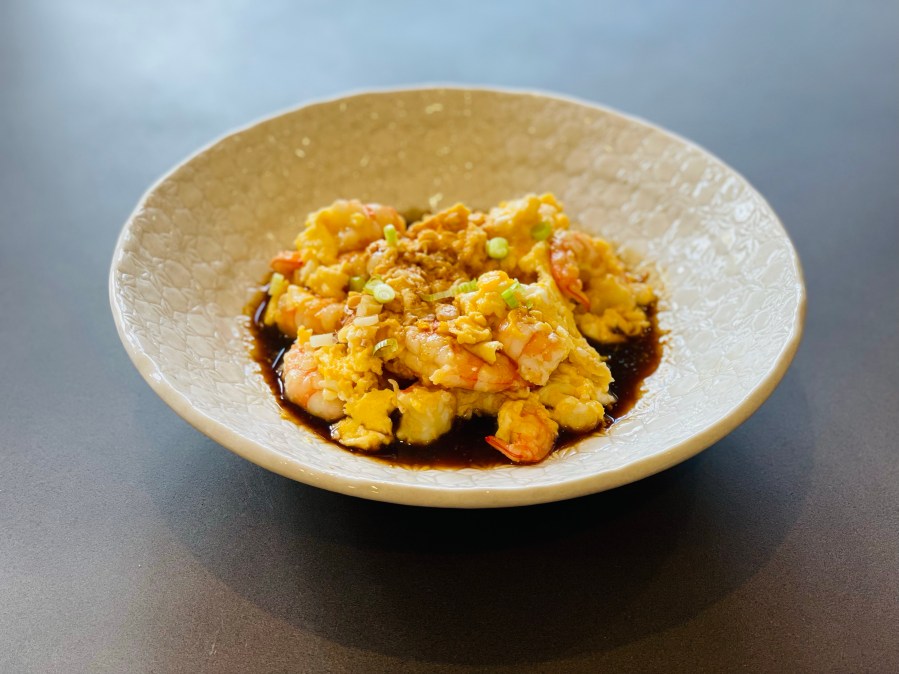
Neil Perry’s Prawn Scrambled Eggs

Serves: 2 as a starter

Neil Perry is famous for his Asian omelettes and my first experience was in 1997 when I graduated from school (boarding school no-less) and in a surprise, my old-man picked me up and we drove into the Sydney CBD and had lunch at the original Rockpool.

We had Neil’s famous blue swimmer crap omelette and it was just awesome.

This particular dish is simpler – incredibly simple in fact – though it is that simplicity that makes it just such a wonderful treat.

What a cracking starter by Nat for a long afternoon of Chinese grazing.

Ingredients

300gm green king prawns, peeled and deveined
2 large eggs
3 tbsp vegetable oil
1 spring onion, sliced

Sauce

2 tbsp light soy sauce
1 tsp sugar
A few drops of sesame oil

Method

  1. To make the sauce, combine the soy sauce, sugar and sesame oil with 2 tbsp water in a small pot and bring to the boil, then remove from the heat.
  2. Break the eggs into a bowl and lightly break up with a fork.
  3. Heat a wok until it is almost smoking, Add half the oil and, when hot, stir-fry the prawns in two batches until almost cooked through. Remove the prawns and wipe the wok clean.
  4. Heat the remaining oil and stir fry the eggs until just beginning to set, then add the prawns and spring onion and gently toss together. Remove from the heat, spoon onto a plate and pour the warm sauce over the eggs to serve.

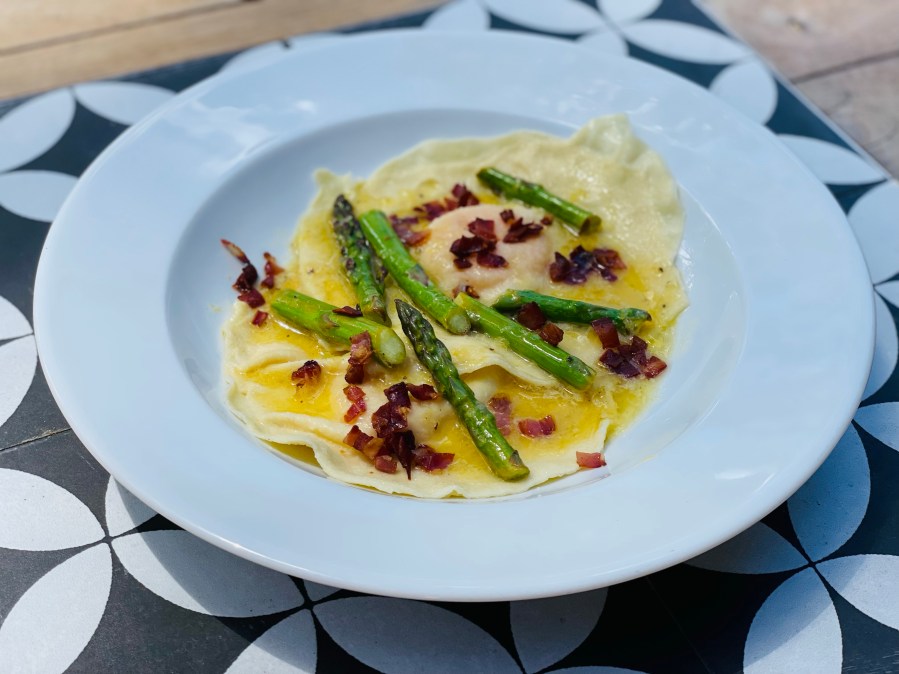
Martin Teplitzky’s Egg Yolk Ravioli with Prosciutto, Asparagus and Lemon Butter

Serves: 6 as a starter

This is a bit of an adventurous dish, though ironically it’s the simplicity of the whole thing that is the point.

This dish from Martin Teplitzky – son of the great Gretta Anna – is all class.

Nat did this as a first course for a long-lunch we had over the past Christmas and my goodness, what a treat:

Doh. I forgot the Parmesan and chives before I took this photo.

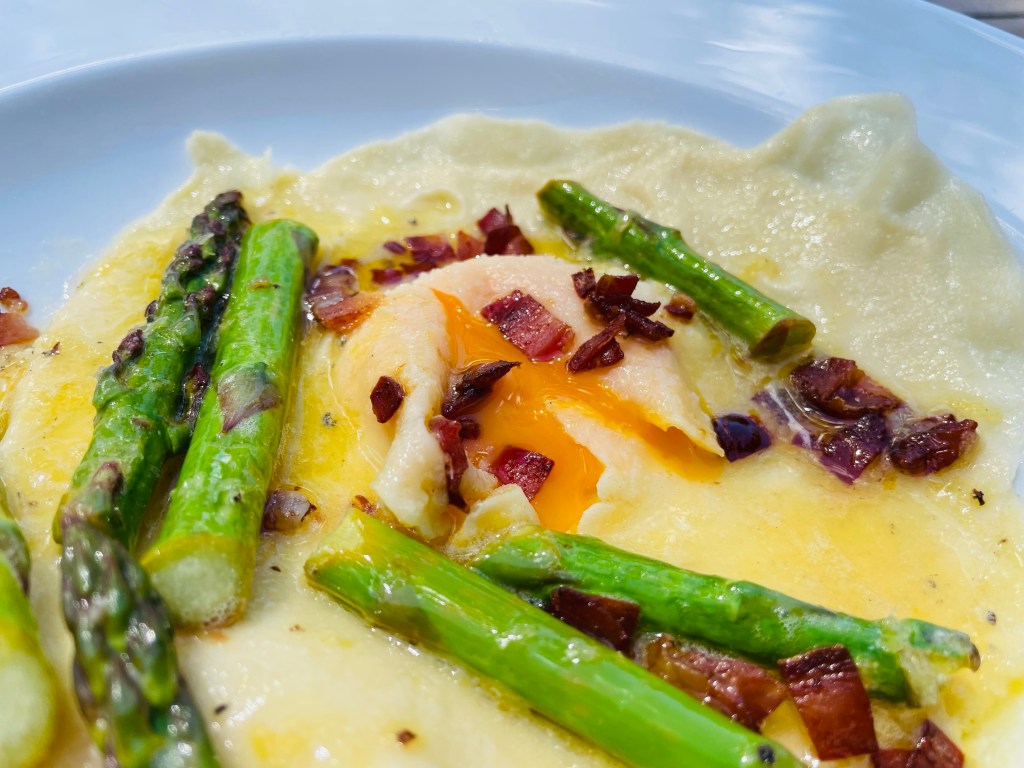
The double whammy here is that you both need to make pasta dough and then expertly transfer egg yolks into each ravioli. I think we lost only two yolks.

Though its a fun dish to make – I helped with the pasta part – and it looks wonderful. (Yolks at room temperature are much easier to handle: pro tip.)

And as I said, it’s just the wonderful simplicity of it all.

Thankfully I nailed the other part of my limited brief which was to have a solid white wine chilled and ready.

Enjoy. (I did. Very much.)

Ingredients

18 egg yolks
1 tbsp olive oil
3 thin slices prosciutto, finely chopped
50gm Parmesan, finely grated
Finely chopped chives, to garnish

Asparagus and Lemon Butter

150gm butter
Grated zest and juice of 2 lemons
1 bunch asparagus, spears trimmed and cut into thirds
Sea salt and freshly ground black pepper

Egg Yolk Ravioli (Makes about 18)

300gm type ‘00’ flour
Pinch of salt
3 eggs, at room temperature
Semolina flour, for dusting

Method

  1. To make the ravioli, sift the flour into a bowl and add the salt. Make a well in the centre of the flour and break the eggs into it. Using a fork, gently beat the eggs and gradually allow the flour to mix with them. Continue until the sauce is too think to work with the fork. Tip out onto a smooth surface and work the dough until all the flour is absorbed, then continue to knead the dough for 5 – 10 minutes until it becomes smooth. (You may need to dust the work surface with a little semolina flour if you find the dough sticking a bit.) Wrap the dough in plastic film and place in the refrigerator to rest for 10 minutes.
  2. Dust the work surface with semolina flour, then cut off about a quarter of the pasta dough, being sure to wrap the remaining dough in a tea towel to prevent it from drying out. Flatten the first piece of dough and pass it through the widest setting on a pasta machine. Drop the setting down a notch and roll out, and again drop the setting a notch and repeat. At this point, take your dough and fold it over twice. Pass it through the pasta machine. Repeat this process 5 times on this setting, folding air into the pasta. Once you have done this, drop the setting down another notch and roll through once, then drop the setting down once more and roll your pasta dough through. You should now have a lovely thin sheet of pasta ready for cutting or filling Repeat with remaining dough it give 4 sheets of pasta.
  3. Using a cutter, cut the pasta dough into 18 discs about 8cm in diameter for the base of the ravioli, and 18 discs about 9cm in diameter for the top. Carefully place an egg yolk in the middle of an 8cm disc and wet the edges with a little water on the end of your fingertips. Place a 9cm disc on top and press the edges together, being careful not to puncture the pasta with your fingernails, and making sure you remove any air pockets from inside the ravioli. Repeat with the remaining pasta discs and egg yolks.
  4. The ravioli can then be dusted with semolina flour and placed in the fridge or thrown straight into a saucepan of salted, boiling water. Remove the ravioli when they float to the surface, after about 2 – 3 minutes.
  5. Meanwhile, heat the oil in a frying pan over a medium-heat and sauté the prosciutto until crisp and golden, then drain on paper towel.
  6. To make the asparagus and lemon butter, simply melt the butter in a frying pan over a medium heat, add the lemon zest and juice and gently sauté the asparagus for 2 – 3 minutes until they turn bright green and have softened a little. Season with salt and pepper.
  7. Drain the ravioli, divide evenly between the plates. Drizzle the asparagus and lemon butter over top and serve with prosciutto and Parmesan, then scatter over finely chopped chives.

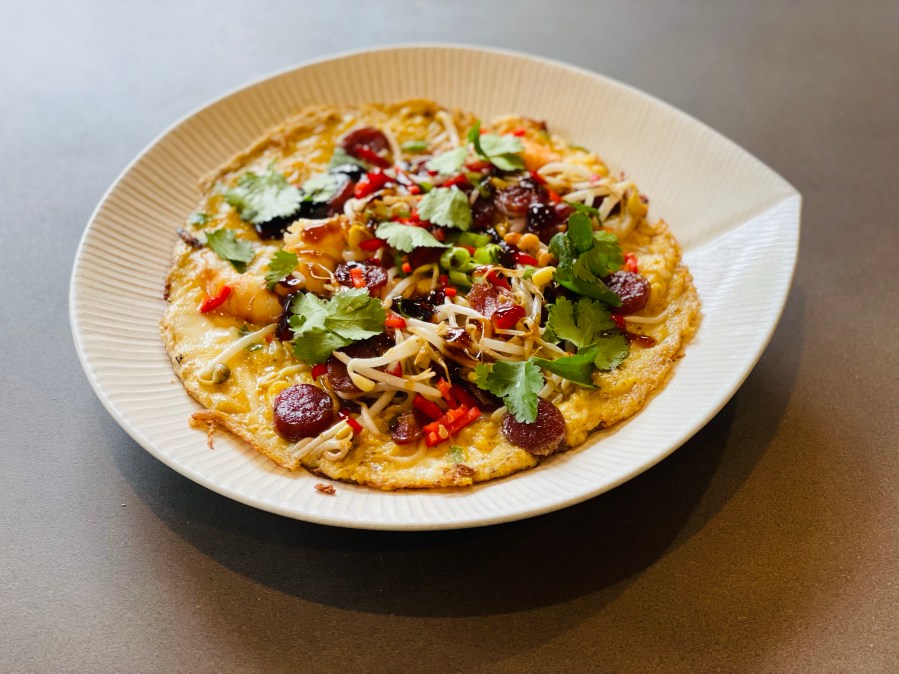
Terry Durack’s Prawn and Lup Cheong Omelet

Serves: 1

Sunday is a long-lunch day and often, we do them at home.

Or more correctly this time, Nat did it at home. An utterly excellent, four course, lux-Chinese banquet.

This recipe by Terry Durack kicked the afternoon off and wow, it was a doozy of a dish. A dish that said things are going to be good.

The flavours are so mature and sophisticated; and it absolutely looks the part.

With Champagne… things were definitely good.

Ingredients

1/2 lup cheong sausage
1 tbsp vegetable oil plus 1 tsp for frying
5 medium prawns, peeled and cleaned
1 mild red chilli, finely sliced
50gm bean sprouts
3 eggs
The green tops of 2 green spring onions, finely chopped
1 tbsp Thai fish sauce
1 tsp caster sugar
Sea salt and black pepper
2 tsp oyster sauce
1 tbsp coriander leaves

Method

  1. Place the lup cheong in a steamer and steam for 5 minutes yo soften, then finely slice. Heat 1 tbsp oil in a wok and stir-fry the prawns, lup cheong and half the chilli for 1-2 minutes over a high heat. Add the bean sprouts and toss for 30 seconds, and remove from the heat.
  2. Lightly beat the eggs, half the onion tops, fish sauce, sugar, sea salt and pepper together with a fork. Heat 1 tsp oil in wok over a medium-high heat and swirl to coat the surface. Pour in the egg mixture and cook, using a fork to draw the mixture back into the centre, allowing the egg to cook.
  3. When lightly set on top, lower the heat, scatter with the stir fry mixture and most of the remaining onion tops and cook for another 30 seconds or until the egg is cooked through. Slide the omelet from the wok onto a warmed plate; optionally fold the it over on itself. Drizzle oyster sauce on top, and scatter with the coriander and remaining onions and chilli. Serve immediately.

Chin Chin’s Son-In-Law-Eggs

Serves: 4

I was a bit perplexed when Nat said that the people reading this blog wouldn’t really want to cook Son-In-Law-Eggs.

I think they are just beautiful. And they’re not complicated.

Perhaps it needs a broader Thai menu behind it? Perhaps deep-fried eggs comes across odd if you’re not in the know?

Because Son-In-Law-Eggs are just essential Royal Thai cooking and by that definition, have to be wonderful. All Royal Thai is! Especially given the Chin Chin twist.

Key is to boil as quickly as possible and then to cool as quickly as possible to keep them as runny as possible. Though don’t worry either way.

They are amazing either way.

Ingredients

Sweet Tamarind (Makes 2 cups) *

120gm palm sugar
1 c tamarind water
1/4 cup fish sauce
2 tbs aromats (chilli, lime leaf, lemongrass scraps)

Chilli Jam (Makes about 1kg) **

10 red birds eye chillies
8 red banana chillies
2 red capsicums
6 red onions
1 stalk lemongrass (pale part only)
1 knob ginger
5 cloves garlic, peeled
1 cup vegetable oil
250gm palm sugar
3 tbs tamarind water
1/2 cup fish sauce

Eggs

4 eggs at room temperature
Vegetable oil for frying
2 sprigs Thai basil, leaves picked
1 large red chilli, sliced

Method

  1. Mix 2 – 3 tbsp of the tamarind and 1 tbs of the chilli jame to make a sauce. Set aside.
  2. Fill a bowl with ice and water. Place eggs in a small saucepan and just cover with water. Bring the water to a rapid boil and cook for 5 minutes. Remove the eggs from the boiling water and put them straight into the iced water to stop the cooking process. When they’ve cooled off, gently roll and tap each egg on a chopping board to break the shell then peel off the shell using your thumb. Gently does it.
  3. Heat a good quantity of oil – enough to deep fry – in a wok to medium (about 180c) and fry the eggs for 4 minutes or until crisp and golden. Drain on absorbent paper.
  4. To serve, arrange the eggs on a serving platter and bruise them gently so that the yolk just starts to ooze out. Drizzle with the sauce and garnish with basil leaves and chilli.

* You need far less than two cups unless you are operating a restaurant. Reduce accordingly.

** Ditto.

Gary Rhodes’ Puff Pastry Scrambled Eggs and Leeks with Ham Crème Fraîche

Serves: 4

Many years ago – like 25 – my mother and I would watch Gary Rhodes and his British cooking show.

Rhodes, Gary (crop).jpg
A wonderful guy, a brilliant chef.

He was not only an incredibly talented chef, though came across as a lovely, calm and collected guy.

Sadly, he died prematurely in 2019 though I remember the tributes at the time from people such as Gordon Ramsay and Jamie Oliver. One quote from the time from Michelin star chef Tom Kerridge described Rhodes as “one of the greatest British chefs who almost single handedly put British food on the world stage”.

My goodness.

All those years ago, my mother bought his two books and we cooked a number of his dishes. Just wonderful, wonderful French cooking.

Twently years later, I am telling Nat about Mr Rhodes and the wonderful books I used to cook from, long out of print of course.

Unbenowst to me, Nat tracks them down in a second hand book store (this is the sort of person Nat is!) and we are back in business.

Five weeks into lockdown in Sydney, Nat and I agreed we needed a break. Home schooling, work, renovating an apartment for sale, endless activities to entertain the kids, endless loops around the park to keep sane, we needed some time for ourselves.

So we took Wednesday off. I lit the outdoor firepit and put the Champagne on ice.

And served this decadent dish as the first course.

My lordy it is fine. Absolute dinner party material.

I said to Nat it reminded me of the food I ate in Chartres (France) many years back. Delicate, so tasty, so bloody good.

Update from my mother. This is me on the far right in Chartres. Haven’t changed a bit.

To say that we had the best afternoon since lockdown would be an understatement. And I can assure you that this starter (along with a cold Champagne) was a strong contributing reason for it!

Ingredients

225gm puff pastry
Flour for dusting
50gm butter plus two large knobs for cooking
5 eggs
1 large or 2 small leeks
3 or 4 thick slices of leg ham
1 tbsp white wine vinegar
6 tbsp vegetable stock
3 tbsp crème fraîche
Sea salt and freshly ground black pepper
Champagne for serving!

Method

  1. Preheat the oven to 180c.
  2. Cut 2 10cm x 10cm squares of puff pastry and then cut them diagonally in half to make four triangles. Beat one of the eggs and use to brush the pastries, and bake in the over for 20 – 25 minutes until risen and golden brown. Remove the tray from the oven and set the pastries to one side.
  3. Split the leeks in half lengthways, removing the outer layer. Finely slice the halves, washing off any grit in a colander. Leave the leek slices to drain.
  4. To make the ham crème fraîche, cut the ham into a 5mm dice and set aside. Heat the white wine vinegar in a saucepan. Once almost all evaporated, add the stock and simmer until reduced by a third. Whisk in the crème fraîch, followed by the measured butter. Season.
  5. Cut through the pastries, separated the risen lid from the base. Keep the pastry tops and bases warm.
  6. Melt a knob of butter in a large saucepan and once bubbling, add the leeks. Cook on a medium heat, stirring from time to time to ensure an even cooking, for 5 – 7 minutes, until very tender.
  7. Whilst the leeks are cooking, add the remaining eggs to the one used as an egg wash, beating with a fork to emulsify. In another saucepan, melt the remaining knob of butter and once bubbling, add the eggs. Season. As they cook, turn the eggs with a spoon reasonably vigorously, capturing every corner of the pan. When they have reached a very soft, scrambled consistency, remove the pan from the heat. This leaves you with just a minute to ‘build’ the rest of the dish while the scrambled egg thickens.
  8. Add the ham to the sauce, warming it through. Place the pastry bases on warm plates and spoon the cooked leeks loosely on top of each. Turn the scrambled eggs just once more, then spoon on top of the leeks and drizzle the ham crème fraîche around and over. Finish by placing the pastry lids on top.