Pushpesh Pant’s Paneer

Makes: 750gm

I’m not sure Pushpesh is behind paneer, though this two ingredient recipe is in his book and every time we cook Indian (which is all the time), Nat asks me to pull down his book which proudly states – in print – that is is 1.5kg.

So this is more a reference for Nat who makes paneer for so much of the Indian cooking we do.

All I can say is that freshly made paneer is so superior to store bought that it’s only an emergency when we… store bought.

Here you go babe. Never stop.

Ingredients

2 ltr whole milk
2 tbsp lemon juice

Method

  1. Heat the milk in a pan over a medium heat. When boiling, add the lemon juice.
  2. As the milk curdles the whey will separate. Strained the curdled milk through a piece of clean muslin, catching all the solids. Bring up and tie the edges of the muslin to form a pouch around the solids. Do not squeeze the muslin.
  3. Hang the pouch over a container and leave until all the water has been drained. Transfer the solids, still covered with the muslin, to the sink and weigh down for 2 – 3 hours to produce a block of paneer that can be cut to the desired shape.

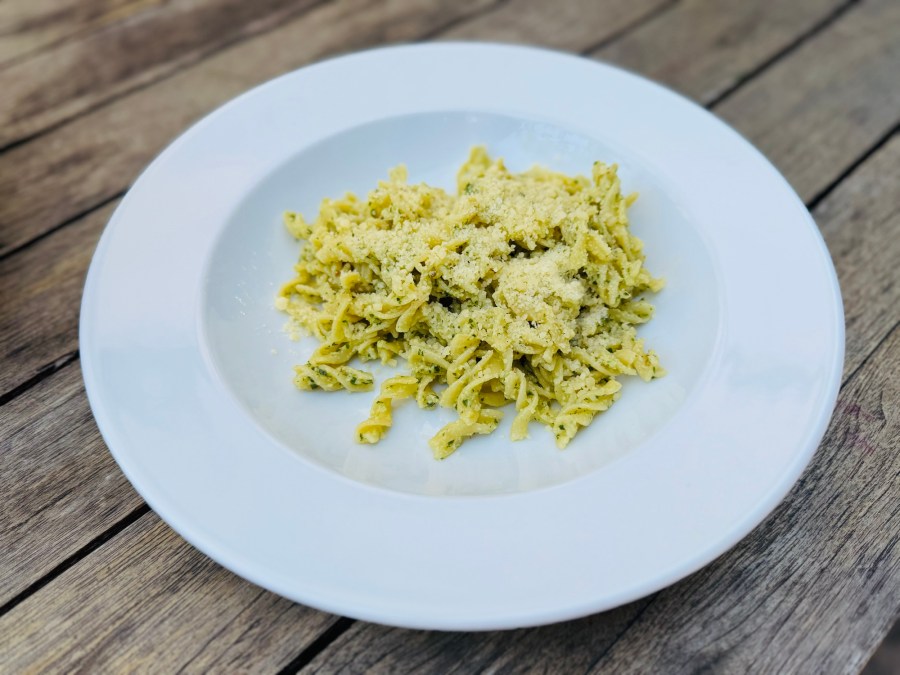
Jeanine Donofrio’s Basil Pesto Pasta

Serves: 1 cup/8

Traditional basil pesto is true comfort.

It’s simple. Moorish. Entirely satisfying.

There is nothing revolutionary in this recipe; it’s down the line.

Though in our search of the simplest – and greatest – pastas, I have no choice but to type it up.

As part of Nat’s search for the world’s best pasta, it’s not going to be a finalist.

Though that isn’t the point.

We all need a (growing) repitoir of simple pastas for a late Saturday lunch. Grab a few ingredients from the shops.

Even better, we have basil aplenty in our modest herb garden and we always have pine nuts and grated Parmesan in the fridge.

The point instead is that you can feed eight on a dime. And in a way that eyes will lock, people will smile, you did this on a whim and satisfaction levels are sky-high given the circumstances: dinner on a whim.

Ingredients

1/2 c toasted pine nuts
2 tbsp fresh lemon juice
1 garlic clove
1/2 tsp sea salt
Freshly ground black pepper
2 c basil leaves
1/4 c extra virgin olive oil
1/4 c fresh grated Parmesan cheese, plus extra to serve
Pasta, cooked al dente to serve

Method

  1. In a good processor, combine the toasted pine nuts, lemon juice, garlic, salt and pepper and pulse until well chopped.
  2. Add the basil and pulse until combined
  3. With the food processor running, drizzle in the olive oil and pulse until combined. Add the Parmesan cheese and pulse to briefly combine. For a smoother pesto, add more olive oil.
  4. Serve with al dente pasta, more Parmesan, open a red, sit back and smile.

Damien Pignolet’s Tiny Omelette of Goat’s Cheese & Pine Nuts

Serves: 1

Nat and I had a simple French lunch a Sunday or two ago and I cooked this omelette from Damien Pignolet’s book, ‘french’.

It’s a book I have had for years and it’s just lovely 80s and 90s French from his various restaurants. (If you haven’t, Bistro Moncur in Woollahra is a wonderful long lunch!)

This omelette is predictable delicate and just a lovely way to kick things off; I doubled it so that we had a small omelette each.

Enjoy.

Ingredients

1 whole egg
1 egg yolk
2 tsp crème fraîche
2 tsp pine nuts, toasted until pale golden
1/4 tsp thyme leaves
1 tsp unsalted butter
2 tsp rosemary oil (below)
1 tbsp rindless mature goat’s cheese, broken into small pieces

Method

  1. Place the egg, egg yolk, crème fraîche, and pine nuts in a small bowl for each omelette. Season with a tiny pinch of salt, freshly cracked black pepper and thyme leaves. Using a fork, break the eggs and yolks, lightly mixing the ingredients so that streaks of white and yolk are still visible – this ensures lightness of texture in the omelette.
  2. Heat the butter and rosemary oil in a blini pan, pour in the egg mixture, wait a moment for it to set, then shake the pan and, using a spatula or fork, draw the cooked egg away to allow the raw mixture to flow underneath and cook. While the omelette is still quite moist, add the goat’s cheese, flip half the omelette over and turn out onto a warm plate.

Rosemary oil

To make the rosemary oil, put 4 tbsp of olive oil in a small ovenproof bowl with 2 tbsp rosemary leaves and place in a 150c oven for 10 minutes. Allow to cool then strain into a bowl or storage jar; the oil will keep for several days. This quantity is enough for 9 tiny omelettes. Rosemary oil can also be used to sauté potatoes, along with some garlic, or to brush on a small fish such as red mullet before grilling.

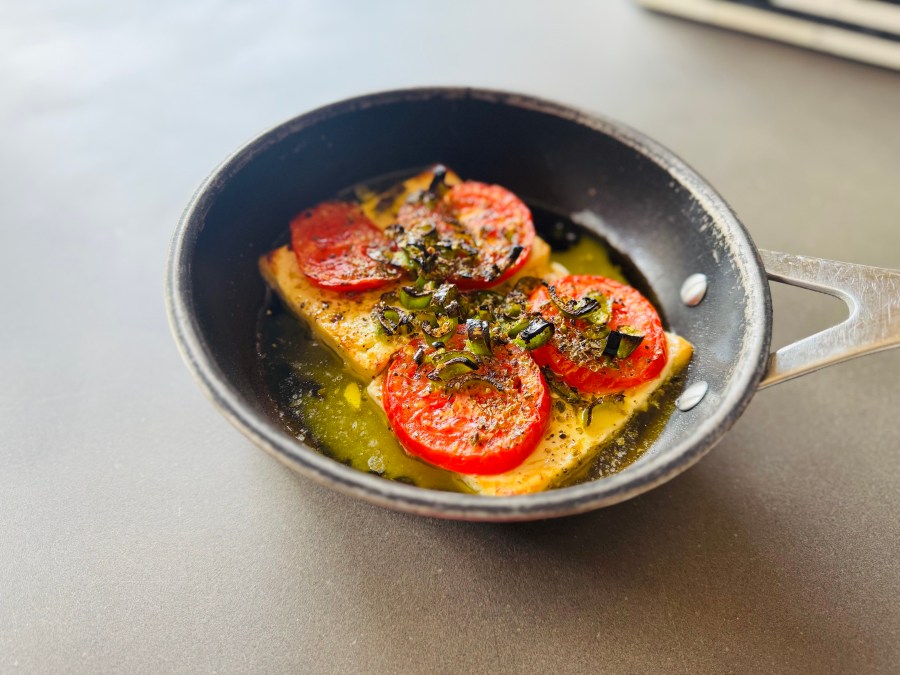
Vefa Alexiadou’s Easy Cheese Appetizer (Tiromezes)

Serves: 4

If ever there was a correlation between simplicity and brilliance, this is it.

Cooked by Nat as a starter to a long, Christmas, Greek lunch, we both agreed that this appetizer was just “stunning”.

If you’ve read my blog, you’ll know I am into my superlatives: though hand-on-heart, this dish is stunning.

I followed up with this Arni Pesto accompanied by a wicked mushroom pilaf by Nat and with Champagne, the sun and the holidays starting, this was a lunch to celebrate.

Ingredients

4 square, thick slices feta cheese
1 large tomato, cut into 4 rounds
1 long green chilli, thinly sliced
Pinch of dried oregano
Pepper
Olive oil, for drizzling

Method

  1. Preheat the broiler (grill).
  2. Put the cheese slices side-by-side in a shallow flameproof dish. Put a tomato slice on top of each feta square and top with the slices of chilli. Sprinkle with oregano and pepper and drizzle with a little olive oil.
  3. Cook under the broiler for 6 – 8 minutes until the chilli and tomato are lightly browned.
  4. Serve immediately: ideally with a delicious ouzo apparently. We had none, though if you do, please tell me. I actually get it. Reminds me of Oysters Charentaise where you have an oyster, a bite of a spicy sausage and a good sip of cold, white wine: heaven.

Daniel Gritzer’s Fettuccini Alfredo

Serves: 4

I’ve read Alfredo recipes that add cream, which I think is akin to adding cream to Carbonara. It’s amazing in a dodgy pizza restaurant in Newtown or Brooklyn, though hardly traditional or subtle.

This recipe from Serious Eats goes back to the original recipe with nothing but pasta, Parmigiano-Reggiano, butter and salt: no pepper, nothing else.

In terms of pure joy, this is it.

As part of Nat’s search for the World’s Best Pasta and in a slipstream of cooking the simplest pasta, the original Alfredo made the cut and came out way ahead.

If you can make your own fettuccini, power to you.

It really is pure joy.

Use a younger Parmigiano-Reggiano, pour a glass of cold Riesling and sit in the sun with a bowl of this pasta and prepare to be amazed.

Pure joy.

Ingredients

115gm good unsalted butter, diced
115gm grated Parmigiano-Reggiano cheese plus more for serving
Salt flakes
500gm fresh fettuccine pasta

Method

  1. In a large heatproof bowl, combine butter and cheese.
  2. Cook the pasta in salted boiling water until al dente; drain, transfer the pasta to the bowl with the cheese, retaining 1/2 c pasta water.
  3. Add the pasta water to the pasta, butter and cheese and using tongs, toss the pasta repeatedly until the butter is melted and a creamy, emulsified sauce forms. Add more pasta water if the pasta seems too dry. Season with salt, sprinkling more cheese at the table.

Paul Farag’s Potato Rosti with Cultured Cream and Bottarga

Serves: 4

Wow.

This as starter or a side. Just brilliant.

By Paul Farag, the genius behind Sydney Turkish 2-hater Aalia, this recipe has a little technique behind it, though it’s otherwise simple and elegant.

What we loved about it was the drama of serving two large Rostis so that everyone can get in on the fun.

The shaved bottarga is just lux. Add caviar if you really want to impress.

I say it every time, though when I find a new potato dish that is a home run, I’m so excited.

(Nat found it, cooked it and I can no credit other than to be typing this up.)

We’re BBQing lobster on Christmas Eve – an annual tradition with Nat’s parents – and this rosti is going to make Nat’s mother so happy: just need to someone cook all that ghee without her seeing!

(If you don’t have a mandoline fitted with a julienne attachment, now might be the time.)

Ingredients

1gm sebago potatoes, peeled*
200gm ghee, melted
200gm crème fraîche
10gm bottarga or roe, caviar
1 bunch chives, finely chopped

Method

  1. Using your mandolin fitted with a julienne attachment, cut your potatoes into fine matchsticks.
  2. I rarely interrupt a recipe other than to suggest a wine or to keep stirring, however I say this as someone that made four cauliflower pizza bases one Friday night, not realising I would need to food-process, steam something like 20 cauliflowers and then suffer through the purgatory of squeezing the hot wet rice of 20 cauliflowers: do not julienne 1kg of potato with a knife. Just don’t.)
  3. Using your hands, squeeze out all the excess liquid, then place potato in a large bowl. Toss the potato with half the ghee and season well with salt flakes and freshly ground pepper.
  4. Place a non-stick pan with a 23cm base (use a sheet of baking paper to line the pan if your pan isn’t non-stick) over medium-low heat. Add half the potato mix, spreading it evenly to cover the base of the pan, lightly shaping it to a neat circle, but trying not to push down too much.
  5. Cook for 15 minutes or until deep golden brown. When ready to flip, place a chopping board over the pan and flip onto the board. Place half the remaining ghee (50gm) in the pan and transfer the rosti back to the pan, uncooked side down and cook for another 10 – 15 minutes until deep golden colour. Remove from the pan and drain on paper towel. Repeat the remaining process with the remaining potato mixture and ghee.
  6. To serve, place a good dollop of crème fraîche on top of each warm rosti, finely shave bottarga over the top and sprinkle with chives.

* Yes, you can buy them in Australia.

Ajoy Joshi’s Spiced Yoghurt Cauliflower Florets

Serves: 4 – 6 with rice

Back from a week in New Caledonia and far too much fine French food (is there such a thing), we were down for a late Friday afternoon curry.

Yes, New Caledonia is amazing. First world, superb food, great bars, 10/10.

Enter the always-reliable Ajoy Joshi with an absolutely moorish cauliflower curry.

Simple, though packed with flavour and wonderful spice.

The sliced ginger are just an added benefit.

If you’re after a cleaner Indian vegetable to go alongside a great curry – I cooked this incredible Doi Murgi (Bangladeshi Yoghurt Chicken Curry) by Dina Begum – this is it.

And yes, I know Indian and Bangladeshi cuisines are different, though these two paired perfectly.

Ingredients

1 1/2 tsp coriander seeds
1/2 c vegetable oil
1 pinch powdered asafoetida
1 tsp cumin seeds
1kg cauliflower, cut into small florets with long stems attached
1 tsp salt
1/2 tsp chilli powder
3cm piece fresh ginger, peeled and sliced thinly
1/2 tsp ground turmeric
1/2 tsp garam masala
1 tbs fresh lemon juice
2 tbsp plain whole-milk yoghurt
2 tbsp fresh coriander, chopped

Method

  1. In a spice grinder, grind coriander seeds. Set aside.
  2. In a wok or deep frying pan, heat oil over medium heat. When oil is hot, add asafoetida and cumin and cook, stirring for 20 seconds. Add cauliflower florets, cover and cook until they start to soften.
  3. Uncover and cook, stirring for 2 minutes. Then cover and cook until florets start to brown. Once again, uncover and cook, stirring, for 2 minutes. Finally, cover and cook for 1 – 2 minutes more. (The cauliflower should be golden-brown.)
  4. Reduce heat to low and add salt, chilli powder, ginger, ground coriander, turmeric, garam masala, lemon juice and yoghurt. Mix well and cook, tossing for 2 minutes to blend the flavours.
  5. Serve immediately sprinkled with the coriander.

Vikrant Kapoor’s Chickpea Curry (Channa Masala)

Serves: 4

Zaafran used to be one of Sydney’s best Indian restaurants. My best mate Giles and I would often go there for lunch, overlooking Darling Harbour and the city.

As Darling Harbour (now demolished) slowly merged from a stylish shopping centre and destination to a tourist trap full of ugg boot and opal sellers, Giles and I stopped visiting. Though what great memories and food: nothing beats a midweek lunch and a bottle of cold white.

This is the second Vikrant Kapoor recipe I have cooked. The first was this tremendous barramundi, something that was simply 5-star.

This chickpea curry’s simplicity is deceptive. The clarity of the flavours is just awesome and it was just a perfect side to this Pushpesh Pant Chicken with Fenugreek Leaves.

Arguably, it was much more than a side. Brilliant.

Ingredients

1 large potato, unpeeled
1 tbsp ghee
1 large onion, chopped
1 large tomato, puréed
2 tsp ginger garlic paste
1/2 tsp ground cumin
1/2 tsp ground coriander
1/2 tsp ground turmeric
1/2 tsp chilli powder
450gm canned chickpeas, drained
1 tsp salt
Coriander leaves, to garnish

Method

  1. Cook the potato in a pan of boiling water for about 10 minutes or until tender. Drain and allow to cool, then peel and cut into cubes. Set aside.
  2. Heat the ghee in a frying pan, add the onion, tomato, ginger garlic paste, cumin, coriander, turmeric and chilli powder and cook for 2 minutes. Add the potatoes and chickpeas and 1/2 c lukewarm water and cook for 5 minutes or until hot. Garnish with coriander.

Lidia Bastianich’s Leek and Ricotta Tart

Serves: 6 – 8

My father-in-law – also a Rob – and I have a shared passion for classic, old-school, home-cooked Italian.

If you follow my blog, you’ll know I have typed up many of Antonio Carluccio’s recipes, as just one example of the old-school Italian Rob and I enjoy so much.

I helped Rob with a few jobs at the start of the year and as thanks, he gave me Lidia Bastianich’s cookbook, ‘From Our Family Table to Yours’. (If you wanted to know the way to my heart, buy me a cookbook and preferably, one written by Lidia!)

And yes, I have previously typed up many Lidia Bastianich recipes. She is a genius.

Rob suggested I kick off the book by cooking Lidia’s Leek and Ricotta Tart.

To summarise the end-result, Tom, our 13-year old food critic simply said, “this is brilliant”. And he wasn’t wrong.

I love anything with ricotta and the leek is a wonderful addition.

For a long, homely Italian lunch or dinner, kicking-off the meal with this tart would very much set the scene for a special meal ahead.

Divertitevi!

Ingredients

For the dough

1 1/2 c all-purpose flour plus more as needed
1/2 c freshly grated Parmesean
2 tsp sugar
1/2 st salt
1 large egg yolk (save the white for the filling)
7 tbsp unsalted butter, cold, cut into bits

For the filling

3 tbsp unsalted butter, plus more for the baking pan
2 large leeks, white and light green parts, halved vertically, sliced 2cm thick
4 spring onions, chopped
Salt and freshly cracked black pepper
1 large egg white (yolk used in the dough)
1 c fresh ricotta (I used smooth)
1/2 c freshly grated Parmesean, plus more for sprinkling
1/4 c chopped fresh Italian parsley
Pinch of freshly grated nutmeg
1 large egg, beaten, for an egg wash

Method

  1. For the dough: combine the flour, grated cheese, sugar and salt in a food processor, and pulse to combine. Beat the egg yolk in a spouted measuring cup with 1/3 water.
  2. Scatter the butter pieces over the flour, and pulse until the mixture is lumpy. Drizzle in the egg-yolk mixture, and pulse until the dough comes together, adding a little more water or flour as needed. Move the dough to a floured counter, and knead it a few times to bring it together. Form it into a disk, wrap is plastic wrap, and chill until just firm, about 1 hour.
  3. For the filling: melt the 3 tbsp butter in a medium skillet over a medium heat. Add the leeks, and cook, stirring often, until they’re tender: about 10 minutes. Add the scallions, and continue to cook until they are wilted but the green parts are still green: about 4 minutes. Season with 1/2 tsp salt and several grinds of pepper, and let it cool.
  4. Beat the egg white in a large bowl until foamy. Add the cooled leeks, the ricotta, 1/2 c grated cheese, parsley, and nutmeg. Season with 1/2 tsp salt and stir to combine.
  5. Preheat the oven to 180c with a rack in the bottom third. Butter a large 18cm cake pan. Roll the dough on a piece of baking paper to a circle about 30cm in diameter and lay it in the buttered pan. Add the filling, and spread it to an even layer. Fold the overhanging edges in to make a crust on the edges. Brush the crust with the egg wash, and sprinkle all over with the grated Parmesan.
  6. Bake until the filling is set and deep golden brown and the crust is golden on the edges: 40 – 50 minutes. Remove to a rack to cool. Serve or warm or at room temperature, cut into wedges.

Lidia Bastianich’s Onion and Potato Gratin

Serves: 8

This is a classic, if slightly inelegant gratin.

And that’s what I love about it.

Thicker slices or potato and onion when compared to the far thinner slices of potato when we cook a French gratin.

The addition of the sage and bay leaves and the two types of cheese just adds to the comfort.

Nothing revolutionary here, though as a side, you’re just going to make people very happy.

Ingredients

2 tbsp unsalted butter plus more for the baking dish
2 large white onions, thickly sliced
Sea salt
8 large, fresh sage leaves
1 c heavy cream
1 c whole milk
2 fresh bay leaves
1 kg medium potatoes, peeled and sliced 1cm thick
170gm Italian Fontina, grated (I substituted Gruyère)
3/4 c freshly grated Grana Padano or Parmesan

Method

  1. Butter a large baking dish and set it aside. Preheat the oven to 200c.
  2. Melt the 2 tbsp butter in a medium pan over medium heat. When the butter is melted, add the onions, season with 1 tsp salt and cook, stirring occasionally, until the onions are wilted, about 10 minutes.
  3. Add the sage leaves, let them sizzle for a minute, then add the cream, milk and bay leaves. Bring to a simmer and season with 1 tsp salt. Add the potatoes, and simmer just to combine, 3 – 4 minutes.
  4. Add the cheeses to a medium bowl and toss to combine them. Transfer half of the potato-cream mixture to the baking dish and spread in an even layer. Sprinkle with half of the cheese mixture. Repeat with the remaining potatoes, then the cheese. Cover the baking dish with foil, and bake until it’s bubbly and the potatoes are tender, about 30 minutes. Uncover, and bake until the top is golden brown and crusty and the potatoes have absorbed the cream and are no longer soupy (it will thicken up more as it cools as well), about 30 minutes. Discard the sage and bay leaves. Let cool for 10 minutes before serving.