Dina Begum’s Doi Murgi (Bangladeshi Yoghurt Chicken Curry)

Serves: 4

This is my third Dina Begum recipe and it was an absolute home run.

It is total comfort food.

The braised chicken thigh in the spices and yoghurt and the wonderful whole green chillies, finished with the crispy shallots on rice: kill me now.

This is what dreams are made of.

I ended up cooking the gravy down longer than the recipe prescribed though other than that, what you see is what you should cook.

Marinate the chicken overnight, get those onions golden and the rest is pretty set-and-forget.

With a glass of wine, two of my favourite things in life were consecutively ticked off!

Update: our best friends Woodles and Billy just had baby #2. A little girl Izzy. Nat is rumoured to get to see the little girl tomorrow and so I’ve doubled this and can confirm it works: as a small dinner gift.

So excited for you guys! Can’t wait for the next looooooong lunch! 🥴

The always wonderful Woodles! (With Nat.)

Ingredients

Chicken marinade

1kg boneless chicken thighs, skinned and cut into large pieces
1/2 tsp salt
2 tsp garlic, finely chopped
2 tsp ginger, finely chopped
(I used 4 tsp ginger garlic paste)
1/4 tsp black pepper, crushed
2 tsp Kashmiri chilli powder
2 tsp lemon juice
1 c Greek yoghurt
1/2 tsp cumin powder

Sauce

5 tbsp mustard oil
3 medium onions, finely sliced
1 tsp salt
6 cardamom pods
1 cinnamon stick
2 bay leaves
8 cloves
1 tsp ground coriander
1/2 tsp cumin powder
1/2 tsp turmeric powder
6 green chillies

To garnish

1 handful crispy shallots
4 green chillies, split lengthways

Method

  1. Place the chicken in a bowl with all the marinade ingredients, mix well and chill in the fridge for at least 2 – 3 hours and preferably overnight. Remove the chicken from the fridge an hour before cooking.
  2. Heat the mustard oil in a large saucepan over a medium-high heat. Add the onions, salt, bay leaves and whole spices and cook until golden brown. Add 125ml of water and bring to a simmer. Turn the heat to low and cook for 10 minutes, stirring occasionally.
  3. When the onion mixture is soft and caramelised, add the ground spices.n Turn up the heat to medium and sauté for a minute or two to cook out the spices. Add the green chillies and marinated chicken mixture together with 50ml of water and stir to combine.
  4. Set the pan back over a low heat and cover. Cook for 40 minutes, stirring occasionally. Uncover the pan and continue to cook until you have a thick gravy with a little oil rising to the surface. Serve with crispy shallots and a split chilli.

Vikrant Kapoor’s Chickpea Curry (Channa Masala)

Serves: 4

Zaafran used to be one of Sydney’s best Indian restaurants. My best mate Giles and I would often go there for lunch, overlooking Darling Harbour and the city.

As Darling Harbour (now demolished) slowly merged from a stylish shopping centre and destination to a tourist trap full of ugg boot and opal sellers, Giles and I stopped visiting. Though what great memories and food: nothing beats a midweek lunch and a bottle of cold white.

This is the second Vikrant Kapoor recipe I have cooked. The first was this tremendous barramundi, something that was simply 5-star.

This chickpea curry’s simplicity is deceptive. The clarity of the flavours is just awesome and it was just a perfect side to this Pushpesh Pant Chicken with Fenugreek Leaves.

Arguably, it was much more than a side. Brilliant.

Ingredients

1 large potato, unpeeled
1 tbsp ghee
1 large onion, chopped
1 large tomato, puréed
2 tsp ginger garlic paste
1/2 tsp ground cumin
1/2 tsp ground coriander
1/2 tsp ground turmeric
1/2 tsp chilli powder
450gm canned chickpeas, drained
1 tsp salt
Coriander leaves, to garnish

Method

  1. Cook the potato in a pan of boiling water for about 10 minutes or until tender. Drain and allow to cool, then peel and cut into cubes. Set aside.
  2. Heat the ghee in a frying pan, add the onion, tomato, ginger garlic paste, cumin, coriander, turmeric and chilli powder and cook for 2 minutes. Add the potatoes and chickpeas and 1/2 c lukewarm water and cook for 5 minutes or until hot. Garnish with coriander.
methi-murg

Pushpesh Pant’s Chicken with Fenugreek Leaves (Methi Murg)

Serves: 4

When I told the owner of our local Indian grocer I wanted fresh fenugreek leaves, he asked why. I explained that I was cooking this curry and he was totally confused by the quantity asked for and doubted it would work.

(It turns out it is also easier to buy frozen fenugreek leaves rather than fresh, though the result is of course the same.)

This curry was superb: it absolutely worked. Served alongside this chickpea curry, it was just a brilliant meal.

The marinade can be made the night before, perfect for a mid-week treat. Open a good red and thoroughly enjoy.

Ingredients

2 tsp ginger garlic paste
2 onions, sliced
2 tbsp natural yoghurt, whisked
1 tsp chilli powder
1/2 tsp ground turmeric
1 medium-sized chicken, cut into pieces (I substituted 1kg chicken thigh)
3/4 c vegetable oil
2 large cardamom pods
1 cinnamon stick
3 green chillies, de-seeded and chopped
1/2 tsp ground caraway seeds
2 c fenugreek leaves, chopped
Juice of 1 lime
Salt

Method

  1. To make the marinade, combine the ginger garlic paste, 1 onion, the yoghurt, chilli powder and turmeric together in a large, shallow bowl and season with salt. Add the chicken and turn to coat well, then cover and set aside in the refrigerator for 20 minutes.
  2. Heat half of the oil in a large, heavy-based pan over low heat, add the marinated chicken and cook for 8 – 10 minutes, or until the chicken is slightly browned. Pour in 3 1/4 c water and cook for about 30 minutes, or until 2/3 of the water has evaporated and the chicken is cooked.
  3. Heat the rest of the oil in a frying pan over medium heat, add the cardamom pods, cinnamon, chillies, ground caraway seeds and the remaining onion and fry for 1 – 2 minutes or until the cardamom swell. Add the chopped fenugreek leaves and fry for 3 – 4 minutes. Add the cooked chicken and simmer together until the leaves are fragrant, then squeeze over the lime juice.

Christine Manfield’s Baked Fish with Mustard Cashew Masala

Serves: 6

The effort in this fish is not to be sneezed at, what with the preparation of tomato kasundi pickle.

Something I am not necessarily entirely convinced you need, though we were left with a jar the pickle and Nat made one of the world’s best cheese toasties the next night with a slathering of the pickle.

The end result of this curry is remarkable, however.

The flavours are gentle and yet so full of layers of flavour. This is not your cheat’s Tuesday night coastal Indian curry.

The evidence of the prep and time in this curry is clear.

This curry is a special keeper. Worth every minute.

Another Christine Manfield homerun.

Ingredients

3 tomatoes, grated
1 tbsp tomato kasundi pickle (see below)
3 tsp sea salt flakes
1 tbsp caster sugar
100ml vegetable oil
2 tsp coriander seeds, roasted and ground
2 tsp cumin seeds, roasted and ground
1 c fish stock
1 tbsp chickpea flour
1/2 c thick plain yoghurt
50ml cream
6 x 150gm mulloway cutlets*
1 tbsp mustard oil
25ml lime juice
2 tbsp chopped coriander leaves
1/2 long green chilli, finely sliced

Mustard Cashew Masala

2 tsp brown mustard seeds
1 tsp ground turmeric
1 tsp chilli powder
60gm grated fresh coconut
1 tbsp minced ginger
4 garlic cloves, chopped
3 small green chillies, chopped
1 brown onion, chopped
2 tbsp raw cashews, chopped
1 tbsp mustard oil

Tomato Kasundi Pickle (Makes 600gm)

1 tbsp brown mustard seeds
160ml malt vinegar
1 tbsp chopped fresh ginger
6 garlic cloves
8 small red chillies, minced
100ml mustard oil
1 tbsp cumin seeds, toasted and ground
1/2 tsp ground cloves
2 tsp ground turmeric
1kg ripe tomatoes, peeled and roughly chopped
50gm brown sugar
1 tbsp sea salt flakes

  1. Kasundi Pickle: heat a frying pan over a low heat. Add the mustard seeds and vinegar and cook for 5 minutes, taking care not to evaporate the vinegar. Set aside to cool.
  2. Place the mustard seed vinegar, ginger, garlic and chilli in a food processor until a smooth paste forms.
  3. Heat the oil in a heavy-based frying pan over a medium-low heat. Add the ground spices and cook for 15 seconds or until just fragrant. Add the mustard paste and tomato, stir to combine and cook, stirring occasionally for 45 minutes or until the tomato has broken down. Add the sugar and salt, stir to combine and cook for a further 5 minutes. Taste and adjust seasoning, if necessary. Transfer to a food processor and pulse briefly to form a coarse paste. Pour into a sterilised glass jar and seal with a tight-fitting lid. Store in the pantry for up-to 1 month and refrigerate once opened.
  4. To make the mustard cashew masala, place all the ingredients together in a food processor and blend to form a paste. Set aside.
  5. Place the tomato and tomato kasundi pickle in a frying pan over a medium heat and cook for 8-10 minutes or until reduced by half. Add 2 tsp of the salt and the sugar, stir to combine and set aside.
  6. Heat the vegetable oil in a wide-based pan over a low heat. Add the ground coriander and cumin and cook for 30 seconds or until fragrant. Immediately stir in the mustard cashew masala, increase heat to medium, and continue stirring for 5 minutes or until aromatic and starting to colour. Add the reduced tomato and the stock and cook for 10 minutes, Reduce heat to low.
  7. Meanwhile, combine the chickpea flour and yoghurt in a bowl, this prevents the yoghurt from splitting during cooking, and stir into the masala sauce. Add the cream and cook for 5 minutes. Remove from the heat while you cook the fish.
  8. To cook the fish, preheat the oven to 200c. Brush the fish skin with mustard oil and sprinkle with a little sea salt. Heat a heavy-based, ovenproof frying pan over medium heat. Add the fish skin-side down, and cook for 3 minutes or until golden and crisp. Turn the fish over, pour the mustard cashew sauce around the fish, transfer to the oven and cook for 4 – 5 minutes depending on the thickness of the fish, or until cooked through. Rest for 2 minutes to allow juices to settle.
  9. Carefully lift the fish from the pan and place on serving plates. Add the lime juice, remaining 1 tsp of salt, coriander and chilli to the sauce in the pan and stir to combine. Spoon sauce over the fish and serve with steamed basmati rice.

* Any deep-sea, firm-flesh fish will do, such as kingfish trevally, trumpeter or groper.

Christine Manfield’s Chettinad Chilli Chicken

Serves: 4

You can point blindfolded to any Christine Manfield recipe and know it will be a knockout.

French, Asian, Contemporary Australian.

My first experience of her cooking was at her extraordinary Sydney restaurant, Paramount. And that would have to have been 25 years ago.

I was then lucky enough to do a Christine Manfield cooking class at the Seafood Markets with my mother, something I still remember well. (Also probably 25 years back!)

Christine’s Five Spice Duck and Shiitake Mushroom Pie is a flavour triumph, though start a day ahead as Nat will attest!

Anything from her book ‘Tasting India’ is going to blow your socks off in a good way: her 100-almond curry is an extraordinary place to start.

I’ve only cooked a few dishes from her latest book ‘Indian Cooking Class’.

This curry is one of them and the complexity of the spice layering is just awesome.

It isn’t so complex that you couldn’t make it mid-week, especially if you made the masala paste on Sunday afternoon.

Put on your blindfold, line this recipe up and thank me later.

Ingredients

75gm ghee
2 brown onions, diced
2 tbsp ginger garlic paste
3 small red chillies, minced
20 fresh curry leaves
2 tsp chilli powder
4 chicken marylands, cut into thigh and leg joints
3 tomatoes, seeded and chopped
100ml chicken stock
2 tsp sea salt flakes
1 tbsp lime juice
1/2 c coriander leaves

Chettinad Masala Paste

1 tsp white poppy seeds
2 large dried chillies
100gm grated fresh coconut
1/2 tsp fennel seeds
1/2 tsp ground cinnamon
1/4 tsp ground cardamom
1/2 tsp ground cloves
1/2 tsp ground turmeric
1/2 tsp garam masala
2 tbsp vegetable oil
1 tbsp finely diced brown onion
2 tsp ginger garlic paste

Method

  1. To make the Chettinad masala paste, place the poppy seeds in a frying pan and cook over low heat for 20 seconds or until lightly toasted. Remove from the pan and soak in 1 tbsp water for 20 minutes. Add the chillies to the pan and cook for 2 minutes or until fragrant. Allow to cool before grinding into a fine powder in a spice grinder. Place the poppy seed mixture, coconut, ground chilli and other spices in a food processor or blender and process to a fine paste.
  2. Heat the oil in a frying pan over medium heat. Add the onion and cook for 4 minutes or until golden. Add the ginger garlic paste and cook for 2 minutes. Stir in the spiced coconut paste and cook, stirring to combine, for 4 – 5 minutes. If the mixture becomes too dry, add a splash of water to prevent it from burning. Set aside to cool.
  3. To cook the chicken, melt the ghee in a wide-based pan over a medium-high heat. Add the onion and cook for 4 minutes or until softened. Add the ginger garlic paste and minced chilli and cook, stirring to combine, for 30 seconds. Add the curry leaves and cook, stirring, for 30 seconds or until crisp. Add the ground chilli and 3 tbsp of the Chettinad masala paste and cook, stirring to combine, for 2 – 3 minutes. Add the chicken and cook, turning once to ensure the pieces are evenly coated in the paste, for 5 minutes. Add the tomato and cook for another 4 minutes. Add the stock, reduce heat to low, cover and simmer for 10 minutes or until the chicken is tender. Season with salt and lime juice. Scatter with coriander and serve with steamed rice.

Pushpesh Pant’s Chicken in a Rich Scarlet Sauce (Murg Roganjosh)

Serves: 4

The name on the tin is exactly what you get here: a beautiful chicken curry in a rich scarlet sauce.

Another Pushpent Pant win.

Marinate the chicken overnight and this is a simple, authentic curry for a special mid-week meal.

Ingredients

1 c natural yoghurt, whisked
4 green cardamom pods
2 black cardamom pods
800gm chicken thigh cut into pieces
1 c mustard oil*
2 bay leaves
2 cinnamon sticks, 2.5cm long
4 cloves
Small pinch of asafoetida
1 tsp Kashmiri red chilli powder
1 tsp ground ginger
1 1/2 tsp ground aniseed
1 tsp Garam Masala
Salt

Method

  1. Mix the yoghurt and cardamom pods in a bowl to make a marinade, then season with salt. Put the chicken in a large shallow dish and rub the marinade evenly over the chicken, cover and set aside in the refrigerator for 3 hours.
  2. Heat the oil in a large, heavy-based pan over medium heat, add the chicken, bay leaves, cinnamon, cloves and asafoetida and stir gently though constantly for 10 minutes until the yoghurt dries and the oil separates out. Now reduce the heat and cook for a further 10 minutes, or until the chicken turns brown. Mix in the chilli powder, increase the heat and stir quickly, then add the ginger, aniseed powder and garam masala together with 1 c of water. Reduce the heat and cook until the sauce thickens.

* Two points here. 1. Mustard oil is lovely and definitely worth getting. 2. I used a little over 1/4 c. Oily Indian curries are lovely, though 1 c will scare your guests.

Ajoy Joshi’s Palak Murgh

Serves: 4 – 6

Nat and I landed from 10 nights in Japan this morning.

Talk about a foodie destination. My god: street-food, Egg-sandwiches at 7Eleven, Michelin Starred restaurants. It honestly doesn’t matter.

A six-seat mixology place floors up somewhere in Tokyo.
Alain Ducasse’s restaurant Benoit in Kyoto. Holy moly.
Lurra. Featured on Someone Feed Phil, a top 50 place to eat in the world. Staggering.
A toasted egg sandwich infused with soy on the side of the road. Seriously, this place would be a pop up institution in Sydney. Here, they just asked us to wait with our sparkling sakes.

The Japanese care about food at every level, at every moment. From a broth at breakfast to tuna belly sashimi at the Tokyo Fish Markets, it literally doesn’t matter.

I kid you not, the fried chicken at the every-corner corner-store Lawsons is hands down better than the best KFC here in Sydney.

We even had an Indian meal in Kyoto in the smallest restaurant you could imagine (well, every restaurant in small) and wasn’t it a complete win on a level you’d almost never find in Sydney?! Cheap, cheerful, completely authentic – a total slam dunk.

You cannot go wrong no matter how much you might try.

But this isn’t a Japan post (which I will do) but a post because we are back and of course, drowning our sorrows with a wine, we return to a curry at the start of a cold, gloomy Sydney winter.

Nat wanted a tomato based curry and who was I to argue?

This relatively simple Ajoy Joshi number absolutely hits the note.

I added a little more Garam Marsala at the end, though do your thing.

Just make sure you slowly cook it down to reduce almost all the liquid.

A beautiful heat, wonderful spinach, just bloody lovely with a red on the couch ready to catch up on whatever Netflix we’ve missed.

(I have slightly adapted this recipe.)

Ingredients

1kg chicken thigh cut into 4cm pieces
1 tsp Garam Marsala
500gm baby spinach
3 mild green chilies, split lengthways
2 brown onions, roughly chopped
1/2 c vegetable oil
1/2 tsp salt
2 1/2 tbsp minced garlic
1 tsp crushed ginger
1/4 c full-fat yoghurt
1/2 tsp chilli powder
3 ripe tomatoes, finely chopped

Method

  1. Marinate the chicken pieces in the Garam Marsala and set aside.
  2. In a food processor, process the spinach and chillies until a paste forms. Transfer to a bowl and set aside.
  3. Clean and dry the food processor and process the onions until finely ground. Set aside.
  4. In a large, heavy-based frying pan, heat the oil. Add onions and salt and cook, uncovered, until lightly golden. Stir in garlic and ginger and cook until fragrant. Add the yoghurt and cook for 5 minutes further.
  5. Raise heat to high, add the chicken and cook until browned. Stir in chilli powder and cook until all moisture evaporates and oil separates.
  6. Stir in spinach purée and tomatoes. Cover, reduce heat and cook until the chicken is cooked through and tender. Uncover and if any liquid remains, cook over a medium heat until the liquid has evaporated. Serve immediately with rice. (And chutney is my strong recommendation!)

Dina Begum’s Slow-cooked Spicy Beef Curry (Mezbani Mangsho)

Serves: 6 – 8

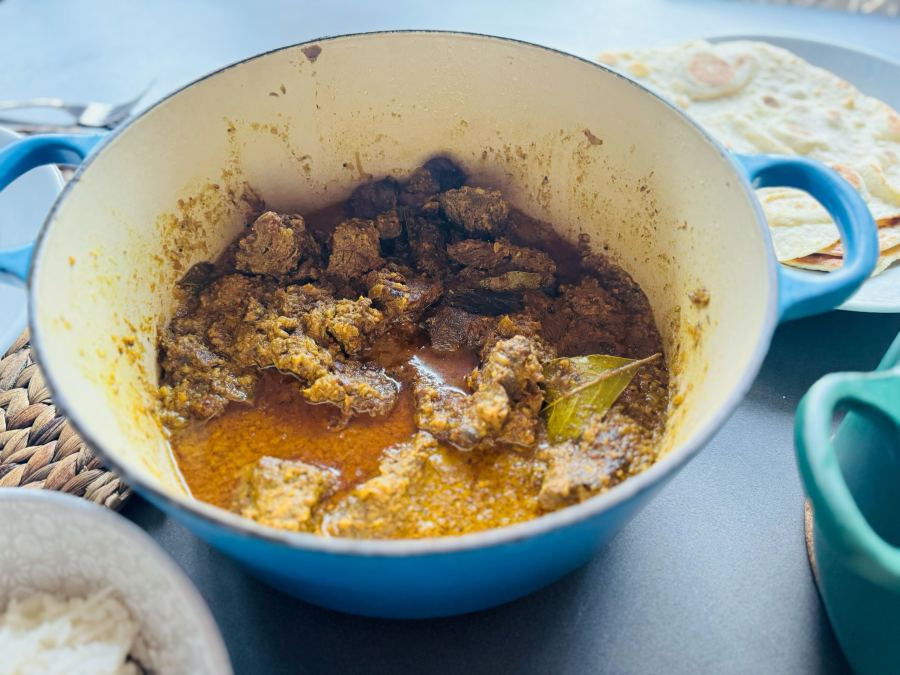
This thumper of a beef curry was cooked by Nat as part of a Bangladeshi lunch.

Calling it a thumper is unfair on one hand because it is so complex and aromatic. But boy, it isn’t mucking around either.

Nat skipped the addition of the final fresh chillies because she felt it was already where she wanted to be, spice-wise. You’re call.

Otherwise, let this number marinate overnight, cook it low and slow and you’re in for a real autumn warmer. Beautiful. (Red wine is not really optional either.)

Ingredients

1.4kg beef shoulder on the bone, cut into 4cm pieces*
1 tsp salt
1 tsp ground turmeric
1 tsp chilli powder
1 tbsp Kashmiri chilli powder
1/3 tsp ground nutmeg
1/3 tsp ground mace
1/2 c mustard oil or rapeseed oil**
2 medium onions, finely sliced
3 c cold water
2 bay leaves
4 – 5 whole green chillies

Dry Spice Mix

2 tsp coriander seeds
2 tsp cumin seeds
1/2 tsp black peppercorns
1 tsp Bengali five-spice or 1/2 tsp (wild) celery seeds
2 green cardamom pods
5cm piece of cassia bark or cinnamon
1 1/2 tsp fennel seeds

Wet Spice Paste

1 tbsp water
4 garlic cloves, peeled
1/2 medium onion, roughly chopped
5cm piece of fresh root ginger, peeled
1 1/2 tsp salt

Method

  1. Place the beef chunks in a large mixing bowl and sprinkle over the salt. Set aside.
  2. To make the dry spice mix, lightly toast all the whole spices except the fennel seeds in a dry frying pan over a medium-heat and stir for 2 minutes, or until the spices are aromatic. Transfer to a dish to cool slightly, then tip into a spice grinder, along with the fennel seeds. Grind until very fine, then pour into the bowl with the meat.
  3. To make the wet spice paste, blend all the ingredients in a blender until you have a smooth paste. Transfer this to the bowl with the meat. Add the turmeric, both chilli powders, nutmeg and max and mix thoroughly. Cover and marinate in the refrigerator for 1 – 2 hours or preferably, overnight.
  4. When you’re ready to cook, heat the oil in a large, heavy-bottomed pan over a high heat. Add the sliced onions and sauté for a few minutes until golden, then add the marinated meat, followed by 1 1/4 c of the water and the bay leaves. Bring to a simmer and cook for 5 – 7 minutes. Reduce the heat to low-medium, cover with a lid and cook for 1 hour, stirring every 15 minutes. Add the remaining 1 1/2 c water. Reduce the heat to low and cook for 45 minutes, or until tender and the gravy is reduced and no longer watery.
  5. For the final 10 minutes of cooking, add the whole green chillies. Stir through a simmer. When ready, serve immediately with boiled basmati rice.

* Nat substituted 900gm of chuck roast, taking into account the weight of the bone
** If using rapeseed oil, add 2 tbsp mustard powder to the marinade.

Dina Begum’s Eggs in Creamy Gravy (Dimer Korma)

Serves: 4 as a main, 8 as a side

The latest addition to the cookbooks is Made in Bangladesh by Dina Begum, a UK cook and food writer.

It’s a lovely book of stories and recipes from a Bangladeshi home kitchen.

As part of a late week – we need to reward ourselves for a flat-chat week of work – lunch, Nat and I tackled a dish each.

This was mine.

Nat is suspicious of egg recipes like this. I suspect (know) it comes from a childhood of whole eggs in dishes, something which in fairness, would have also skewed my view of whole eggs in really any dish.

The sauce is silken with the addition of milk and yoghurt towards the end. It is aromatic and actually pretty addictive. If I had to eat this for breakfast every day, sign me up!

Paired along side this spicy beef curry, it was just excellent.

If you have the opportunity, cook both and this is a perfect late-Autumn meal. Add a red wine and now you’re talking.

Ingredients

8 large eggs
4 tbsp vegetable oil
1 large onion, finely sliced
2 tbsp ghee
2 cloves
4 peppercorns
5cm piece of cassia bark (substitute cinnamon stick)
3 cardamom pods
1 bay leaf
1 1/4 tsp salt
1/2 tbsp ground cumin
1/2 tbsp ground coriander
1/2 tsp garam masala
1/2 tsp Kashmiri chilli powder
1/2 c water
2/3 c full-fat milk
4 heaped tbsp Greek yoghurt
4 whole green chillies

For the paste

1 large onion, roughly chopped
4 garlic cloves, crushed
2.5cm piece of fresh root ginger, grated
3 – 4 tbsp water

Method

  1. Combine the paste ingredients in a food processor and blitz until smooth, then set aside.
  2. Place the eggs in a pan of cold water over medium-high heat. Bring to the boil and boil for about 15 minutes, then remove from the water and cool under cool running water. Once cool, peel the eggs and very lightly score their surfaces lengthways. Set aside.
  3. Heat the oil in a deep, wide frying pan over medium-heat and fry the onions for about 10 minutes until golden. Transfer the cooked onion to a bowl and set aside. Add the ghee to the same pan, still over the heat. Add the hard-boiled eggs and lightly fry for 1 – 2 minutes until lightly golden. Use a slotted spoon to remove them from the pan and set aside.
  4. Next, add the whole spices and the bay leaf, along with the onion paste and salt. Stir well to combine, then cover. Reduce the heat and cook for 7 – 8 minutes, or until soft, ensuring the paste doesn’t brown. Now add the ground spices. Increase the heat to medium to cook out the spices, then add the water. Cover, reduce the heat to low and cook for 6 – 7 minutes, checking occasionally to ensure nothing is catching on the pan. Add a splash of water if necessary. Take off the heat and leave to rest, cover, for a minute or two.
  5. In a jug mix the milk and yoghurt until combined, then very slowly whisk into the pan – working slowly will help the mixture from splitting. Once you have a smooth sauce, stir in the eggs until they are coated with the sauce, then add the whole green chillies and half the fried onions. Return to a low heat and simmer, covered, for 5 minutes. Sprinkle over the remaining fried onions to serve.

Maunika Gowardhan’s Chicken Curry cooked with Fried Onions, Tomato, Spices and Garam Masala (Murgh do Pyaza)

Serves: 4

Another cracker from Maunika Gowardhan.

The addition of the chargrilled shallots at the end is the clincher here, adding great texture and flavour: though the whole curry is just a wonderful Saturday night in sort of curry. Plus the potato adds even more luxury when accompanied by the couch, dimmed lights, a glass of red and a good movie.

Somewhat on the Colonial Indian side of cooking.

Definitely one to bookmark. (And do yourself a calorie favour, even on a Saturday night: substitute this great cauliflower rice for rice and cut your calories by 90%!)

Ingredients

1kg skinless chicken thigh, cut into bite-sized pieces
6 garlic cloves, roughly chopped*
2″ ginger, roughly chopped*
3 tbsp vegetable oil
2 bay leaves
2 dried mild red chillies
200gm white onions, finely chopped
1 1/2 mild chilli powder (or Kashmiri chilli powder)
1 tsp turmeric powder
1 tbsp cumin powder
1 tbsp cumin powder
1 tbsp coriander powder
200gm tomatoes pureed to a paste
140gm Greek yoghurt whisked
150ml water
140gm baby potatoes, roughly chopped
Sal to taste
1 tbsp garam masala
Coriander for garnish

For the shallots

2 tbsp vegetable oil
200gm shallots peeled and halved

Method

  1. Grind the garlic and ginger in a blender with a splash of water. In a large mixing bowl add the chicken, and mix in the garlic ginger paste. Mix well and set aside for an hour or overnight preferably.
  2. Heat the oil in a large, heavy-bottom sauce pan over a medium flame. Add the bay leaves and chilli and fry for a few seconds. Add the onion and fry for 17 – 18 minutes, stirring well: as they begin to brown, add the marinated chicken. Turn the heat up and cook the chicken until it is sealed.
  3. Stir well and at this stage, add the chilli powder, turmeric, cumin and coriander powder. Fry for a minute. Add the pureed tomato and mix well, scraping the bottom of the pan. Cook for 4 minutes.
  4. Turn the heat back to medium and add the yoghurt, a little at a time. Stir well, ensuring it doesn’t curdle, for 6 minutes. Add water, potatoes and season to taste. Turn the heat down low and cook the curry for 20 minutes with the lid on or until the potatoes are cooked through and the gravy reduced. Add the garam masala and let rest.
  5. In the meantime, in a frying pan, heat the oil and fry the shallots for 5 – 6 minutes on each side over a medium heat. Cook until slightly charred, add to the curry and stir well. Garnish with coriander and lemon juice and serve with rice or roti

* Or if you’re cooking curries as often as we are, get yourself a large jar of garlic and ginger paste from any good Indian supermarket and measure out the equivalent amount.