Lucas Hollweg’s Spinach Gnudi

Serves: 4 as a starter

Geez I wish I took a photo of this cracker of a starter plated by Nat as part of a long Italian lockdown lunch we felt we needed.

(We needed it.)

There is a little time in it, though it’s worth it.

Ricotta and parmesan, burnt butter and more parmesan?

Yes please!

Reminds me of a very similar dish I had at Otto Restaurant on Sydney’s Woolloomooloo Wharf with a cracking bottle of Italian white and the sun dancing on the water.

If only…

Ingredients

250gm ricotta (we used smooth)
Olive oil for frying
200gm baby leaf spinach
1 small garlic clove, crushed
50gm parmesan grated, plus extra to serve
Sea salt and freshly ground pepper
1/4 nutmeg, freshly grated
250gm fine semolina for dusting
50gm butter to serve

Method

  1. Place the ricotta in a fine plastic sieve over a bowl and let it drain for a few hours.
  2. Heat a splash of olive oil in a saucepan and add the spinach and garlic. Stir over the heat until the leaves are completely wilted. Set aside to cool and then squeeze out as much of the liquid as you can with your hands. Very finely chop and then squeeze again.
  3. Put spinach in a bowl with the ricotta and parmesan. Season, add the nutmeg and mix well. Taste and add more seasoning/nutmeg if needed.
  4. Spread half the semolina over a large plate or tray. Shape the the ricotta mixture into 16 – 20 balls, rolling them between damp hands. Place on the semolina and carefully roll until coated on all sides. Cover with the remaining semolina, then chill (don’t cover with anything else) overnight. This creates a semolina ‘skin’ that holds he gnudi together.
  5. To cook, bring a large saucepan of water to a gentle boil. Melt the butter in a frying pan over a medium heat and slightly brown/burn. Set aside and keep warm.
  6. Drop the gnudi into the boiling water, turn down the heat and gently cook for 3 minutes or until the gnudi float to the surface. Carefully remove with a slotted spoon, drain off the excess water then toss in the butter.
  7. Divide the gnudi among 4 bowls, drizzle the butter over and shave over plenty of parmesan to serve.

Dan Toombs’ Keema Pau Samosa

Serves: 4 as part of a meal

Dan Toombs doesn’t specifically make a Keema Pau Samosa.

Though he does make samosas. And he does make the Keema Pau.

And so I chose to bring them together and I am giving him pretty much all of the credit.

I made these as part of a bigger lunch and the boys – 13 and 10 – literally wolfed them down and asked for more to be made.

They’re not revolutionary. Keema never is.

Though they are as good as I have had.

Note, I skipped making the samosa pastry and went for store-bought shortcrust.

I also baked these samosas rather than (shallow) frying them. Hundreds of videos on how to fold samosas and so I’ll leave that for you.

Ingredients

500gm minced lamb
5 tbsp canola oil
2.5cm cinnamon stick
3 cardamom pods, bruised
500gm onion, finely chopped
2 tbsp garlic and ginger paste*
1/2 tsp ground tumeric
1 very generous tbsp garam masala**
Generous handful of coriander
4 birds eye chillies
1/4 c frozen baby peas
1 tbsp dried fenugreek leaves***
Salt, to taste
Shortcrust pastry
1 egg
Mint yoghurt to serve

Method

  1. Mix the minced lamb with 2 cups of water and break it up with your hands until the mixture is about the same consistency as porridge. (This will help achieve a smooth keema without any lumps.) Set aside.
  2. In a large pan or wok, heat the oil over a medium-high heat and when visibly hot, stir in the cinnamon and cardamom pods and let the flavours of the spices infuse in the oil for 30 seconds. Add the onion and fry for 10 minutes, stirring occasionally, until the onion turns light brown. Stir in the garlic and ginger paste and fry for an additional 30 seconds and then tip in the meat/water mixture. Cook until the water is evaporated.
  3. Add the turmeric and garam masala and stir well to combine and simmer.
  4. In the meantime, blend the coriander and chillies with 1/4 cup of water until smooth and add to the pan; continue to cook, remembering that this needs to be a dry mixture. Add the peas and cook for a few minutes more.
  5. Finally, add the dried fenugreek leaves, breaking them up as you go. Continue to cook until the oil separates from the meat. Season with salt.
  6. Make an egg wash, heap a tablespoon of the mixture into the pastry and fold the samosas one by one, using the egg wash to seal. (I didn’t egg wash all over though will next time.)
  7. Bake until golden brown.

* Mince equal parts garlic and ginger with a small amount of water.

** I ended up adding at least two tbsp. Taste and go from there.

*** Order from Herbies.

Gordon Ramsay’s Pan-fried Sea Trout, Peas & Chorizo Fricassée

Serves: 2

This is simply a great, 1-hat bistro lunch.

Nat took a day of work – as we all really need to do during this endless Sydney lockdown – and presented this with a glass of Krinklewood Verdelho (if in the Hunter Valley, visit their vineyard: it is wonderful as are the wines) and as we sat in the sun, we agreed that it was moments like these that made the long weeks and routine bearable.

The fricassée gives the dish a rustic, moorish backbone – chorizo, potato, paprika and peas – and the warm caper dressing just finishes it.

We have never cooked a disappointing Gordon Ramsay recipe and this lunch just continued that tradition.

This dish would be perfect for any Saturday lunch though my pro tip: have it on Monday and beat the lockdown!

And vino of course!

Ingredients

2 fillets of sea/ocean trout (or use salmon)
2 tbsp butter
Sea salt and freshly ground black pepper
1 lemon, halved

For the fricassée

100gm cured chorizo (1 small chorizo), diced
350gm waxy potatoes (we used kipflers)
Large pinch sweet smoked paprika
125ml fresh chicken stock
150gm cooked peas

For the warm caper dressing

3 tbsp olive oil
2 tbsp small capers, drained
1 red onion, finely chopped
1 tbsp red wine vinegar
Small bunch tarragon, chopped

Method

  1. For the dressing: Heat 1 tbsp of the oil in a small saucepan. Add the capers as well as the onion and cook for 3 minutes until softened. Add red wine vinegar and cook down until evaporated. Add in the rest of the oil plus the tarragon and leave to infuse.
  2. For the fricassee: heat the oil in a saute pan, add the chorizo and fry for two minutes until crisp and the red oil has rendered out. Add the potatoes and paprika and cook for 5 minute until the chorizo is starting to get browned edges.
  3. Add the chicken stock, bring to a boil; and then simmer for 10 minutes or until the stock has evaporated and the potatoes are tender. Stir in the peas and cook for another two minutes. Set aside and keep warm.
  4. For the fish: Score the skin of the trout and season generously.
  5. Heat the butter inside a non-stick frying pan. When it begins to sizzle. cook the fish skin-side down. Gently fry for 8 minutes until the skin is crisp and golden and the fish on its way to being cooked.
  6. Turn the fish and squeeze over the juice of half a lemon, basting the fish with all the lemony pan juice for a 1 minute whilst it cooks. Set aside in the pan.
  7. To plate: Spoon a pile of the fricassee into the centre of each plate. Gentley sit the fish on-top, skin side up (if using). Spoon the caper dressing around the outside and serve.

Justin North’s Blue Eye and King Prawn Bourride

Serves: 4

I first tried Justin North’s food at Becasse, a totally insane 25-seat restaurant in the top floor of the new Westfield Sydney.

I recall the first dish I ever tried being something like a parakeet egg with volcanic ash and citric something and from there, the crazy show rolled on. A waiter tapped a triangle as the first dish was presented. (I’m not kidding or more the clearer about what it all meant.)

I only ever ate at Becasse – maybe three times – with a great client and friend Paul and it was the food and theatre plus the sheer over-the-top plating that amused and impressed us so much.

Wine plus this theatre went to much laughter.

North’s food empire – which employed 180 people at its peak – collapsed as sadly they all do, though bloody credit. This man can cook.

Think genius.

My mother shared this recipe with me and it is unquestionably 2-hat.

It is breakthrough stuff like where you’re at a running race with your kids and that freak headed for the Olympics is also in the race. Love ya son, though who the hell is that kid that just clocked in 11 seconds flat?

That’s this dish, out of the blocks – wow.

We had the bourride with a wonderful green salad and thus far in this never ending Sydney lockdown, the bourride wins gold. (And don’t think we’re not trying to give the cooking a nudge!)

Just, bloody wow.

Ingredients

Herb dressing

1/2 cup basil leaves
1/2 cup coriander leaves
1/2 cup chervil (or parsley if you absolutely must)
2 – 3 tbsp olive oil
Pinch of sea salt flakes

For the bourride

2 tbsp olive oil
1/2 tsp fennel seeds
1/2 tsp coriander seeds
2 cloves garlic sliced
1 c sliced brown onion
1/2 c sliced fennel
Pinch of sea salt flakes
Pinch of saffron threads
1 c chopped ripe juicy tomatoes
1 strip orange peel
1/2 large chilli
1 c white wine
2 c fish stock
4 x 80gm blue eye fillets (skinned, pinned etc)
12 large king prawns (heads and tails removed)

To finish

1 cup mixed baby herbs such as coriander and basil

Method

  1. Preheat the oven to 180c. Heat the olive oil in a oven proof casserole dish. Add the seeds, garlic, onion, fennel, salt, saffron and cook gently over a medium heat for 8 – 10 minutes until the vegetables are soft, juicy and aromatic.
  2. Add the tomatoes, orange peel, chilli and white wine and continue to cook for a few minutes until pulpy, then add the fish stock, bring to the boil and add the fish fillets and prawns, season with a pinch of salt flakes, cover with a lid and place in the oven for 5 minutes to cook the fish and prawns.
  3. Remove from the over, take the seafood out of the pan and blitz the pulpy sauce for a few seconds to a rustic chunky saucy consistency.
  4. To finish: Spoon the bourride sauce into warm serving bowls, top with the seafood, drizzle over the herb dressing and decorate with the baby herbs and serve.

Sean Connolly’s Crab Linguini

Serves: 4

Nat and I have a great tradition on those public holidays where the gathering of family isn’t a prerequisite: Labour Day, Queens Birthday, Boxing Day etc.

We lock in a babysitter for the kids and we have lunch at The Morrison, a Sydney-city institution by Sean Connolly.

Clean, crisp seafood. Great wine list. Great buzz looking out onto the street at all the trams going backwards and forwards.

The oysters are a must. The prawn cocktail is a must.

Though the biggest must is the Crab Linguini.

We order it every time and I know of at least one other mate that does the same.

And here is the receipe.

Simple as one would expect from a chef that heros simplicity.

To really go the extra mile, Nat made fresh linguini and my word, what an awesome dinner we had:

If you really want to bowl your guests over, this is how you do it!

Paired with Rodney Dunn’s Leaf Salad with an Anchovy Cream and a great bottle of Chardonnay, nobody ate better in our part of that night.

(And when this Sydney lockdown ends, book a table at the Morrison. It really is a fun afternoon.)

Ingredients

500gm thickened cream
300gm fresh crab meat
50gm unsalted butter
Sea salt and freshly ground black pepper
Juice of 1 lemon
1 tbsp canola oil
1 red chilli, finely chopped
Handful mint leaves, torn
Handful of Italian parsley leaves, chopped

Method

  1. Heat the cream in a large pan, bring to a simmer and reduced until thickened.
  2. Remove from the head, add the butter and a pinmch of salt, combining vigorously.
  3. Once combined, return to the heat and add the lemon juice. Bring to a gentle simmer and reduce for a further 2 minutes.
  4. Cook the linguini al dente and set aside.
  5. In a heavy saucepan, heat the oil and once hot, warm through the crab and chilli. Add the mint and then the cream sauce. Season, stir through the parsley and serve.

Prawn & Cannellini Bean Salad

Serves: 4

This is just a great salad.

Like surprisingly great.

Saturday lunch is served!

Ingredients

500gm green prawns peeled
400gm canned cannellini beans, rinsed and drained well
2 inner celery stalks, sliced, leaves torn
20 pitted Ligurian olives
8 basil leaves, torn
Crusty bread, to serve

Red Wine Dressing

100ml extra virgin olive oil
1 tbsp red wine vinegar
2 tbsp oregano leaves, roughly chopped
Salt flakes and freshly ground black pepper

Ingredients

  1. Make Red Wine Dressing: combine oil, vinegar, oregano, salt and pepper in a screw top jar and shake well to emulsify. Pout into a bowl.
  2. Bring a large saucepan of water to the boil with 2 tbsp of salt per litre of water.
  3. Add the prawns to the boiling water and cook for a minute or two. Allow to cool somewhat and then cut into chunks and add to the Red Wine Dressing.
  4. Add beans, celery, celery leaves, olives and basil and toss until well combined.
  5. Serve at room temperature with crusty bread.

Crab and Preserved Lemon Risotto

Serves: 6 as an entree

Just before Sydney’s lockdown, Nat and I did one of the Sydney Seafood School classes: a well received Mother’s Day present.

At their best, these classes are a lot of fun. An hour in the auditorium watching the chef cook and then two hours cooking at a workstation with another couple, knocking over the various dishes.

Then it’s lunch with a glass of wine. (You can even order an additional bottle of wine which of course, I commend firmly.)

The Italian Seafood class we attended did not push us particularly in terms of technique or complexity, though Nat cooked one of her first risottos (I am the resident risotto cooker) and I cleaned a squid for only the second time. And hey, we had fun!

And of course, I only type up recipes that are great and genuinely, this risotto is great.

I overheard someone saying that the preserved lemon was a little overpowering and lemon zest would be better.

Wrong.

It works and if you love crab and/or preserved lemon, this risotto is definitely for you.

Ingredients

300gm raw crabmeat*
1.25 litres quality chicken stock
1/4 c extra virgin olive oil
1 small brown onion, chopped
Salt flakes and freshly ground white pepper
250gm risotto (do not rinse)
1/2 cup dry white wine
1 preserved lemon, rinsed and dried, skin only finely diced
50gm salted butter
3 tbsp freshly grated Parmesan
2 tbsp snipped chives

Method

  1. Heat stock in a saucepan until simmering, then maintain at that temperature.
  2. Heat oil in a large pan over medium heat, add onion and a good pinch of salt and fry until soft but not coloured.
  3. Add the rice and stir over a high heat until grains are well coated in oil and warmed through.
  4. Add white wine and stir until most of the liquid has been absorbed.
  5. Reduce the heat to medium, add stock, a ladleful at a time, stirring constantly and allowing each ladleful to be absorbed before adding the next.
  6. Continue until rice is tender, with a slight bite, and has a creamy consistency (about 18 minutes): you may not need all of the stock.
  7. Add a final ladle or 2 of stock, preserved lemon, crabmeat, butter, Parmesan, salt and pepper and beat vigorously with a wooden spoon until all the butter is incorporated and the grab has broken into thin wisps. The finished risotto should be quite soupy. (The Italians call it all’onde which translates to wave-like.)
  8. Taste, season, stir through chives and serve immediately on a flat plate, tapping the bottom of the plate to spread the risotto out.

* Look, maybe it needs to be said, maybe not. We need to be buying only local, sustainable seafood. Australian for me. The time is up on imported seafood, please.

Chin Chin’s Bo La Lot

Makes: 20

Nat cooked these as part of a Chin Chin-themed afternoon (great Melbourne and Sydney South East Asian noshery) and wow, they’re great. Hot, juicy, absolutely full of flavour, totally fun.

We grilled them and ate them on the spot.

So good!

As part of an afternoon with friends, these would be perfect with cold beers and lots of other hot, Asian nibbles on the grill.

(Fingers crossed Sydney’s lockdown ends by Christmas so we can do just that!)

Ingredients

1 stalk lemongrass (pale part only), chopped
1 large red chilli, chopped
2 shallots, chopped
4 cloves garlic, chopped
1/2 bunch coriander root, chopped
1 tsp black peppercorns
300gm wagyu beef mince
1 tsp mild curry powder
1/2 bunch miny leaves, picked, roughly chopped
1 tbsp fish sauce
1 tsp caster sugar
20 betel leaves*
1 tbs ground roast rice**
1/2 cup nahm jim jaew
4 lemon cheeks
20 toothpicks, soaked in water

Method

  1. Pound or blitz the lemongrass, chilli, shallot, garlic, coriander root and pepper to make a paste.
  2. In a bowl, combine all the ingredients down to and including the caster sugar, before checking the seasoning.
  3. Roll the mixture into 20 balls of equal size.
  4. Roll the balls into individual betal leaves an ‘sew’ each together with a toothpick.
  5. Heat a chargrill pan (or grill) and cook the parcels for about 90 seconds each side.
  6. Garnish with ground roast rice and serve with a dash of nahm jim jaew and some lemon cheeks for squeezing.

* I wandered into our local Thai restauarnt who was happy to sell me a bag. Harris Markets and other fancy fruit and vegetable shops I went to in the Lower North Shore of Sydney came up stumps. Speaks to the size of the Thai community in my part of town I guess.

**Roast rice in a pan until golden. Allow to cool and then blitz in a spice grinder until ground. Store in a dry container.

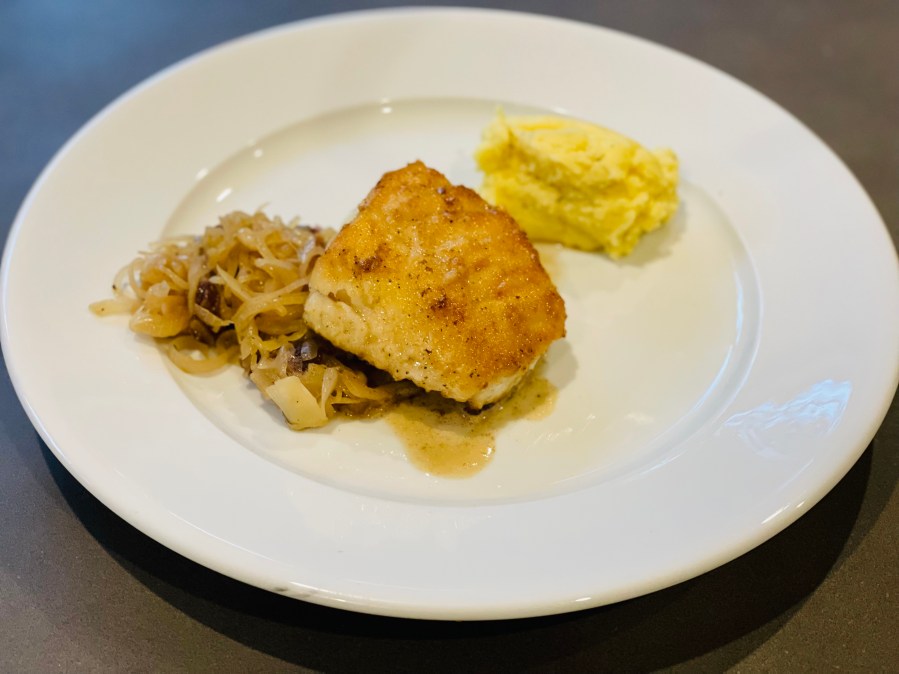
Gary Rhodes’ Fillet of John Dory and Raisin and Thyme Onions and Bigarade Mashed Potatoes

Serves: 4

This is French bistro at its best.

Such a wholesome, satisfying dish: you’ll be grinning at the end of the meal.

With a good bottle of white as we did, hard to fault this.

The potatoes are called bigarade which in French refers to a bitter orange known as the Seville orange. I susbstituted and it worked well: the absolutely subtle citrus flavour adds just another twist and it pairs perfectly.

Bon appetit!

Ingredients

3 onions, sliced
3 shallots, sliced
50gm raisins
3 tbsp sherry vinegar
1 tbsp brown sugar
3 tbs olive oil
1 scant tsp thyme leaves
Sea salt and freshly ground black pepper
Flour, for dusting
4 x John Dory fillets, each approximately 175gm and skinned
2 tbsp canola oil
Large knob of butter

For the potatoes

675gm flourly potatoes, peeled and quartered
50gm butter
Sea salt
Freshly ground white pepper
150ml crème fraîche
Finely grated zest and juice of 2 (Seville) oranges
1 tsp caster sugar

Method

  1. Boil the potatoes in salted water, approximately 20 – 25 minutes, before draining off the water. The potatoes can now be mashed, adding the butter a little at a time, along with the crème fraîche. Season with the salt and white pepper. (Can I make the quick point that if you are not mashing your potatoes with a ricer, you are strongly encouraged to do so. Perfect mash every time!)
  2. Boil together the orange zest and juice, allowing it to reduce by at least three quarters. Add the caster sugar, stirring the juice into the potatoes which can be rewarmed just before serving.
  3. While the potatoes are cooking, prepare the onions and shallots. Blanch the onion and shallot slices in boiling water for just 15 minutes, then drain in a colander. This softens both, allowing them to be stewed with the olive oil and thyme, rather than fried.
  4. Place the raisins, sherry vinegar and brown sugar in a small saucepan and bring to a simmer then remove from the heat, cover and leave to one side. This opens up the raisins, releasing their quite strong flavour.
  5. Pour the olive oil into a saucepan and add the blanched onions, shallots and thyme leaves. Cook over a low heat for at least 15 – 20 minutes, until completely softened. Add the sherry vinegar and raisins and season. Continue to cook for a further 5 – 10 minutes, until all the flavours have combined.
  6. Lightly flour the fish and season each with a pinch of salt. Heat the oil in a large frying pan. Once hot, place the fish in the pans. Season the fish again. Fry for 3 minutes, until golden brown. Add the knob of butter and continue to fry for a further minute, then turn the fish over. Cook for just 1 more minute and then off the heat. The residual heat of the pan will continue to fry the fish for at least 2 – 3 minutes, providing enough time to plate the garnishes.
  7. Present the raising onions and bigarade mashed potatoes side by side on the plates, then place the John Dory fillets on top of the onions. Any remaining butter in the pan is then spooned over the fish.

Chin Chin’s Naum Jim Jaew 2

Makes: 1 1/2 cups

Many years ago – together with my mother – we went on Royal Thai dive, inspired mainly by David Thompson. So much so in fact, we did a the Royal Thai course at our local TAFE!

One of staples of Royal Thai is Naum Jim, a wonderfully hot, salty and sour sauce.

This interpretation from Chin Chin (of Melbourne and now Sydney fame) is on the money and our favourite weekday use of it, is to steam or pan fry some barramundi and then to pour over Nahm Jim. Serve along side some Asian greens tossed with sesame, soy, oyster, Chinese cooking wine and some dark caramel.

Healthy and yum!

Stored in the fridge for a few weeks so well worth the effort.

Ingredients

12 birds-eye chillies, chopped
6 large red chillies, chopped
2 cloves garlic
2 shallots, chopped
2 tbs grated palm sugar
1/3 c tamarind water
2/3 cfish sauce
2 tbs ground roast rice*

Method

  1. Blitz the chillies, garlic, shallot and palm sugar. Add the tamarind water, fish sauce and ground roast rice, stir checking for seasoning. Should be hot, salty and sour.

* Roast rice in a pan until golden. Allow to cool and then blitz in a spice grinder until ground. Store in a dry container.