Lidia Bastianich’s Leek and Ricotta Tart

Serves: 6 – 8

My father-in-law – also a Rob – and I have a shared passion for classic, old-school, home-cooked Italian.

If you follow my blog, you’ll know I have typed up many of Antonio Carluccio’s recipes, as just one example of the old-school Italian Rob and I enjoy so much.

I helped Rob with a few jobs at the start of the year and as thanks, he gave me Lidia Bastianich’s cookbook, ‘From Our Family Table to Yours’. (If you wanted to know the way to my heart, buy me a cookbook and preferably, one written by Lidia!)

And yes, I have previously typed up many Lidia Bastianich recipes. She is a genius.

Rob suggested I kick off the book by cooking Lidia’s Leek and Ricotta Tart.

To summarise the end-result, Tom, our 13-year old food critic simply said, “this is brilliant”. And he wasn’t wrong.

I love anything with ricotta and the leek is a wonderful addition.

For a long, homely Italian lunch or dinner, kicking-off the meal with this tart would very much set the scene for a special meal ahead.

Divertitevi!

Ingredients

For the dough

1 1/2 c all-purpose flour plus more as needed
1/2 c freshly grated Parmesean
2 tsp sugar
1/2 st salt
1 large egg yolk (save the white for the filling)
7 tbsp unsalted butter, cold, cut into bits

For the filling

3 tbsp unsalted butter, plus more for the baking pan
2 large leeks, white and light green parts, halved vertically, sliced 2cm thick
4 spring onions, chopped
Salt and freshly cracked black pepper
1 large egg white (yolk used in the dough)
1 c fresh ricotta (I used smooth)
1/2 c freshly grated Parmesean, plus more for sprinkling
1/4 c chopped fresh Italian parsley
Pinch of freshly grated nutmeg
1 large egg, beaten, for an egg wash

Method

  1. For the dough: combine the flour, grated cheese, sugar and salt in a food processor, and pulse to combine. Beat the egg yolk in a spouted measuring cup with 1/3 water.
  2. Scatter the butter pieces over the flour, and pulse until the mixture is lumpy. Drizzle in the egg-yolk mixture, and pulse until the dough comes together, adding a little more water or flour as needed. Move the dough to a floured counter, and knead it a few times to bring it together. Form it into a disk, wrap is plastic wrap, and chill until just firm, about 1 hour.
  3. For the filling: melt the 3 tbsp butter in a medium skillet over a medium heat. Add the leeks, and cook, stirring often, until they’re tender: about 10 minutes. Add the scallions, and continue to cook until they are wilted but the green parts are still green: about 4 minutes. Season with 1/2 tsp salt and several grinds of pepper, and let it cool.
  4. Beat the egg white in a large bowl until foamy. Add the cooled leeks, the ricotta, 1/2 c grated cheese, parsley, and nutmeg. Season with 1/2 tsp salt and stir to combine.
  5. Preheat the oven to 180c with a rack in the bottom third. Butter a large 18cm cake pan. Roll the dough on a piece of baking paper to a circle about 30cm in diameter and lay it in the buttered pan. Add the filling, and spread it to an even layer. Fold the overhanging edges in to make a crust on the edges. Brush the crust with the egg wash, and sprinkle all over with the grated Parmesan.
  6. Bake until the filling is set and deep golden brown and the crust is golden on the edges: 40 – 50 minutes. Remove to a rack to cool. Serve or warm or at room temperature, cut into wedges.

Vefa Alexiadou’s Fried Cheese Balls from Crete

Serves: 6 as a starter

Vefa Alexiadou’s book ‘Greece – The Cookbook’ by publisher Phaidon is the sort of wonderful cooking tome you’d expect from one of the world’s best publishers of cookbooks.

The recipes are traditional and numerous. No doubt every dish would be marvellous.

Nat served these cheese balls as a starter before a long Greek, Sunday lunch.

And what a traditional treat.

Ricotta and mint is such a great savoury combination and here you have it in spades.

It’s winter. Do a Greek lunch and start here.

Beautiful.

Ingredients

500gm anthotiro or ricotta cheese
1 – 2 eggs
4 tbsp all-purpose flour, plus extra for coating
4 tbsp finely chopped fresh mint
4 tbsp finely chopped fresh parsley
Salt and pepper
Vegetable oil, for deep frying*

Method

  1. Place the cheese in a bowl and mash with a fork. Add the eggs, flour, mint and parsley, season with salt and pepper, and blend to a thick, pliable mixture. If it is soft and sticky, add more cheese.
  2. Cover with plastic wrap and put the mixture in the refrigerator until required.
  3. Heat the oil in a deep-fryer to 180c – 190c. Pinch off small pieces of the cheese mixture and roll between your palms to form balls the size of a small walnut. Coat with flour and fry in the hot oil, in batches if necessary, for 3 – 4 minutes or until golden all over. Drain well and serve immediately.

Pinbone’s Peas, Beans, Ricotta and Mint Bruschetta

Serves: 6

What an absolutely lovely, fresh way to kick off a lazy Sunday lunch.

Nat and I never went to the restaurant Pinbone, though we did have dinner at their successor – I Maccheroni – a few weeks back and it was a really lovely Italian meal.

For this dish, I started with the foccacia and as the non-bread maker in the family, this turned out to be a real trick. Though not in the tricky vein.

Follow the instructions, lose faith at some point, though watch the dough transform and transform and wow. An absolutely wonderful base for the dish, with just enough oil to be interesting, a cracking crust and a soft interior. Yum.

It’s then the simplicity of the ricotta and the peas and beans. You don’t really need four varieties here and I swapped out Italian beans for the broadbeans. Though add the olive oil, lemon juice and then the mint and a big paste of ricotta, and with a glass of Champagne… this is why life is so good.

And can be so simple.

If I showed up to lunch and was handed one of these with a glass of wine, wow. What a way to set the bar and clear intentions of the afternoon ahead.

Ingredients

50gm sugarsnap peas, coarsely chopped
50gm frozen baby peas
50gm podded broad beans (about 150gm unpodded) – I substituted Italian beans and coarsely chopped
50gm podded edamame*
Juice of 1/2 lemon
1 tbsp olive oil
150gm ricotta
1/4 cup mint, coarsely torn

Focaccia

460gm baker’s flour
1 tsp brown sugar
7gm (1 sachet) dried yeast
1/4 c extra-virgin olive oil, plus extra to serve

Method


  1. For the focaccia, combine 450gm flour and 1 1/2 tsp salt in an electric mixer fitted with a dough hook. Lightly whisk remaining flour, sugar and dried yeast in a separate bowl with 300ml lukewarm water, then leave until bubbles appear (5 – 7 minutes). Add oil to the yeast mixture, then, with the mixer on low speed, add yeast mixture to the flour and knwad until smooth and elastic (8 – 9 minutes). Transfer to a lightly oiled bowl, cover with plastic wrap and leave in a warm place until nearly doubled in size (20 – 30 minutes). Preheat the over to 230x. Gently knock back the dough, cover and prove until nearly doubled in size again (10 – 15 minutes). Transfer to a well-oiled 12cm x 23cm load pan**. Cover and leave to prove until about 1cm below top of tin (15 minutes), then bake until golden brown and the focaccia sounds hollow when tapped on the base (25 – 30 minutes). Cool on a rack (about 1 hour), then cut into 12 slices.
  2. Brinf a saucepan of salted water to the boil and blanch peas and bans for 20 – 30 seconds until bright green and still crunchy. Drain, then peel broadbeans and mix with lemon juice, oil and remaining peas and beans in a bowl and season to taste.
  3. Toast/grill the focaccia slices until well toasted.
  4. Spread the ricotta on focaccia, spoon pea and bean mixture on top, scatter with mint, extra virgin olive oil and serve.

* Frozen section of the supermarket.

** We’ve been baking our focaccias in a large, heavy skillet to great effect. Just keep and eye on it. These skillets get so hot, it brings forward the cooking time. This focaccia was done in 18 minutes in the skillet.

Yotem Ottolenghi’s Kale and Herb Dumplings in Broth

Serves: 4

A read through the ingredients and then method of this dish and you can almost taste it.

The wonderful kale and herb dumplings, with the ricotta, feta and soudough breadcrumbs. And the broth, elevated with theinitial addition of vegetables.

And anything with dill has me listening!

Such a warm, hearty and really fun dish: especially elevated through the herbs and the addition of the lemon.

Bookmark to cook this one. Classic Ottolenghi!

Ingredients

1 1/2 ltr vegetable stock
Salt and freshly ground black pepper
300gm kale, thick stems discarded, leaces and thinner stems roughly chopped (150gm net weight)
1 eschalot, peeled and quartered lengthways
2 spring onions, quartered
1/2 garlic clove, peeled and crushed
1 lemon – zest finely grated to get 1/2 tsp and juiced to get 1 tsp
10gm dill, finely chopped
5gm chives, finely chopped
5gm tarragon leaves, finely chopped
80gm ricotta
60gm feta, roughly broken into 2cm pieces
1/2 tsp ground nutmeg
1 egg, beaten
60gm fresh sourdough breadcrumbs (about 2 slices, crusts removed)*
30gm plain flour
2 tbsp olive oil, to serve

Method

  1. In a large saucepan for which you have a lid, bring the stock and 3/4 of a tsp of salt to a boil. Lower the heat to medium-high, then blanch the kale for four minutes, until soft. Drain the kale well and when cool enough to handle, squeeze the kale with your hands to get rid of any remaining liquid. Return the liquid to the stock pot.
  2. While the kale is cooling, add the shallot, spring onions and garlic to the stock, simmer on a medium-high heat for 15 minutes, then discard the shallot and spring onions; turn off the heat.
  3. Process the kale in a food process until finely chopped and put in a bowl with the lemon zest and juice, herbs, both cheeses, the nutmeg, egg, breadcrumbs, 1/3 tsp of salt and a good grind of pepper; stir to combine.
  4. Line an oven tray with baking paper. Spread te floir on a large plate. Roll the kale mixture into 12 balls, dipping your hands in water from time-to-time to prevent sticking. The balls should be quite compact, so roll them tightly and put them on the tray as you go. Next, roll each ball in the flour a couple of times, applying pressure so they’re very well coated.
  5. Return the stock to a medium-high heat and bring to a simmer. Turn the heat to medium, gently lower in the dumplings, cover and cook for four to five minutes, until theyr swell and float to the top.
  6. Divide the broth and dumplings between four bowls, sprinkle with a pinch of salt, drizzle over the oil and serve piping hot.

* When we have some leftover baguette or sourdough, I blitz it – crusts and all – in the food processor and add it to a bag of fresh breadcrumbs in the freezer. Means having fresh breadcrumbs always at hand.

I hope I’m not telling you how to suck eggs!

Rodney Dunn’s Mushroom Cannelloni

Serves: 6 -8

Nat and I did a cooking class with Rodney Dunn a few years ago when we spent a week in Hobart.

It was an awesome afternoon; true paddock to plate stuff, where every ingredient came from his farm. We cooked in his large country kitchen and then ate lunch in a wonderful dining room surrounded by cookbooks and sampling some amazing Tasmanian pinots.

An afternoon that Nat and I still talk about.

Rodney Dunn’s food is about body, flavour and honesty.

This salad of his is a great example.

This mushroom cannelloni is an amazing example.

We’ve slightly adapted the recipe by blitzing the mushrooms and combining them with the ricotta and I think this made a textural improvement on keeping the mushrooms whole.

Though its the flavours that cannot be doubted.

Absoluely beautiful.

The homemade pasta is so good, you’re eating something elevated far above a cannelloni with tubes from the shops. (If making your own pasta, we always use this amazing Kitchenaid pasta dough recipe and suggest you do too!)

And the filling and the Béchamel!

This would be a signature dish in a good Italian restaurant.

Hitting a pasta homerun is my favourite thing and hands-down this pasta is a homerun.

Ingredients

580gm ricotta, drained
2 eggs, lightly beaten
100gm Parmesan, finely grated
1/4 c extra virgin olive oil, plus extra for drizzling
4 garic cloves, thinly sliced
3 spring onions (white part only), thinly sliced
300gm Swiss brown mushhrooms, coarsely chopped
250gm large flat mushrooms, coarsely chopped
6 sage leaves, thinly sliced
1 tsp thyme leaves
30gm dried porcini mushrooms, soaked in 200ml warm water for 10 minutes, drained and soaking liquid reserved

Pasta dough

1 1/2 c plain flour
1/2 c coarse semolina
2 eggs
For drizzling: olive oil

Béchamel sauce

100gm butter, coarsely chopped
1/3 c plain flour
550ml warm milk
1/4 c finely grated Parmesan
Pinch of finely grated nutmeg, or to taste

Method

  1. For pasta dough, pulse flour and semolina in a food processor until combined. With motor running, add eggs, then gradually add 20ml iced water and process until mixture just comes together. Remove dough, knead until smooth (5 – 7 minutes), wrap in plastic wrap and res at room temperature (1 hour). Divide pasta into four, then using a pasta roller, roll until ou have pasta 2mm in thickness. Cut pasta into ten 12cm x 15cm pieces. Cook in a large saucepan of boiling salted water over high heat until al dente (1 minute), drain and refresh, drizzle with a little oil, set aside.
  2. Preheat oven to 180c. Press ricotta through a fine sieve into a large bowl, then combine with eggs and 75gm Parmesan, season to taste and set aside.
  3. Heat extra virgin olive oil in a large frying pan over medium heat, add garlic and spring onion, sauté until starting to soften (2 – 3 minutes). Add the mushrooms and herbs and sauté until tender (8 – 10 minutes). Add prorcini and soaking liquid, simmer until liquid has been reduced (7 – 10 minutes), season to taste and set aside to cool. When cool, blitz in a food processor until consistency of mince and stir in with the ricotta mixture.
  4. For béchamel, heat butter in a saucepan over medium heat until foaming (1-2 minutes), add flour and stir until mixture is light brown in colour (2-3 minutes). Whisk in warm milk, a little at a time, and stir until beginning to bubble (2-3 minutes), remove from heat, add parmesan, season to taste with salt, freshly ground black pepper and nutmeg, set aside.
  5. Spoon ricotta into a piping bag fitted with a 2cm-plain nozzle, pipe across the middle of each piece of pasta, top with mushrooms and roll to enclose. Arrange cannelloni in a 25cm x 35cm buttered baking dish. Spoon béchamel on top, scatter with remaining parmesan and bake until golden and warmed through (30-40 minutes). 

Lidia Bastianich’s Shepherd’s Rigatoni

Serves: 6

I am now two for two with Lidia’s recipes.

Two pastas down – two incredible pastas down – and both needing to be typed up.

I’m going to put her into the Antonio Carluccio class of chefs where everything will be brilliant.

Indeed, his rustic pasta is yet more proof that the simplest pastas can not only be the best, though can be the most sophisticted. Long Sunday-lunch sort of stuff.

This will most definitely be cooked again.

Ingredients

500gm sweet Italian sausage, removed from casings
1/4 c extra virgin olive oil
1/2 tsp chilli flakes
500gm rigatoni
1/2 tsp salt
1/4 c grated Parmesan
1/2 c loosly packed basil leaves, shredded

Method

  1. Bring a pot of salted water to the boil to cook the pasta.
  2. For the sauce, crumble the sausage meat in a bowl, breaking into small clumps with your fingers. Pour the olive oil into a skillet and set it over a medium-high heat. Sprinkle in the chilli flakes and toast for a few seconds., then scatter the crumbled sausage meat in the pan. Cook the sausage, stirring and breaking up any clumps, for 10 minutes or so, as the meat juices are released and cook away, until it is all well browned and crispy.
  3. Meanwhile, while the sausage is cooking, drop the rigatoni into the boiling water, stir and cook to the boil. When the sausage is browned and crisp, laddled about 1/2 cup of the pasta cooking water into the skillet, and deglaze the pan bottom, scrapping up the browned bits. Season the sausage meat with the salt, and stir with the bit of moisture in the pan.
  4. When the pasta is al dente, lift it from the pot, drain briefly and drop in into the skillet. Toss the rigatoni and sausage together, then turn off the heat and stir in the ricotta and Parmesan. Scatter the basil on top and toss well to dress the pasta evenly. Heap the ragatoni in warm bowls and serve immediately with extra Parmesan.

Yotem Ottolenghi’s Aubergine Dumplings Alla Parmigiana

Serves: 4

This really is a dish that tells you that vegetables really are better than meat.

Line it up against a chicken parmigiana and hands down the eggplant wins. Even without the shallow fried-breadcrumb.

The basil. The ricotta. The Parmesan. The toasted breadcrumbs.

Brilliant.

I don’t often cook a dish twice in quick succession, though this is now in the repertoire. Make the sauce a few days ahead, the aubergine mixture in the afternoon and bam, with a salad of greens, you’ll have just a marvellous dinner on your hands.

Another Ottolenghi home-run.

Ingredients

90gm fresh breadcrumbs (preferably sourdough)
4 aubergines (eggplants) roughly cut into 2 1/2cm cubes (1kg)
150ml olive oil, plus extra for shaping
100gm ricotta
75gm Parmesan, finely grated, plus extra to serve
10gm parsley, finely chopped
1 egg, plus 1 yolk
1 1/2 tbsp plain flour
6 garlic cloves, crushed
15gm basil leaves, roughly chopped
1 1/2 x 400gm tins of peeled plum tomatoes, blitzed until smooth (600gm)
1 1/2 tsp tomato paste
1 1/2 tsp caster sugar
1/4 tsp chilli flakes
3/4 tsp paprika
2 tsp fresh oregano leaves, finely chopped
45gm pitted Kalamata olives, roughly torn in half
Salt and black pepper

Method

  1. Preheat the oven to 160c. Spread the breadcrumbs on a baking tray and bake for 12 minutes, until lightly browned and dried out. Set aside to cool and turn the oven temperature up to 220c.
  2. On a large, parchment-lined tray, toss the aubergines with 75ml of oil, 1/2 tsp of salt and a good grind of black pepper. Spread out as much as possible and bake for 30 minutes, tossing halfway through, until golden brown.
  3. Roughly chop the aubergines not a chunky mash, then transfer to a large bowl and refrigerate for 20 minutes, or until cool. Once cool, add the ricotta, Parmesan, parsley, egg, yolk, flour, breadcrumbs, a third of the garlic, 10gm of the basil, 1/4 tsp of salt and a good grind of black pepper. Mix well, then with lightly oiled hands, shape the mixture into 16 golf-ball-sized dumplings, about 55gm each, compressing them as you go so they hold together.
  4. Put 2 tbsp of oil into a large non-stick frying pan on a medium-high heat. In two batches, fry the dumplings for 3-4 minutes, turning them until golden-brown all over. Adjust the heat if they’re browning too much. Add another 1 tbsp of oil and fry the remaining dumplings in the same way. Transfer to a plate and set aside.
  5. Preheat the oven to 180c. Put the remaining 2 tbsp of oil into a large sauté pan on a medium-high heat. Add the remaining garlic and cook for 1 minute until fragrant, then add the tinned tomatoes, tomato paste, sugar, chilli flakes, paprika, oregano, 1 tsp of salt and a good grind of black pepper and cook for 8 minutes or until thickened slightly, stirring occasionally. Pour 400ml of water, bring to a simmer, then lower the heat to medium and simmer for another 10 minutes.
  6. Pour the sauce into a medium baking dish, top with the dumplings and bake for 20 minutes, until bubbling. Remove from the oven, scatter over the olives, the remaining basil and a grating of Parmesan, and serve.

Yotam Ottolenghi’s (All the) Herb Dumplings with Caremelised Onions

Serves: 4

A few weeks back, Nat pull together an absolutely wonderful three-part Yotam Ottolenghi dinner.

Every dish was just Yoman clever/unique/amazing as they always are.

Though these herb dumplings with caremalised onions were the evening’s winner. (They’re from his cookbook Ottolenghi Test Kitchen (OTK) Shelf Love, a cookbook I highly, highly recommend. An absolute delight to flick through, not a recipe you wouldn’t cook.)

Slightly Middle Eastern, it’s one part the herbs which really are earthy and deep. With the other part being the slow-cooked onions, with the butter, saffron and cardamom.

It would be a meal in itself, alongside a green salad.

Though as a side, it was just damn clever; and it would certainly indicate to your quests that a special meal was coming.

Ingredients

1kg onions (about 5 or 6), halved and sliced 1/2cm thick
10 cardamom pods, roughly bashed open with a mortar and pestle
60ml olive oil
110gm unsalted butter, at room temperature
4 garlic cloves, crushed
100gm fresh coriander, roughly chopped
100gm parsley, roughly chopped
70gm dill, roughly chopped
30gm tarragon leaves, roughly chopped
7 spring onions, thinly sliced
1 1/2 tsp cumin seeds, roughly crushed with a mortar and pestle
3/4 tsp ground turmeric
50gm whole-milk ricotta
100gm Greek feta, roughly crumbled
60gm Parmesan, finely grated
1 large egg
70gm plain flour
1/3 tsp saffron threads, roughly crushed
2 tbsp lemon juice
Sea salt and freshly cracked black pepper

Method

  1. Preheat the oven to 180c.
  2. Put the onions, cardamom, half the oil, 40gm of butter and 1 tsp of salt into a medium baking dish and mix together to combine. Bake for 60 – 70 minutes, stirring 4 – 5 times during, until softened and nicely caramelised.
  3. Meanwhile, heat the remaining 2 tbsp of oil in a large, non-stick sauté pan on a medium heat. Add the herbs and spring onions and cook, stirring often for about 10 minutes. Add the cumin and turmeric and cook for 10 minutes more or until the herbs are deeply green and fragrant. Set aside to cool.
  4. Beat together the ricotta, feta, 50gm of the Parmesan, the egg, 1 tsp of salt and plenty of pepper in a large bowl. Add the flour and the cooled herb mixture and mix well. Refrigerate to set, about 20 – 40 minutes. Use your hands to roll into 12 compact dumplings, about 45 – 50gm each.
  5. Bring a large pot of water to the boil, then turn the heat down to a bare simmer on a medium heat. Drop in the dumplings and cook for 10 – 12 minutes, or until they rise to the surface and have cooked through the centre. Use a slotted spoon to gently transfer the dumplings to a tray lined with kitchen paper, to dry.
  6. When the onions are ready and hot from the oven, add the remaining 70gm of butter, the saffron and the lemon juice and mix everything to combine. Turn the oven temperature up to 200c fan.
  7. Top the onions with the dumplings, slightly spaced apart, then sprinkle over with the remaining Parmesan. Return to the oven for 8 – 10 minutes, or until everything is bubbling and warmed through.

Lucas Hollweg’s Spinach Gnudi

Serves: 4 as a starter

Geez I wish I took a photo of this cracker of a starter plated by Nat as part of a long Italian lockdown lunch we felt we needed.

(We needed it.)

There is a little time in it, though it’s worth it.

Ricotta and parmesan, burnt butter and more parmesan?

Yes please!

Reminds me of a very similar dish I had at Otto Restaurant on Sydney’s Woolloomooloo Wharf with a cracking bottle of Italian white and the sun dancing on the water.

If only…

Ingredients

250gm ricotta (we used smooth)
Olive oil for frying
200gm baby leaf spinach
1 small garlic clove, crushed
50gm parmesan grated, plus extra to serve
Sea salt and freshly ground pepper
1/4 nutmeg, freshly grated
250gm fine semolina for dusting
50gm butter to serve

Method

  1. Place the ricotta in a fine plastic sieve over a bowl and let it drain for a few hours.
  2. Heat a splash of olive oil in a saucepan and add the spinach and garlic. Stir over the heat until the leaves are completely wilted. Set aside to cool and then squeeze out as much of the liquid as you can with your hands. Very finely chop and then squeeze again.
  3. Put spinach in a bowl with the ricotta and parmesan. Season, add the nutmeg and mix well. Taste and add more seasoning/nutmeg if needed.
  4. Spread half the semolina over a large plate or tray. Shape the the ricotta mixture into 16 – 20 balls, rolling them between damp hands. Place on the semolina and carefully roll until coated on all sides. Cover with the remaining semolina, then chill (don’t cover with anything else) overnight. This creates a semolina ‘skin’ that holds he gnudi together.
  5. To cook, bring a large saucepan of water to a gentle boil. Melt the butter in a frying pan over a medium heat and slightly brown/burn. Set aside and keep warm.
  6. Drop the gnudi into the boiling water, turn down the heat and gently cook for 3 minutes or until the gnudi float to the surface. Carefully remove with a slotted spoon, drain off the excess water then toss in the butter.
  7. Divide the gnudi among 4 bowls, drizzle the butter over and shave over plenty of parmesan to serve.

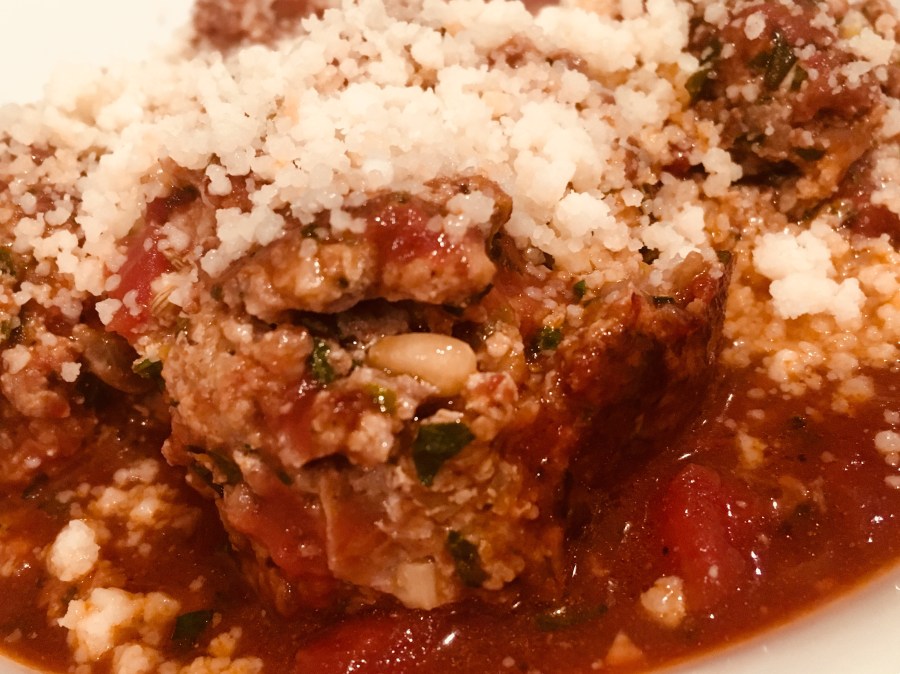
Italian Meatballs with Tomato Sauce

Serves: 4

I’m not sure how you couldn’t love meatballs and I’m especially unsure how you couldn’t love these ones: with the herbs, the cheeses, the pine nuts (and some extra pistachios we added) and more grated Parmesan to serve, they’re awesome.

Prepare the meat mixture in the morning, head out to lunch and come Saturday night, open a bottle of red, put some music on and enjoy some truly excellent meatballs and sauce.

Seriously, they’re excellent.

Ingredients

3/4 cup olive oil
1 red onion, finely chopped
2/3 cup pine nuts, roughly chopped
3 garlic cloves, crushed
40gm parsley, roughly chopped
5g basil or rosemary, roughly chopped
2 tsp fennel seeds
2/3 cup fresh breadcrumbs
1 cup ricotta cheese
1/4 cup grated Parmesan cheese (plus extra to serve)
Grated zest of 1 large lemon
1 egg
500gm minced pork or beef

Sauce

2 x 400gm tinned tomatoes
1/2 cup red wine

Method

  1. Heat half the olive oil in a saucepan and cook the onion and pine nuts over a low heat until the onion is soft and the pine nuts are golden brown. Add the garlic and cook for a few minutes more and then set aside to cool.
  2. Put the herbs, fennel seeds, breadcrumbs, ricotta, Parmesan, lemon zest and egg in a bowl and add the mince. Add the cooled onion mixture, season well with salt and freshly cracked pepper and mix until all the ingredients are combined. Set aside the mixture to rest in the fridge for at least an hour or overnight.
  3. Roll the meatballs about the size of a walnut and flatten slightly to make it easier to cook on both sides.
  4. Heat the remaining olive oil in a large saucepan and fry the meatballs until golden on both sides; do two batches if necessary in order to avoid overcrowding. Remove and set aside.
  5. For the sauce: Add the tinned tomatoes and wine to the saucepan over a medium heat, breaking up the tomatoes. Season with salt and pepper and simmer for 10 minutes. Gently add the meatballs to the sauce and reduce the heat to a gentle simmer. Cover and cook for another 10 minutes.
  6. Serve with a good sprinkling of Parmesan and some fresh basil leaves.