Valeria Necchio’s Casoncelli – Pork, Beef, Raisin and Amaretti Ravioli

Serves: 6

Holy shit, this recipe is just incredible.

“Decident” said Nat. “Marvellous” I said. “I don’t want this to end” said Nat.

And boy, wasn’t that the truth.

Yes, in our pre-baby #4 quest to find the world’s greatest pasta, this is truly, truly in the running.

This pasta separates itself from the wonderful though simple Lidia Bastianich and Antonio Carluccio pastas we have been pushing, taking it up a level in finesse and clarity.

This pasta jumps over this otherwise incredible white ragu, being more sophisticated: less steam train, more race car.

And look, this Rodney Dunn Mushroom Cannelloni with fresh pasta sheets was one of the best pastas we have cooked.

Though in terms of peak genius, this Casoncelli is just so much more refined. Just so much more ‘in the moment’ special.

We used sliced roast beef from the supermarket. Otherwise, everything is straightforward.

Slightly depressed to read this is a common dish in the Bergamo and Brescia parts of Italy, though I guess we’ve always known the Italians have truly the best food lives. I guess we have our beaches here in Sydney however. (I know which I would take!)

If you are like us and want to chase the Saturday-night pasta hit, this my friend is unquestionably the next rung in the ladder.

Ingredients

Pasta dough

Make my Kitchenaid Pasta dough

Filling

1 tbsp unsalted butter
150gm Italian sausage meat, crumbled
100gm roast beef, minced
120gm breadcrumbs
1 medium egg
70gm Parmesean, grated
10gm Amaretti biscuits (about 3), crushed
10gm raisins, soaked, squeezed and then chopped
Fine sea salt
Freshly ground black pepper

Sauce

80gm unsalted butter
80gm pancetta, cut into thin strips
4 sage leaves
80gm Parmesean, grated

Method

  1. Make the pasta per my Kitchenaid Pasta Dough Recipe.
  2. Make the filling: brown the sausage meat with the butter over a medium heat, then add the roast beef and cook for a few minutes, stirring often, so the flavours can mingle together. Transfer to a bowl, then add the breadcrumbs, egg, Parmesean, amaretti and raisins. Season with salt and pepper and stir to combine.
  3. Roll the pasta in a pasta machine to setting 2. Using a round 7 – 8cm ravioli cutter, cut out as many circles of pasta as you can get.
  4. Place a tsp of the filling at the centre of each circle, then gently fold it over to form a half moon. Press the edges together using a fork.
  5. Bring a large pot of salted water to a rolling boil. Meanwhile, in a frypan set over a medium heat, melt the butter for the sauce. Add the pancetta and sage and fry for a few minutes, until crispy.
  6. Cook the casoncelli in boiling water for a few minutes until they float to the top. Drain with a slotted spoon and transfer to the frying pan with pancetta and butter sauce. Sauté for 30 seconds, until evenly dressed.
  7. Serve immediately with a dusting of grated Parmesean.
Mushroom Risotto

Serves: 6

When I was a much younger man, I used to make mushroom risotto all the time.

In hindsight, I used too much white wine and not having the waiting, scalding stock was truly counterproductive.

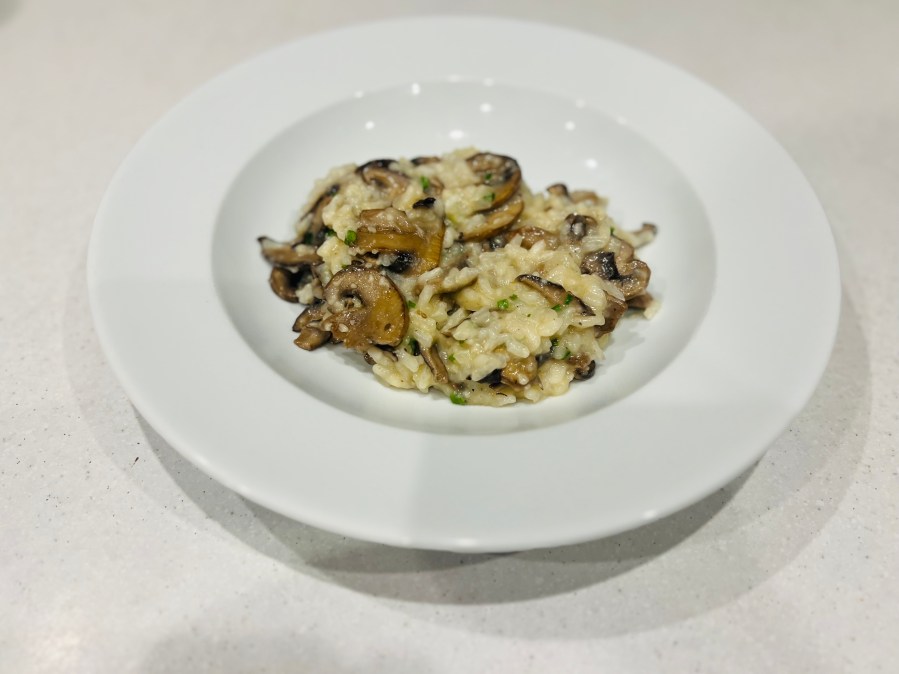
I also didn’t used reserved mushrooms which are half the mushrooms in this recipe, a suggestion of Nat’s and one that just adds meat, epecially with the cup of reserved soaking water. And set aside at least 30 minutes to saute the mushrooms.

Quiet winter Saturday lunch with a glass of white?

I think I am going to get back into mushroom risotto. Nat said it was the best she has had and that for me is the door ajar!

Ingredients

6 c chicken stock or broth, heated in a pan
3 tbsp extra virgin olive oil
500gm brown or other mushrooms, thinly sliced
100gm dried shiitake mushrooms, soaked in boiling water for an hour, then sliced; reserve 1 c of the soaking water
2 eschallots, diced
1 1/2 c Arborio rice
1/2 c dry white wine
4 tbsp softened butter
3 tbsp finely chopped chives
1/3 c grated Parmesean cheese
Sea salt and freshly cracked black pepper

Method

  1. Heat 2 tbsp of the oil in a large frypan and saute the mushrooms for a good 20 – 30 minutes, seasoning to taste. Set aside.
  2. At the same time, add the remaining 1 tbsp oil to a saucepan over a low-medium heat and saute the eschallots for a minute or two. Add the rice, coat with the oil and slowly toast until their colour is pale, golden. About 2 minutes.
  3. Pour in the wine and stir until the wine is full absorbed. Laddle 1/2 c of the hot stock and stir until combined. Continue this process – adding the reserved soaking liquid at some point – until the risotto is creamy.*
  4. Stir in the reserved mushrooms, butter, Parmesan and chives and stir through. Season and serve immediately. With white wine!

* It is a personal preference, though I prefer a creamy risotta and not one with bite. Obviously, cook it to your preference.


Lidia Bastianich’s Linguine with Bacon and Onions

Serves: 4 – 6

I described this recipe to a cooking mate and he said, “so you cooked Carbonara” and I said “sort of, though with onions and less egg yolks” and he said said “so you cooked Carbonara with onions”.

He’s right, though I’m typing it because it is a sensational pasta – one where Nat made our own linguini – as well that the addition of the onions really are lovely, especially with the size of the cut of the onion.

If making your own pasta, we always use this amazing Kitchenaid pasta dough recipe and suggest you do too!

Fresh pasta is your every-time trump card.

Find the thickest bacon you can find, crisp it up, open a good red and this is a thoroughly enjoyable lunch.

Another Lidia win.

Ingredients

Salt
180gm slab bacon, ideally in one piece – or thick bacon
2 tbsp extra virgin olive oil
2 large yellow onions, , sliced 1.5cm thick (about 3 cups)
1 1/2 c hot chicken stock
500gm linguini
3 egg yolks
1 c freshly grated Parmesean cheese
Freshly ground black pepper

Method

  1. Bring a large pot of salted water to the boil.
  2. Cut the bacon into 1cm slices and heat the olive oil in a large, heavy skillet over a medium-high heat. Add the bacon and cook, stirring, untilthe bacon is lightl browned, but still soft in the centre, about 6 minutes.
  3. If there is more and 3 – 4 tbsp of fat in the skillet at this point, pour off the excess. If less, top up to 3 – 4 tbsp with olive oil. Add the onions and cook until wilted though still crunchy, about 4 – 5 minutes. Add the stock, bring to the boil and adjust the heat to a lively simmer. Cook until the liquid us reduced by half.
  4. Meanwhile, cook the pasta until al dente reserving some pasta water.
  5. Laddle a cup of the pasta water and add it to the sauce along with the drained pasta. Bring to the boil, stirring to coat the pasta with sauce and adding stock or water as necessary to make it a generous coat.
  6. Remove the pan from the heat and add the egg yolks one at a time, tossing them through the pasta. Add the grated cheese and black pepper, toss through and serve.

Parmigiano Sformato with Piquillo Peppers and Almonds

Serves: 8

Wow these are good!

This recipe by Anne Burrell is awesome and was one of the dishes we had when our parents – Deb and Rob/Ellen and Bill – met for the first time. A dish, awesome in not just in how elegant and sophisticated it all looks but in the nutty yet beautifully creamy textured taste.

(The meeting of the parents was a complete success for what it’s worth!)

People will know you’re a cooking star and you’ll put the leg-of-lamb-rosemary-garlic crowd to shame when you show them some real preparation, cooking and style.

Move over braised meat. This is preparation and sophistication and it shows.

Do it as a starter and start it right!

(Tip: the cayenne is the zinger here: don’t overdo it though it is the zinger…)

Oh… fast forward two years: we cooked this for our long lunch/wedding and it was THE standout dish. Well. Done. Ellen.

Ingredients

Nonstick cooking spray
2 cups heavy cream
4 eggs
1 cups grated Parmigiano-Reggiano
Salt
1 pinch cayenne
1 jar piquillo peppers, julienned
1/4 c sliced almonds, toasted
2 c arugula or mesclun
Extra-virgin olive oil
4 tbsp sherry vinegar
2 tbsp chopped chives

Method

  1. Heat the oven to 180c. Spray your ramekins with nonstick spray.
  2. In a medium bowl, add the heavy cream, eggs and Parmigiano and whisk to combine. Season with salt and cayenne. Divide the egg, cream, cheese mixture between the ramekins.
  3. Place the filled ramekins in a baking dish and fill halfway with hot tap water. Cover with aluminum foil and bake in the preheated oven for 20 to 25 minutes. Remove from oven and let cool on racks.
  4. Place the cooled sformato in a warm oven for 10 minutes to reheat.
  5. While the sformato is reheating toss the peppers and almonds with the greens and a sprinkle of oil, vinegar and salt.
  6. Arrange some of the pepper mixture on individual serving plates. Unmold the sformato on the serving plate and arrange the peppers against the sformato. Drizzle with olive oil.
  7. Sit back and observe your slightly stunned guests.

Neil Perry’s Pan-fried Polenta

Serves 4

If you cook this and serve it with a roast or a braise, it will replace mash as your go-to side. Hands down, money on it.

It is a Neil Perry dish (tick) and it continues (as far as I know) to be served in Qantas First and Business Class (tick). It can be prepared beforehand (tick) and people’s eyes light up when they taste it (tick).

It’s creamy, it tastes great, it sops up all the juices on the plate and it can be reheated the next day.

Tick tick tick.

None of us cook enough polenta. This dish will resolve that for you.

Ingredients

2/3 cup (100g) polenta
1 1/2 cups (375ml) milk
1 cup (250ml) chicken stock
1 teaspoon sea salt
1/2 cup (50g) finely grated Parmesan
50g unsalted butter, chopped well
Freshly ground pepper
Extra virgin oil

Method

  1. Lightly grease a rectangular baking tin (or small baking dish as I did). Line the tin with baking paper.
  2. Bring the milk, stock and sea salt to scalding point (just below boiling point) in a large saucepan.
  3. Gradually shower the polenta into the milk mixture, stirring continuously with a whisk.
  4. Simmer, still stirring for about 40 minutes, or until the polenta is very thick and pulls cleanly away from the side of the pan.
  5. Remove from the heat, stir in the parmesean, butter, salt and pepper to taste.
  6. Spread the polenta immediately into the tin and allow to cool slightly. Cover and refrigerate for about 3 hours, or until firm.
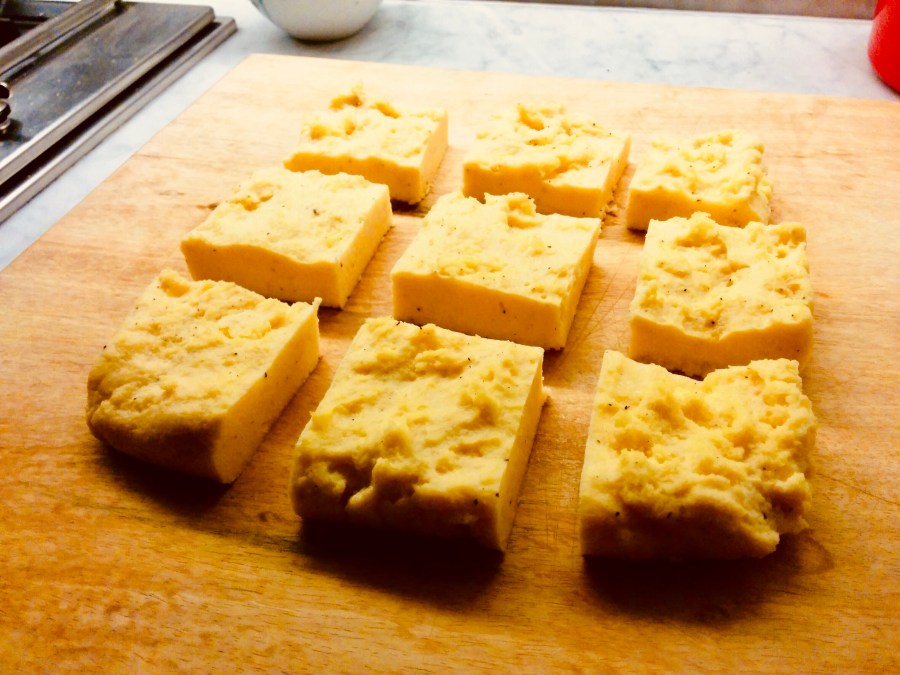
  7. Run a sharp knife around the edges of the tin and gently turn out the polenta. Cut into eight slices thick.
  8. Quickly pan-fry the polenta slices in a little olive oil on both sides until lightly browned.