Lidia Bastianich’s Leek and Ricotta Tart

Serves: 6 – 8

My father-in-law – also a Rob – and I have a shared passion for classic, old-school, home-cooked Italian.

If you follow my blog, you’ll know I have typed up many of Antonio Carluccio’s recipes, as just one example of the old-school Italian Rob and I enjoy so much.

I helped Rob with a few jobs at the start of the year and as thanks, he gave me Lidia Bastianich’s cookbook, ‘From Our Family Table to Yours’. (If you wanted to know the way to my heart, buy me a cookbook and preferably, one written by Lidia!)

And yes, I have previously typed up many Lidia Bastianich recipes. She is a genius.

Rob suggested I kick off the book by cooking Lidia’s Leek and Ricotta Tart.

To summarise the end-result, Tom, our 13-year old food critic simply said, “this is brilliant”. And he wasn’t wrong.

I love anything with ricotta and the leek is a wonderful addition.

For a long, homely Italian lunch or dinner, kicking-off the meal with this tart would very much set the scene for a special meal ahead.

Divertitevi!

Ingredients

For the dough

1 1/2 c all-purpose flour plus more as needed
1/2 c freshly grated Parmesean
2 tsp sugar
1/2 st salt
1 large egg yolk (save the white for the filling)
7 tbsp unsalted butter, cold, cut into bits

For the filling

3 tbsp unsalted butter, plus more for the baking pan
2 large leeks, white and light green parts, halved vertically, sliced 2cm thick
4 spring onions, chopped
Salt and freshly cracked black pepper
1 large egg white (yolk used in the dough)
1 c fresh ricotta (I used smooth)
1/2 c freshly grated Parmesean, plus more for sprinkling
1/4 c chopped fresh Italian parsley
Pinch of freshly grated nutmeg
1 large egg, beaten, for an egg wash

Method

  1. For the dough: combine the flour, grated cheese, sugar and salt in a food processor, and pulse to combine. Beat the egg yolk in a spouted measuring cup with 1/3 water.
  2. Scatter the butter pieces over the flour, and pulse until the mixture is lumpy. Drizzle in the egg-yolk mixture, and pulse until the dough comes together, adding a little more water or flour as needed. Move the dough to a floured counter, and knead it a few times to bring it together. Form it into a disk, wrap is plastic wrap, and chill until just firm, about 1 hour.
  3. For the filling: melt the 3 tbsp butter in a medium skillet over a medium heat. Add the leeks, and cook, stirring often, until they’re tender: about 10 minutes. Add the scallions, and continue to cook until they are wilted but the green parts are still green: about 4 minutes. Season with 1/2 tsp salt and several grinds of pepper, and let it cool.
  4. Beat the egg white in a large bowl until foamy. Add the cooled leeks, the ricotta, 1/2 c grated cheese, parsley, and nutmeg. Season with 1/2 tsp salt and stir to combine.
  5. Preheat the oven to 180c with a rack in the bottom third. Butter a large 18cm cake pan. Roll the dough on a piece of baking paper to a circle about 30cm in diameter and lay it in the buttered pan. Add the filling, and spread it to an even layer. Fold the overhanging edges in to make a crust on the edges. Brush the crust with the egg wash, and sprinkle all over with the grated Parmesan.
  6. Bake until the filling is set and deep golden brown and the crust is golden on the edges: 40 – 50 minutes. Remove to a rack to cool. Serve or warm or at room temperature, cut into wedges.

Lidia Bastianich’s Onion and Potato Gratin

Serves: 8

This is a classic, if slightly inelegant gratin.

And that’s what I love about it.

Thicker slices or potato and onion when compared to the far thinner slices of potato when we cook a French gratin.

The addition of the sage and bay leaves and the two types of cheese just adds to the comfort.

Nothing revolutionary here, though as a side, you’re just going to make people very happy.

Ingredients

2 tbsp unsalted butter plus more for the baking dish
2 large white onions, thickly sliced
Sea salt
8 large, fresh sage leaves
1 c heavy cream
1 c whole milk
2 fresh bay leaves
1 kg medium potatoes, peeled and sliced 1cm thick
170gm Italian Fontina, grated (I substituted Gruyère)
3/4 c freshly grated Grana Padano or Parmesan

Method

  1. Butter a large baking dish and set it aside. Preheat the oven to 200c.
  2. Melt the 2 tbsp butter in a medium pan over medium heat. When the butter is melted, add the onions, season with 1 tsp salt and cook, stirring occasionally, until the onions are wilted, about 10 minutes.
  3. Add the sage leaves, let them sizzle for a minute, then add the cream, milk and bay leaves. Bring to a simmer and season with 1 tsp salt. Add the potatoes, and simmer just to combine, 3 – 4 minutes.
  4. Add the cheeses to a medium bowl and toss to combine them. Transfer half of the potato-cream mixture to the baking dish and spread in an even layer. Sprinkle with half of the cheese mixture. Repeat with the remaining potatoes, then the cheese. Cover the baking dish with foil, and bake until it’s bubbly and the potatoes are tender, about 30 minutes. Uncover, and bake until the top is golden brown and crusty and the potatoes have absorbed the cream and are no longer soupy (it will thicken up more as it cools as well), about 30 minutes. Discard the sage and bay leaves. Let cool for 10 minutes before serving.

Lidia Bastianich’s Linguine with Bacon and Onions

Serves: 4 – 6

I described this recipe to a cooking mate and he said, “so you cooked Carbonara” and I said “sort of, though with onions and less egg yolks” and he said said “so you cooked Carbonara with onions”.

He’s right, though I’m typing it because it is a sensational pasta – one where Nat made our own linguini – as well that the addition of the onions really are lovely, especially with the size of the cut of the onion.

If making your own pasta, we always use this amazing Kitchenaid pasta dough recipe and suggest you do too!

Fresh pasta is your every-time trump card.

Find the thickest bacon you can find, crisp it up, open a good red and this is a thoroughly enjoyable lunch.

Another Lidia win.

Ingredients

Salt
180gm slab bacon, ideally in one piece – or thick bacon
2 tbsp extra virgin olive oil
2 large yellow onions, , sliced 1.5cm thick (about 3 cups)
1 1/2 c hot chicken stock
500gm linguini
3 egg yolks
1 c freshly grated Parmesean cheese
Freshly ground black pepper

Method

  1. Bring a large pot of salted water to the boil.
  2. Cut the bacon into 1cm slices and heat the olive oil in a large, heavy skillet over a medium-high heat. Add the bacon and cook, stirring, untilthe bacon is lightl browned, but still soft in the centre, about 6 minutes.
  3. If there is more and 3 – 4 tbsp of fat in the skillet at this point, pour off the excess. If less, top up to 3 – 4 tbsp with olive oil. Add the onions and cook until wilted though still crunchy, about 4 – 5 minutes. Add the stock, bring to the boil and adjust the heat to a lively simmer. Cook until the liquid us reduced by half.
  4. Meanwhile, cook the pasta until al dente reserving some pasta water.
  5. Laddle a cup of the pasta water and add it to the sauce along with the drained pasta. Bring to the boil, stirring to coat the pasta with sauce and adding stock or water as necessary to make it a generous coat.
  6. Remove the pan from the heat and add the egg yolks one at a time, tossing them through the pasta. Add the grated cheese and black pepper, toss through and serve.

Lidia Bastianich’s Ziti with Broccolini and Sausage

Serves: 4

Excited! Nat is just over five months pregnant with baby #4, our first girl!

The spell is broken!

Our schedule of long lunches has been tempered somewhat and much less wine is being decanted. Though we’re having a girl!

It hasn’t meant the cooking has dialed down however. Quite the opposite.

Nat has gone headfirst into dough. Breads, pastry and pasta.

Especially the pasta, where we are determined with each cook to find just brilliant pasta. Stuff that screams: how good is life.

It starts with fresh pasta. In this instance, ziti, a small thin tube similar to a penne.

If making your own pasta, we always use this amazing Kitchenaid pasta dough recipe and suggest you do too!

And this sauce. Which I have adapted slightly and which is just sublime.

Almost as good as it gets. The second pasta we have cooked with a residual liquid which is just fun, so bloody good. Half the point of the dish. (Check out this white ragu which is just incredible.)

My point on the adaptation is a few.

I found the recipe on Lidia’s website and it didn’t quite translate.

I’ve crumbled the sausage meat here. Halved the broccoli and then used broccolini instead, which I cut into 3cm pieces. And guessed at the butter – measurement missing otherwise – which based on her previous recipes, was on the mark.

As Nat says, you need things to look forward to during the waiting period and pasta seems to have become our thing. No complaints there and absolutely no complaints with this pasta.

Sublime as I said. 1 hat good. Totally great restaurant stuff.

Ingedients

1 tbsp olive oil
500gm Italian sausage meat, removed from skins
500gm broccolini
3 tsp sea salt
500gm ziti
3 large garlic cloves, crushed
1/4 tsp salt
1/4 tsp chilli flakes
1 c chicken stock
3 tbsp unsalted butter
1/2 c grated Parmesan

Method

  1. Heat the olive oil in a pan over a medium-heat and pan fry the sausage meat, breaking it up as you go. Fry until slightly browned, drain from the oil and set aside.
  2. Wash the broccolini, drain and cut into 3cm pieces.
  3. Heat a large pot with boiling water and cook the ziti until al dente.
  4. In a large, deep, heavy skillet with a fitted lid, heat the olive oil, add the garlic and sauté, uncovered until golden, about 2 minutes. Add the broccolini, 1/4 tsp salt and pepper flakes, cover, and steam 5 minutes, stirring occasionally.
  5. Stir in the sausage. Add the butter and stock and cook uncovered, over a high heat, about 3 minutes, until the liquids are slightly reduced.
  6. Add the drained pasta to the sauce and toss gently. Sprinkle on half the cheese, toss again, serve immediately and distribute the remaining cheese over the pasta.

Lidia Bastianich’s Tagliatelle with Walnut Pesto

Serves: 6

First, I used rigatoni here and I am really glad I did.

Secondly, I almost did not type it.

Initially at least, as a main, it was a bit overwhelming.

All those walnuts. Lovely, though unusual and together with the ricotta and the Parmesan and the butter, quite something.

Indeed, we both agreed lovely, though maybe as a starter.

The next day though, I took a box to work with some sprinkled Parmesan and wow. What a lunch.

Not a low-cal lunch by any stretch, though what a bloody treat. I couldn’t get enough.

And then Nat messaged me and whilst she had a mush smaller serve, also agreed that it was just bloody wonderful.

So do it with rigatoni. And let it sit in the fridge for a day.

Because as with every Lidia Bastianich recipe, you’re onto a winner. Even if it does take one more day to fully get there.

Ingredients

2 cups walnut halves or pieces, toasted
2 plump garlic cloves, peeled
1 1/2 c ricotta
6 tbsp extra-virgin olive oil
6 tbsp grated Parmesan plus extra for serving
3 tbsp chopped fresh Italian parsley
1 tsp salt
Freshly ground black pepper to taste

For the pasta

1 batch tagliatelle (use 500gm rigatoni)
3 tbsp soft butter

Method

  1. Heat the water to a boil ready for the pasta.
  2. Put the walnuts and garlic in a food processor and pulse until the nuts are chopped into very tiny bits, though not a powder. Scrape the nut-garlic mixture into a bowl and stir in the ricotta, olive oil, Parmesan, parsley, salt and pepper, until thoroughly blended.
  3. Cook the pasta and when cooked, working quickly, and add to the walnut pesto. Drop the soft butter into the mixture, stirring to combine.
  4. Serve immediately in warm bowls, with more grated Parmesan at the table.

Lidia Bastianich’s Shepherd’s Rigatoni

Serves: 6

I am now two for two with Lidia’s recipes.

Two pastas down – two incredible pastas down – and both needing to be typed up.

I’m going to put her into the Antonio Carluccio class of chefs where everything will be brilliant.

Indeed, his rustic pasta is yet more proof that the simplest pastas can not only be the best, though can be the most sophisticted. Long Sunday-lunch sort of stuff.

This will most definitely be cooked again.

Ingredients

500gm sweet Italian sausage, removed from casings
1/4 c extra virgin olive oil
1/2 tsp chilli flakes
500gm rigatoni
1/2 tsp salt
1/4 c grated Parmesan
1/2 c loosly packed basil leaves, shredded

Method

  1. Bring a pot of salted water to the boil to cook the pasta.
  2. For the sauce, crumble the sausage meat in a bowl, breaking into small clumps with your fingers. Pour the olive oil into a skillet and set it over a medium-high heat. Sprinkle in the chilli flakes and toast for a few seconds., then scatter the crumbled sausage meat in the pan. Cook the sausage, stirring and breaking up any clumps, for 10 minutes or so, as the meat juices are released and cook away, until it is all well browned and crispy.
  3. Meanwhile, while the sausage is cooking, drop the rigatoni into the boiling water, stir and cook to the boil. When the sausage is browned and crisp, laddled about 1/2 cup of the pasta cooking water into the skillet, and deglaze the pan bottom, scrapping up the browned bits. Season the sausage meat with the salt, and stir with the bit of moisture in the pan.
  4. When the pasta is al dente, lift it from the pot, drain briefly and drop in into the skillet. Toss the rigatoni and sausage together, then turn off the heat and stir in the ricotta and Parmesan. Scatter the basil on top and toss well to dress the pasta evenly. Heap the ragatoni in warm bowls and serve immediately with extra Parmesan.

Lidia Bastianich’s Pasta with Baked Cherry Tomatoes

Serves: 6

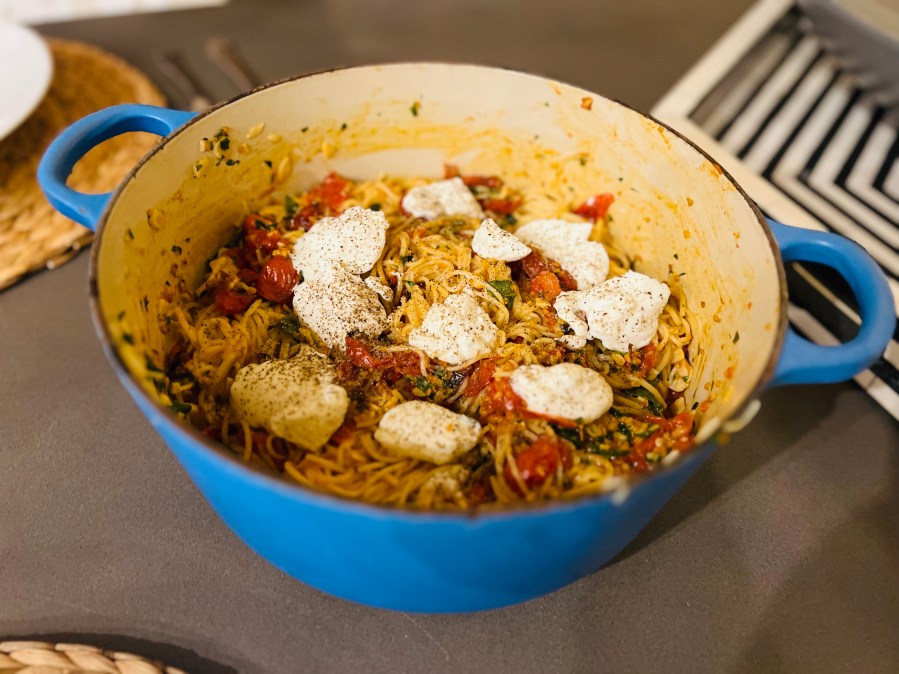
Goodness, I did not expect my first Lidia pasta to be this good.

As in, immediately one of Nat’s absolute favourites of all time and better than my abbriata which until then was the favourite of all time!

It’s much more than a baked cherry tomato pasta.

It’s all that garlic, fried and then fast boiled in the pasta water; the subsequent frying off of the parsley. The basil. The chilli, The parmesan.

And the addition of the ricotta adding all that creaminess.

Absolutely lovely.

Hats off Lidia. Your book will be revisited imminently

Ingredients

1.5kg cherry tomatoes, halved
1/2 c plus 1 tbsp extra-virgin olive oil
1/3 c fine dry breadcrumbs
1 tsp salt, plus more for the pasta pot
1/4 tsp chilli flakes, or to taste
500gm spaghetti, gemelli or penne*
10 plump garlic cloves, peeled and sliced
2 tbsp chopped fresh Italian parsley
1 c loosely packed basil leaves, shredded
1/2 c freshly grated parmesan
125gm ricotta

Method

  1. Heat the oven to 180c. Toss the cherry tomato halves in a large bowl with 3 tbsp of the olive oil. Sprinkly over the breadcrumbs, salt and chilli flakes and toss well to coat the tomatoes evenly. Pour the tomatoes onto a baking tray lined with baking paper and spread them apart in a single layer. Use a second tray if necessary. Bake until the tomatoes are shriveled and lightely caramelised (though not dried out), about 25 minutes in all.
  2. Meanwhile, fill a large pot with salted water and heat to a rolling boil. When the tomatoes are nearly done, drop the pasta into the pot, stir and cook.
  3. As soon as the pasta is cooking, pour the remaining olive oil into a big skillet, set over a medium-high heat and scatter in the sliced garlic. Cook for a minute or two, until it is sizzling and lightly coloured, then ladle in about 2 cups of the pasta cooking water, and bring to a vigorous boil, stirring up the garlic. Let half the water evaporate**, stir in the chopped parsley, and keep the sauce barely simmering.
  4. As soon as the tomatoes are done, remove them from the oven.
  5. When the pasta is al dente, lift it from the water, drain for a moment, and drop it into the skillet, still over the low heat. Toss the pasta quickly with the garlic-and-parsley sauce in the pan, then slide in the baked tomatoes on top of the pasta. Scatter the basil shreds all over, toss everything together well, until the pasta is evenly dressed and the tomatoes are distributed throughout. Turn off the heat, sprinkle on the grated parmesan, and toss once more.
  6. Mound the pasta in a warmed serving bowl. Shred the ricotta all over the top of the pasta and serve immediately.

* When our builder looks after our house when we are away, he always leaves some damn fine Italian staples he picks up in Five Dock, Sydney. Quite the foodie. Anyway, we used a beautiful packet of spaghettini and it was just lovely.

** I did not read this right and cooked it right down before adding the parsley. Worked, though you can’t go wrong with pasta water in pasta so go with Lidia’s instruction here.