This is such a delightful side, showcasing how the addition of a few simple ingredients can make a vegetable side totally sing.
For a BBQ, this is the sort of dish that makes good, great.
Definitely one to bookmark.
Ingredients
2 bunches of asparagus 2 tbsp rapeseed oil, plus extra to finish 1 tsp sea salt 60gm feta, crumbled 1 tbsp capers Grated zest of 1 lemon Black pepper
Method
Snap off the tough ends of the asparagus and discard. Toss the spears in the oil and sprinkle with the salt and pepper. Lay the asparagus in a hot griddle pan, placing them perpendicular to the ridges of the pan. Cook for 6 – 9 minutes, turning occasionally, or until just al dente and lightly charred.
Arrange the asparagus on four serving plates. Sprinkle over the feta, the capers, lemon zest, more pepper and a drizzle more of the oil.
Before diving into this quite excellent recipe, it has been a few months since my last post.
It is not that we haven’t been cooking and eating well, though, since my last post, Nat and I have welcomed a little baby girl to the family: Avalon.
I can’t blame sleepless nights. Avalon has been an absolute dream and has slept from 7pm to 7am since she was nine weeks old. Though with Christmas, a few trips thrown in and all the rest of the craziness, typing up recipes has taken a back seat.
I have a real backlog of recipes to get through, though now have the joy of typing, looking at the most beautiful sister to Max, Tom and Oliver. This recipe is for Avalon.
I can’t wait to cook with her in the kitchen.
And now to these fritters.
They are superb.
Chosen and cooked by Nat as part of a bigger Yotam feast, they are so tasty and so soft. Add the sauce and serve alongside this Yotam Ottolenghi Char-grilled Asparagus, and you’ve got an absolutely wonderful weekend meal on your hands.
Ingredients
3 leeks (450gm in total, trimmed weight) 5 shallots, finely chopped 150ml olive oil 1 fresh red chilli, deseeded and sliced 25gm parsley (leaves and fine stalks), finely chopped 3/4 tsp ground coriander 1 tsp ground cumin 1/4 tsp ground turmeric 1/4 tsp ground cinnamon 1 tsp sugar 1/2 tsp salt 1 free-range egg white 120gm self-raising flour 1 tbsp baking powder 1 egg 150ml milk 55gm unsalted butter, melted
Start by making the sauce. Blitz all the ingredients together in a food processor until a uniform green. Set aside for later.
Cut the leeks into 2cm thick slices; rinse and drain dry. Sauté the leeks and shallots in a pan with half the oil on medium heat for about 15 minutes, or until soft. Transfer to a large bowl and add chilli, parsley, spices, sugar and salt. Allow to cool down.
Whisk the egg white to soft peaks and fold it into the vegetables. In another bowl, mix together the flour, baking powder, whole egg, milk and butter to form a batter. Gently mix it into the egg white and vegetable mixture.
Put 2 tbsp of the remaining oil in a large frying pan and place over medium heat. Spoon about half of the vegetable mixture into the pan to make four large fritters. Fry them for 2 – 3 minutes on each side, or until golden crisp. Remove to kitchen paper and keep warm. Continue making the fritters, adding more oil as needed. You should end up with about eight large fritters. Serve warm, with the sauce on the side or drizzled over.
* Substitute a squeeze of lemon or lime juice if you just don’t have the time for the sauce.
It is so classic, so fresh, so moorish. And that splash of white wine!
Do better at your next BBQ and present this. Level up!
Ingredients
1 stick celery, roughly chopped 1 carrot, roughly chopped 1 small white onion, roughly chopped 2 – 3 bay leaves 1 x 600gm octopus, well cleaned (ask your fishmonger to do this) 1 1/4 tbsp rock salt 400gm potatoes 100ml extra virgin olive oil Salt and pepper 1 tbsp finely chopped flat-leaf parsley 1 clove garlic, finely chopped Good splash of dry white wine
Method
Put the celery, carrots onion and bay leaves in a large saucepan, add 2 litres of water and bring to the boil. Continue boiling over a medium heat for 10 minutes to make a broth.
Take the octopus by the head, with four fingers into it like a handle, and dip it into the boiling broth for 30 seconds. Repeat this two or three times until the tentacles start to curl, then release the octopus into the broth (this process should stop the octopus becoming hard during cooking).
Leave it to boil over a medium heat for 30 minutes, adding some rock salt to taste. Test by piercing with a fork – if it pierces easily, it’s ready; if its still hard, let it cook for a little longer. When it’s ready, remove it from the broth and set aside until it is cool enough to handle with bare hands.* Reserve about 250ml of the broth as you may need it later.
Meanwhile, boil the potatoes in their skins until cooked but not too soft. Leave to cool slightly, then peel and cut into a 2cm dice, Set aside.
Pull each cooled tentacle down lengthways, squeezing at the same time to remove the suction pads and gelatine coating. Chop the flesh into 2cm pieces.
Combine the octopus and potato in a bowl and dress with the oil, salt, parsley and garlic. Mix well, then finish with a splash of white wine to give the salad perfume. If the salad seems a little dry, add some of the reserved broth and to see gently.
“Serve with Amore!”
* When it comes to pulling down the tentacles and gelatine coating, the octopus must be warm or hot.
A couple of years ago, we spent New Years up in Newcastle, about two and a half hours north of Sydney.
We really like Newcastle. We have some very good friends there, the restaurant and bar scene gets better every year and with an AirBNB with a good enough kitchen, the show can go on.
We did a Greek/Mediterranean cook off and Nat made this wonderful salad along-side a braised octopus. Incredibly fresh, a wonderful simplicity of flavour and healthy.
Definitely a keeper for any Greek lunch, and a salad Nat has served a few times since.
Ingredients
2 c dried black eyed beans 1 l chicken stock 1 celery stick, finely diced 1/2 red capsicum, finely diced 1 white onion, finely diced Big handful of Italian parsley leaves, finely chopped Salt and pepper 1 tbsp red wine vinegar 1 tsp extra virgin olive oil Braised octopus optional
Method
Soak the beans overnight.
Heat the stock to a simmer in a large saucepan, add the beans and simmer for 45 minutes or until softened. Drain and set aside to cool.
We used Rainbow Trout here and whilst it is likely a distance from the turbot Josh Niland originally cited as his inspiration for this dish, I think it is an acceptable distance.
Not coral trout sure, though who doesn’t love Rainbow Trout.
Fish over charcoal is always just bloody brilliant. The addition of the salt and vinegar spray misted over whilst we cooked was just an incredible touch.
Nat served it with a celeriac slaw and my goodness, this was two-hat simplicity. Just sublime. Sublime.
An incredible slaw, also from Josh Niland.
We should have dried the skin more and that would have seriously changed the profile. Next time.
The concept was not lost how good this simple approach to BBQing fish really could be.
Stunning.
Ingredients
1 x 1kg whole coral trout, gutted and pin boned 1/4 c best-quality seaweed vinegar or white wine vinegar (not too sweet) 1/2 c extra virgin olive oil Sea salt flakes
Method
About 45 minutes before grilling, remove the coral trout from the fridge and let it come to room temperature.
In a spray bottle fitted with a misting nozzle, shake together the vinegar, olive oil and 1 tsp salt. Set aside.
For the charcoal grill, make sure the grill is hot and the charcoal has cooked down to hot embers. Divide the coals across the floor to create a cooler side and a more intense side of the grill.
Season the coral trout liberally with salt flakes, then either securely skewer lengthways, or place it in a grilling basket; set it over the hot side of the grill. Cook until the skin begins to blister slightly, about 4 minutes, then carefully tun the fish over and cook for another 4 minutes, generously misting the first blistered side with about one-third of the vinaigrette as you go.
Flip the trout back over, and cook the first side for 3 – 4 minutes until the skin is well blistered and the flesh is opaque, misting the second side with half the remaining vinaigrette. The fish is ready when the skin is evenly coloured and the internal temperature registers 44c on a probe thermometer.
Remove the coral trout from the grill and rest on a large serving platter for 8 – 10 minutes, then spoon over the remaining vinaigrette.
Carve the trout, discarding the spine and reserving the collar and head, and transfer the fillets to serving plates. Pour the resting juice from the serving platter into a small saucepan and bring to a simmer, whisking to form a glaze. Spoon the glaze over the fillets and serve right away.
Nat and I love farro; an ancient Mediterranean wheat species.
And it is definitely back in vogue based on the number of salads featuring farro we have cooked the last few years.
As with many (all?) of her recipes, this salad is simply a charming honesty of ingredients. Entirely satisfying to the point that I kept reaching for spoon after spoon.
There is a suggested variation which, whilst I have not cooked, I’ve listed below. It’s the next farro adventure.
Variation
Omit the tomatoes; instead, mix in 50gm raisins (soaked in water for 30 minutes), 50gm lightly toasted pine nuts and the shredded leaves of 3 basil sprigs and 3 mint sprigs.
Ingredients
250gm pear farro or spelt 200gm baby plum tomatoes, halved 1/2 red onion, finely chopped 6 tbsp extra virgin olive oil Juice of 1/2 – 1 lemon, to taste Bunch of flat-leaf parsley, coarsely chopped Salt and black pepper
Method
Soak the farro or spelt in plenty of cold water for 30 minutes. Rinse, drain and put it in a pan with plenty of water to cover. Bring to the boil and simmer until tender, adding salt towards the end. Drain and put it in a serving bowl.
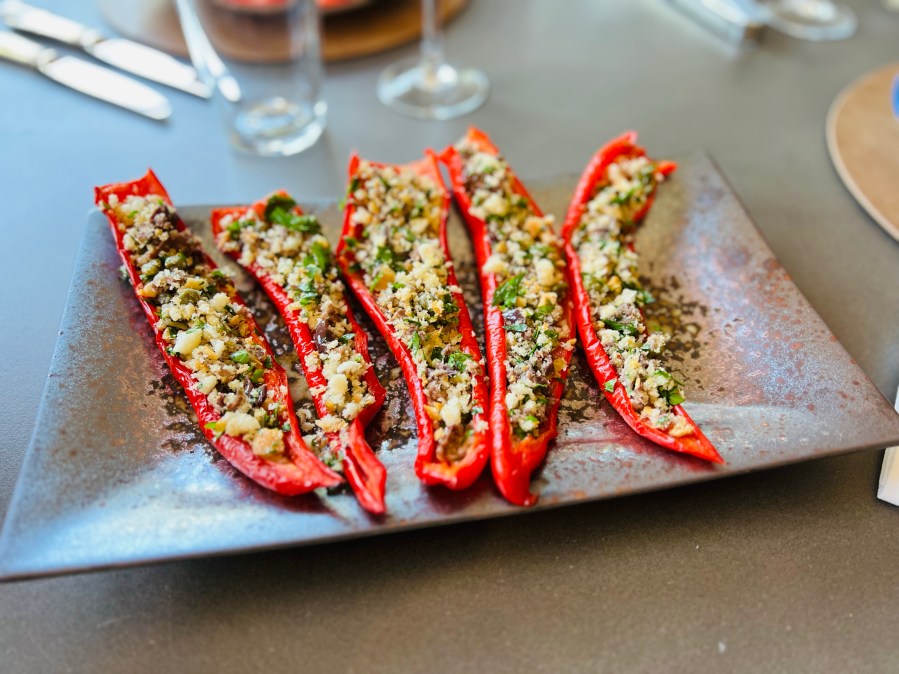
A lightly stuffed Romano pepper, with a fragrant, Mediterranean stuffing of anchovies, olives, capers, parsley, breadcrumbs and olive oil.
This was the first recipe I cooked from Claudia Roden’s new book Med and I am in love. As I type, I am eight recipes in and each has been such a great, simple example of how a few ingredients and flavours can bring so much joy.
This dish could very easily be prepared in advance, mixing the breadcrumbs and parsley with the balance of the stuffing at the last minute.
Lovely.
Ingredients
3 Romano peppers, cut in half lengthways and seeded 6 anchovy fillets in oil, drained and chopped 6 good quality black olives, such as Kalamata, pitted and chopped 1 tbs tiny capers in brine, drained and squeezed Small bunch of flat-leaf parsley leaves chopped 40gm fresh breadcrumbs 3 tbsp extra virgin olive oil
Method
Preheat the oven to 150c. Line a roasting tin with foil and arrange the peppers cut-side up on the foil. Roast for about 30 minutes until they are soft. Leave to cool.
Mix all the remaining ingredients together to make a stuffing. When the peppers are cool enough to handle, put a little stuffing into each and serve at room temperature.


 Robby Dog Cooks