I hate to admit it – and rarely do – though there are go-tos I have when the cooking pressure is on and we have guests for lunch. (Generally speaking we don’t cook many dishes twice.)
This is one of them.
It’s a winner on every level.
It is simple.
It looks incredible: looks that betray its simplicity. Think elegant, yet rustic: provincial.
And predictably: it tastes awesome.
As a starter. As a side. With a salad. With baby potatoes. With dressed-up fries.
Really anyway you can serve it, it’s genius.
There is a reason I’ve plated this half a dozen times at least.
(Which is all I am admitting to!)
Ingredients
1kg salmon (I use ocean trout) filet with skin, pin boned 1 tbsp extra virgin olive oil 3/4 tsp sea salt flakes
Place the salmon on a baking sheet. Drizzle with olive oil and sprinkle the salt evenly over the top. Place in the oven and roast for 40 – 50 minutes, until the fish begins to flake in the thickest part of the filet.
For the salsa, combine the shallot and vinegar for 15 minutes. In a separate bowl combine the herbs, olive oil, salt and a few grinds of pepper.
Flake the salmon into large rustic chunks (on the skin); combine the herb mixture with the shallot mixture, testing the amount of vinegar you need.
This blog has never been about anything but obtainability and this recipe is proof of that.
Nat offered a late mid-week lunch (with a Champagne) if I crunched a tonne of work in the morning (and then again post-lunch) and who was I disagree with the offer to good to refuse.
I initially thought I was up to cook, so headed straight to Gourmet Traveller: I am after all a kid of the 80s.
Nat of course headed straight to Gordon: she’s a kid from the less cooler 90s.
Though turns out I’m the less cooler one.
This is just such a bloody wonderful, obtainable, sorry not-sorry, simple dish.
It well crosses the line of effort and sophistication to smash the boring Chef’s salads I so often serve up on a Saturday after kids’ sport and shopping.
One hat, no. You won, yes.
(And yes: don’t eat farmed salmon. Wild caught salmon is out there and your kids will thank you for it.)
Ingredients
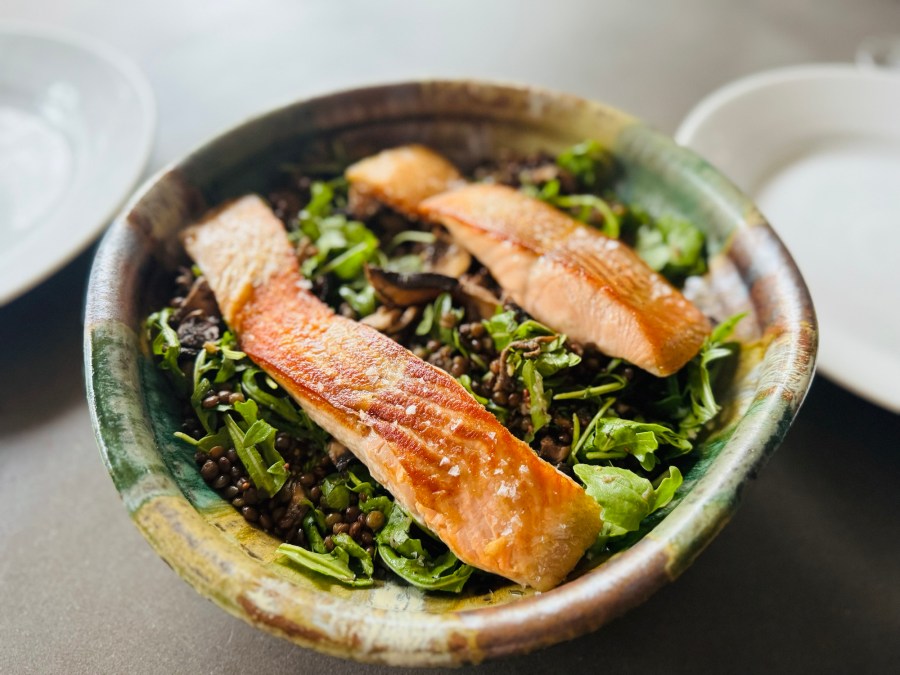
200gm Puy lentils 1 bay leaf 2 thyme sprigs 800ml vegetable stock 1 tbsp olive oil 200gm chestnuts mushrooms, cut into eights 200gm Portobello mushrooms, sliced 2 garlic cloves, peeled and finely chopped 4 x 100gm wild salmon fillets 100gm rocket leaves Sea salt and freshly ground black pepper
For the dressing
1 garlic clove, peeled and crushed 2 tbsp white wine vinegar 1 tsp wholegrain mustard 1 tsp runny honey 1 tbsp extra virgin olive oil 1 tbsp water
Method
Put the lentils into a saucepan along with the bay leaf, thyme and stock. Bring to the boil over a medium-high heat, then reduce to a simmer. Simmer for 15 – 20 minutes until tender.
In the meantime, heat a large-based frypan over a medium-high heat and add the olive oil. Once hot, add the mushrooms with a pinch of salt and cook in the pan for 6 – 8 minutes stirring now and again, until soft and caramelised on the edges.
Add the chopped garlic and continue to cook for 2 minutes, then remove from the heat.
Once the lentils are tender, drain well and discard the herbs. Put the lentils into a large mixing bowl and add the mushrooms. Mix together gently to avoid breaking up the lentils too much.
To make the dressing, put all the ingredients into a clean jar with a punch of salt and pepper. Close the jar, shake until the dressing comes together and emulsifies.
Preheat the grill to high: grill the salmon for 6 – 8 minutes to your liking.
Pout half the dressing over the warm lentils and toss gently to get everything coated. Fold in the rocket, place the salmon on top and pour over the remaining dressing. Serve immediately.
Nat and I had a simple French lunch a Sunday or two ago and I cooked this omelette from Damien Pignolet’s book, ‘french’.
It’s a book I have had for years and it’s just lovely 80s and 90s French from his various restaurants. (If you haven’t, Bistro Moncur in Woollahra is a wonderful long lunch!)
This omelette is predictable delicate and just a lovely way to kick things off; I doubled it so that we had a small omelette each.
Enjoy.
Ingredients
1 whole egg 1 egg yolk 2 tsp crème fraîche 2 tsp pine nuts, toasted until pale golden 1/4 tsp thyme leaves 1 tsp unsalted butter 2 tsp rosemary oil (below) 1 tbsp rindless mature goat’s cheese, broken into small pieces
Method
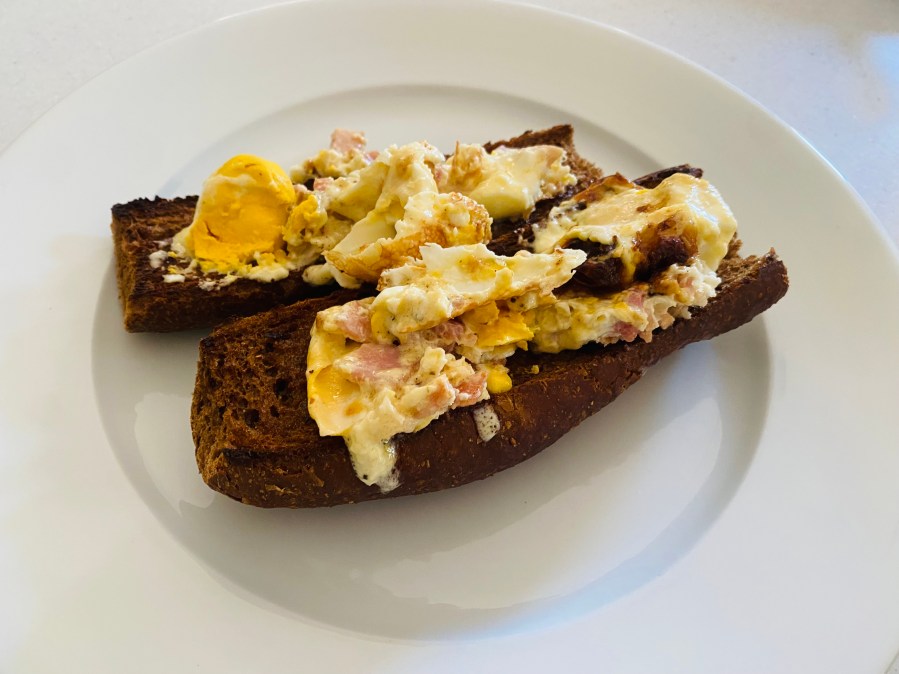
Place the egg, egg yolk, crème fraîche, and pine nuts in a small bowl for each omelette. Season with a tiny pinch of salt, freshly cracked black pepper and thyme leaves. Using a fork, break the eggs and yolks, lightly mixing the ingredients so that streaks of white and yolk are still visible – this ensures lightness of texture in the omelette.
Heat the butter and rosemary oil in a blini pan, pour in the egg mixture, wait a moment for it to set, then shake the pan and, using a spatula or fork, draw the cooked egg away to allow the raw mixture to flow underneath and cook. While the omelette is still quite moist, add the goat’s cheese, flip half the omelette over and turn out onto a warm plate.
Rosemary oil
To make the rosemary oil, put 4 tbsp of olive oil in a small ovenproof bowl with 2 tbsp rosemary leaves and place in a 150c oven for 10 minutes. Allow to cool then strain into a bowl or storage jar; the oil will keep for several days. This quantity is enough for 9 tiny omelettes. Rosemary oil can also be used to sauté potatoes, along with some garlic, or to brush on a small fish such as red mullet before grilling.
Nat found this recipe on Instagram and whilst we have been plenty burnt by Instagram and TikTok recipes in the past, just watch the video below and tell me we should/could have moved on?!
Like our signature Snapper Pie from The Boathouse, this pie is a labour of love. Time is your friend here. From roasting the chicken the night before. The gravy reducing for hours. The baked potato mash (will I ever do a mash that isn’t baked potato again?).
And of course, homemade shortcrust which is absolutely essential.
The sum of the parts is extraordinary. This is a signature pie. We almost feel embarrassed to have cooked a chicken pie prior to this one.
The gravy was probably the finest gravy I have ever had. Together with the pie and that incredible crust; and that mash. I am not overstating it. This is 2-hat cooking, a recipe they would never manage to take off the menu. We both agreed, a chicken pie could surely not go further. We’d well and truly found the outer limits of what a chicken pie could be.
It was a rainy Sunday in Autumn in Sydney when we (Nat) cooked this. A decanted 2019 Barolo. And it frankly doesn’t get better.
Ingredients
For the chicken 1 large free-range chicken 1/3 c extra virgin olive oil Salt and freshly cracked pepper 1 large eschalot, peeled 1 lemon, halved 4 garlic, peeled Two sprigs of rosemary
For the chicken filling 3 tbsp extra virgin olive oil 250gm streaky bacon, chopped 1 white onion, finely chopped 1 leek, white and green parts thinly sliced 2 garlic, thinly sliced and rubbed well through salt 1/2 bunch of flat-leaf parsley finely chopped 2 tbsp Dijon mustard Salt and freshly cracked pepper 2 1/2 tsp softened, unsalted butter 1 tbsp plain flour 1/2 c hot chicken stock 1 egg, lightly beaten for egg wash
For the gravy 1/4 c extra virgin olive oil 1 white onion, chopped 2 carrots, coarsely chopped 1 stick of celery, coarsely chopped Half a bunch of flat-leaf parsley including the stalks 7 peppercorns A good splash of Madeira (or sherry)
For the shortcrust pastry 1 c plain flour 1/2 tsp salt 115gm cold, unsalted butter cut into cubes 3 tbsp ice water
For the mashed potatoes 5 large, unwashed potatoes 1/2 c cream 80gm unsalted butter Salt
Method
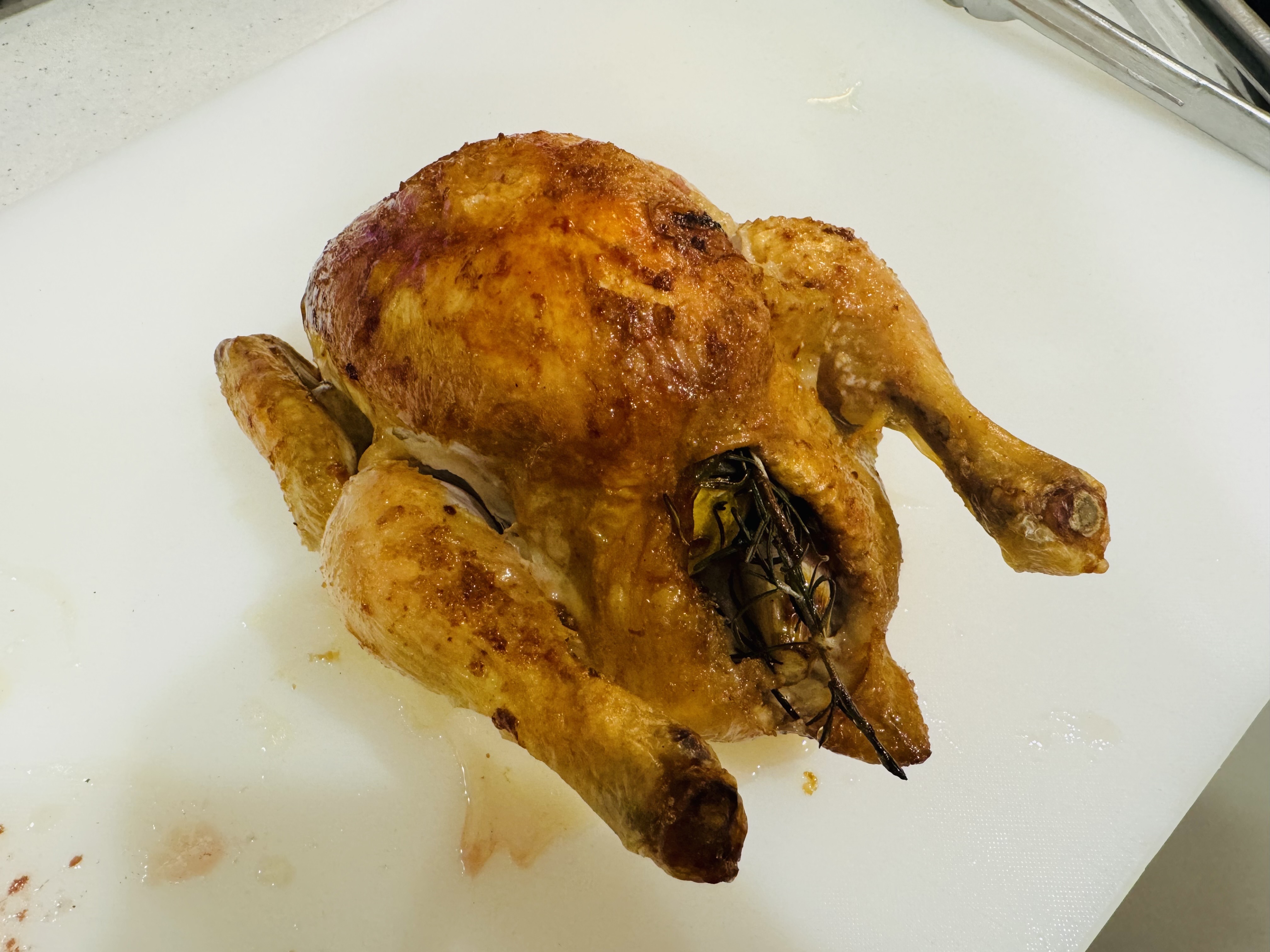
Heat the oven to 200c. Rinse the chicken and stuff the cavity with the eschalot, lemon, garlic and rosemary. Drizzle over the olive oil and season well. Roast in a roasting pan for 1 1/4 hours or until cooked through, basting occasionally with the oil and juices.
Set aside and allow to cool slightly Remove and discard the skin. Remove all the flesh, chop coarsely and place in a large mixing bowl. Discard the ribs. Combine the bones and remaining chicken and juices and set aside to make the gravy.
In a fresh pan, cook off the bacon until slightly browned and set aside.
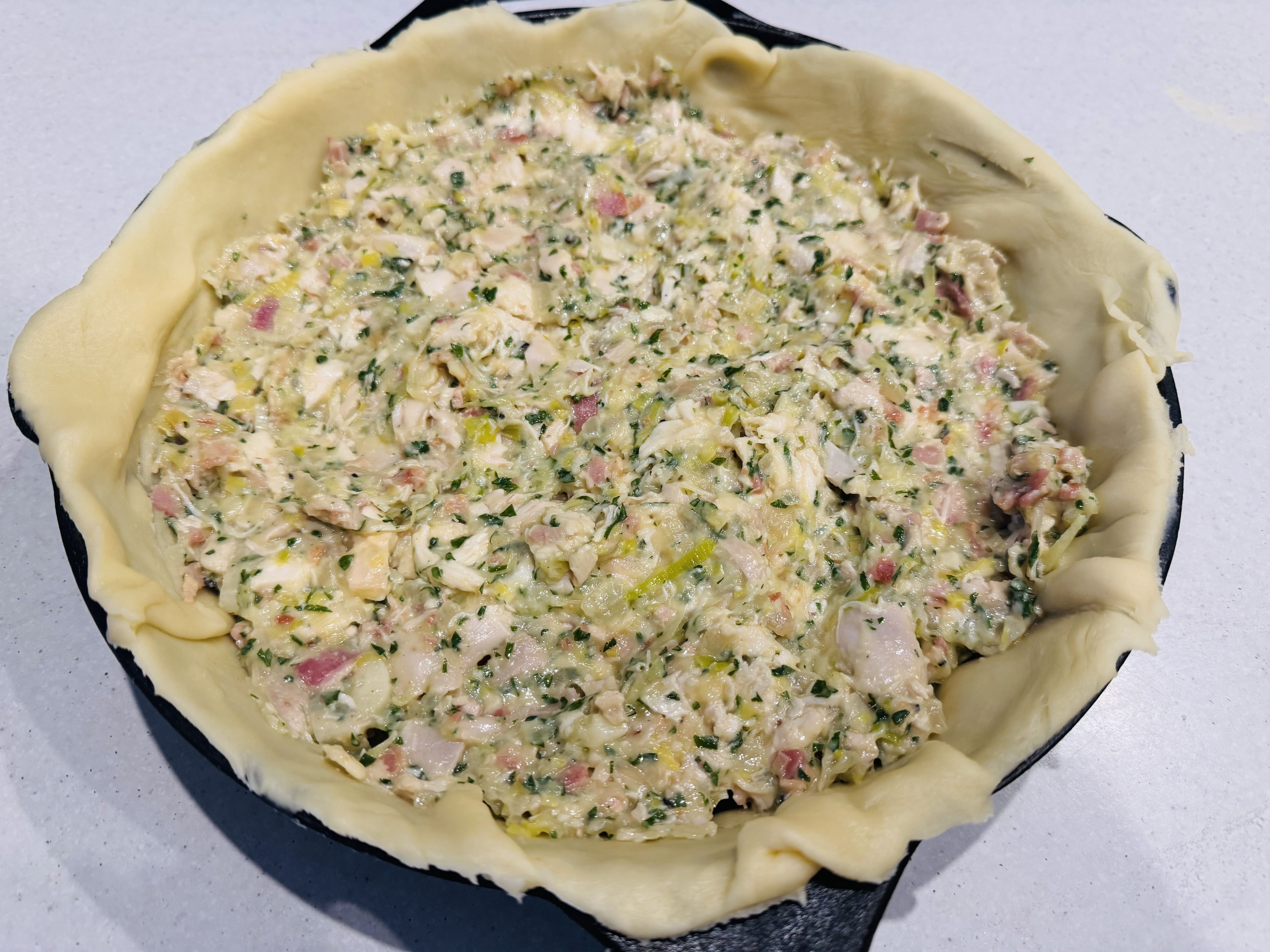
In a separate pan, heat the oil over a medium heat and sauté the onion until soft. Add the leeks and continue cooking until softened. Turn down the heat and add the garlic, cooking for a few minutes and finally add the cooked bacon. Take off the heat and stir through the cooked chicken flesh, parsley and mustard. Season with pepper.
In a pan, heat the butter until bubbling. Add the flour, whisking constantly. Slowly pour in the chicken stock, continuing to whisk until you have a thickened mixture. Add to the chicken mixture, stir through and set aside.
For the gravy, heat the olive oil over medium-high heat and add the chicken bones and juices, sautéing for a few minutes. Add the the vegetables and the peppercorns, cook until softened and then cover with boiling water and add a few splashes of the Madeira. Reduce the heat, cover and cook down until you’re close to a gravy consistency. Check the seasoning, strain and set aside.
For the shortcrust pastry, put the flour and salt in a food processor. Add the butter and process, cutting the butter into the flour until you have a coarse meal. Add the cold water and process for 30 seconds until you have a soft dough. Remove the dough, shape it into a thick dough, wrap tightly in cling wrap and refrigerate for at least 2 hours. Bring to room temperature prior to rolling.
For the mashed potatoes, heat the oven to 180c. Wash the potatoes well and spike all over with a fork. Bake on a baking tray for 1 1/2 hours or until cooked through. Set aside to slightly cool. Peel by hand, removing and setting aside the flesh. Heat the butter in a saucepan and using a ricer, rice the potato flesh, adding it to the butter. Add the cream and season with salt, adding more butter or cream as need-be.
Heat the oven to 220c. Lightly oil your pie tin. Roll out your shortcrust pastry and line the tin. Fill with the chicken mixture. Cover the pie with more shortcrust pastry, sealing well with a fork. Trim the edges and brush all over with the egg wash. Create a small hole in pie to let the steam escape and bake for 30 minutes or until golden.
Send the kids to their rooms. Have a bottle of good red decanted. Serve the pie with the mash and plenty of gravy and goddam, enjoy.
Nat started with a freshly baked baguette: cheese, pâté, cured meat.
What a way to start with a cold lager!
And then this dish.
Something to smile about afterwards? You absolutely bet!
This was French Bistro as good as you could imagine. Absolutely impossible to fault.
So Hubert Keller? I’d never heard of him, though he trained under Paul Bocuse, the father of modern French cooking who undisputedly set the benchmark for this style of French cuisine. (Fun fact: my parents went to a dinner he hosted in Sydney and Mr Bocuse signed a menu for me. I still have it!)
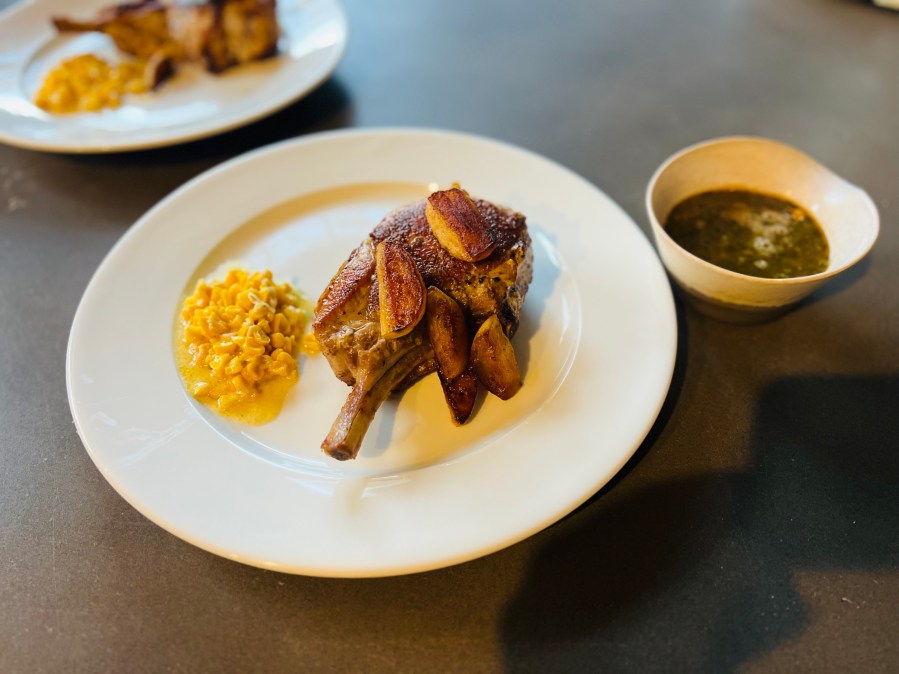
And then this cut of pork. I’ve mentioned our amazing local butcher Hummerstons and a quick text to Steve and he had it under control. 2 double pork chops with 1 bone removed, about 4cm thick. Talk about a dramatic presentation!
Nat and I debated using a thinner pork chop as an easier entry to this dish, though absolutely do not cut corners. If ever there was a time to engage your butcher and have the double chop, it is this.
The roasted cream corn with the spring onions and parmesan is just luxury and pairs perfectly with the pork and the apple. Did I mention smiles?
Occasionally you wander onto a dish that is a hero and this is one of them.
It is rude however to suggest that Nat wanders into anything when it comes to food.
This was always going to be an extraordinary meal and mopped up with a homemade baguette and glass of light red, very hard to argue that life isn’t great.
P.S. Nat says start the corn first.
Ingredients
2 double pork chops with 1 bone removed, 4cm thick 2 tsp salt 1 tsp black pepper 2 tbsp olive oil 4 Fuji apples 2 tbsp butter 3/4 c Calvados apple brandy* 1 c apple cider 1 c chicken stock 2 tbsp chives, thinly snipped
Creamed Corn
2 ears corn, husks removed, both ends trimmed 2 tbsp softened butter Pinch salt Pinch pepper 1 c heavy cream 1/2 c chicken stock 1/2 tsp salt 1/4 tsp pepper 1 tsp fresh ginger, minced 2 stalks spring onion, thinly sliced 1/4 c Parmean cheese grated
Method
Peel the apples and cut each into 6 wdges. Cut out the cores, and trim each wedge into a football shape. Reserve all peels and trimmings.
In a small sauté pan, melt butter and add apple wedges. Coover over a medium heat, stirring occasionally, until apples are browned and softened, 10 – 12 minutes. Set aside. Season both sides of the pork chops with salt and pepper and in a sauté pan large enough to hold both pork chops, heat oil until smoking.
Lay pork chops into hot oil and sear approximately 7 minutes on each side until golden brown and the internal temperature is at 62c. **
Remove from the pan and cover with foil to keep warm whilst you make the sauce. Discard half the fat and trimmings from the pan, then add apple trimmings and sauté over medium-high heat for a few minutes.
Add Calvados and apple cider, and bring just to a boil. Reduce the heat and allow to simmer for 5 minutes, or until it becomes thick, with a syrup-like consistency. Add chicken stock and simmer for 5 minutes. Strain the sauce through a fine mesh strainer, pushing down on the apple trimmings with the back of a spoon to remove all juices.
Put the sauce back in the pan over low heat and add the chives. Taste and adjust for seasonings.
For the creamed corn, heat the oven to 180c. Brush the corn with butter and season with salt and pepper. Warp each corn ear in foil and roast in the oven for 30 minutes, or until the corn starts to brown.
Unwrap the corn and when cool enough to handle, slice off the kernels. In a small saucepan over a medium-heat, combine cream, ginger, salt and pepper and reduce by one-third, 5 – 7 minutes. Add the corn kernels and chicken stock to reduced cream and cook for 10 minutes, or until cream thickens and is absorbed by the corn.
Remove corn from the heat, and stir in the spring onions and Parmesean cheese.
Served the pork, with apple wedges, corn alongside and the sauce ready to pour.
* Substitute 1/2 c brandy and 1/4 c apple juice.
** This will take longer. Potentially finish off in the oven if the internal temperature is rising too slowly.
I’m not the pastry or dessert person in our house, though I have come to appreciate that the French really did understand that you really don’t need to go overboard to achieve something truly delicious.
And this is a classic example of that. Chaussson aux Pommes.
This is such a classy, self-contained number.
Largely pre-prepared and something you could happily eat the next day with a coffee.
I spend my time on the savoury. The first and second course. Decanting the wine. Etc.
Though jeez I am happy for the slight stretch to include these in our last meal.
Won’t be the last time.
I have very slightly adjusted the recipe.
Ingredients
2 sheets of puff pastry 4 apples 1 tbsp lemon juice 100ml apple juice (or water) 50 – 60gm caster sugar, to taste 4 egg yolks, plus 1 to glaze 80ml crème fraîche or double cream Sunflower oil for greasing Icing sugar for dusting
Method
Take the puff pastry out of the fridge to dethaw and preheat the oven to 200c.
Peel, core and quarter the apples, dropping them into a bowl of water with the lemon juice to stop them discolouring. Drain them and put in a pan with the apple juice, put the lid on and cook over a low heat for 15 minutes until they are very soft. Remove the lid and simmer until all the liquid has evaporated.
Mash the apples with a potato masher, stir in the suggar and cook over a medium heat, stirring, for about 2 – 3 minutes to allow for liquid to evaporate.
Beat the 4 egg yolks with the crème fraîche. Add this to the apple mixture and cook over a low heat, stirring vigourously, for 1 – 2 minutes until the mixture thickens slightly. Leave to cool.
Lightly oil a large baking sheet with baking paper. Mix the remaining egg yolk with a drop of water.
Cut the 2 pastry sheets into four squares. Lightly brush the tops with the egg yolk glaze and bake for 20 minutes until puffed up and browned.
Leave the pastries to cool slightly, then slice through the middle with a serated knife and fill each one with about 2 heaped tbsp of the apple cream. Dust with icing sugar.
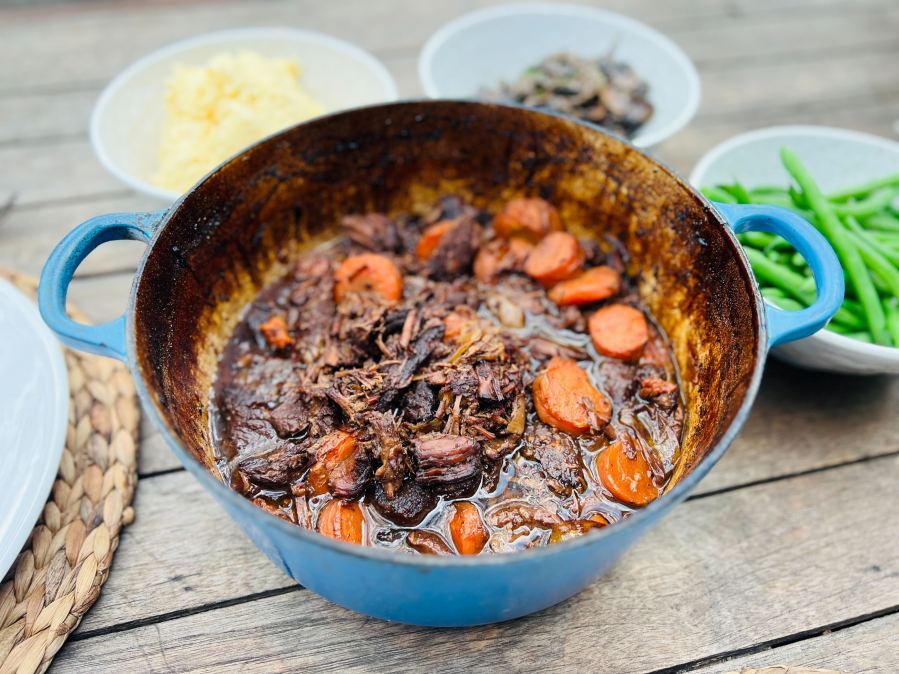
Red wine. Beef juices. Garlic, Orange peel. Herbs and spices. And hours of time in the oven or on the stove.
Nothing to assume this isn’t a marvellous winter lunch party dish.
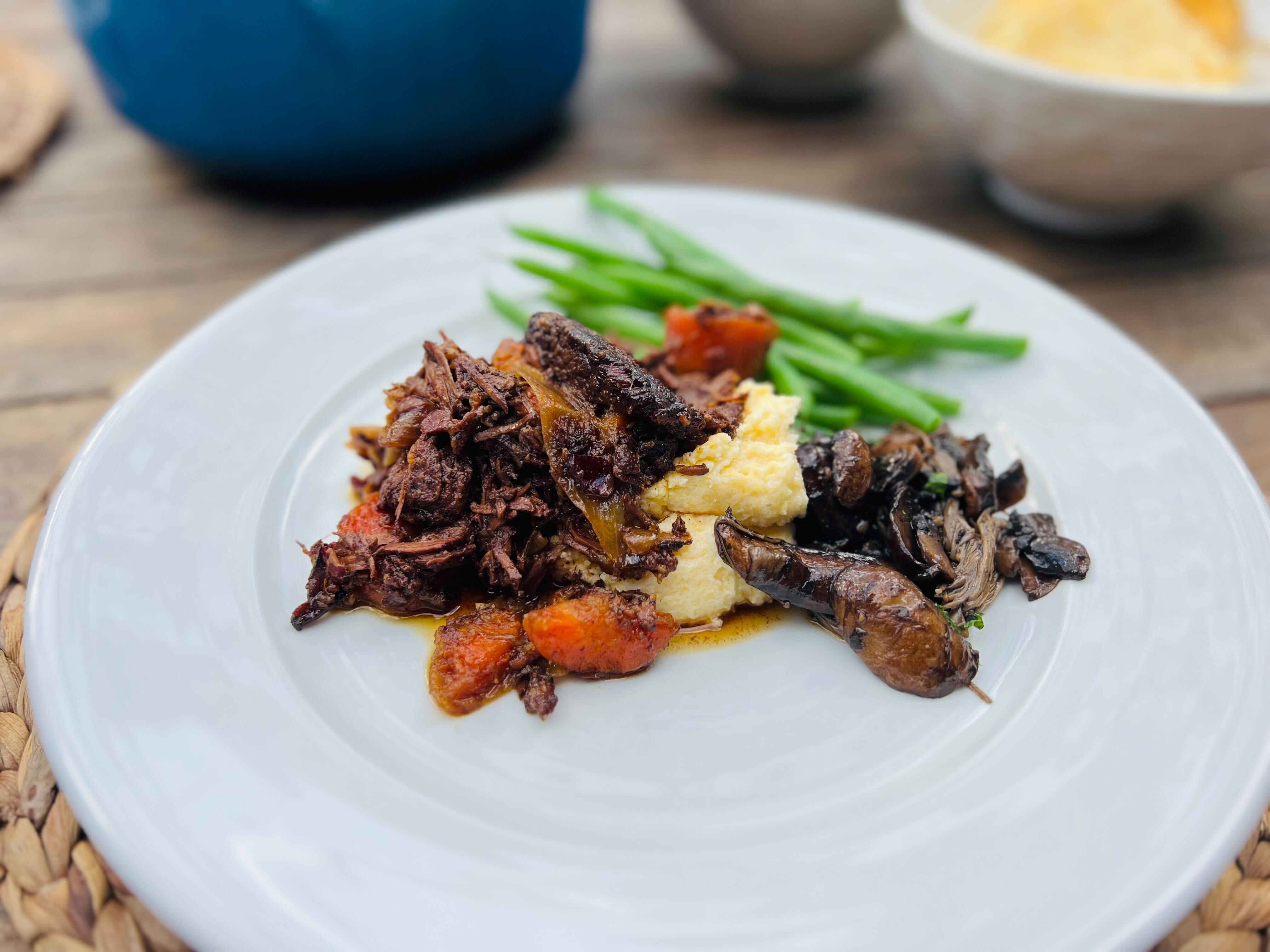
Served with a Parmesan polenta, braised mushrooms and green beans, this was comfort dialed up.
We lit the fire pit, turned up the music and wow, didn’t this make for a great afternoon.
Skip breakfast and thank me later.
Ingredients
4 tbsp olive oil 1.5kg beef, cut into large pieces* 2 large onions, each cut into 6 wedges 125gm unsmoked pancetta or diced streaky bacon 5 garlic cloves, peeled 500gm carrots, cut into 1.5cm slices 1 bottle of red wine 2 bay leaves 4 – 5 thyme sprigs 1 tsp ground cinnamon 3/4 tsp ground allspice 3 – 4 cloves 2 – 3 tsp sugar Strips of peel from 1 orange 3 – 4 tbsp cognac or grappa (optional) Salt and black pepper
Method
Heat the oil in a large heavy-based pan or casserole over medium heat, put in the meat and cook, turning the pieces to brown all over.
Remove the meat to a plate and put the onions and pancetta into the pan. Sauté for about 6 minutes, stirring until the onions are lightly coloured and the pancetta releases its fat. Add the garlic for the last minute or so, then the carrots, and season.
Return the meat to the pan, pour in the wine and add the herbs and spices, sugar and orange peel. Add water to cover, bring to the boil, then turn the heat down to low, cover the pan, and simmer very gently for 2 – 3 hours, keeping the meat submerged, until it is so tender, you can cut it with a spoon. Towards the end of the cooking time, remove the orange peel and if you like, add the cognac.**
* My brother-in-law Sean really dropped in a cracking rump cap a week ago. He is a master of the BBQ and we share notes, ideas and recipes. We even once had a reverse-sear vs sous vide rib eye bone in challenge (he won ever so slightly, though a win is a win). Anyway, he would never have done a rump cap in a 6 hour braise, though my reading was that it was a perfect cut and indeed… it was.
If you can get a rump cap, trim it and this will be perfect.
** I did the main cooking time in the oven at 160c. After 2 hours, I removed the lid and cooked down the liquid for another hour or two. Would do it again.
Monday of a long weekend in Sydney: a Saturday and Sunday filled with chores, a concert for Nat and a birthday party for Max and his class.
So Monday is ours.
Which obviously – obviously – means a long lunch. French. Obviously.
We started with these toasts and my word, they are elegant.
The addition of the white rum is genius. The anise flavour adds such a quality.
And on a fresh, toasted baguette.
If these were trotting around a wedding as canapes, you’d know you were in for a good night.
Next dinner party, these are definitely coming out. Awesome.
Ingredients
150gm fresh goats’ cheese 1 1/2 tbsp extra virgin olive oil 1 tbsp pastis, arak, raki or ouzo – or white rum 1 small garlic cloves, crushed Freshly ground black pepper, to taste 1 tbsp snipped fresh chives 5 pitted black olives, chopped, to garnish Sliced, toasted baguettes or other toasts
Method
Using a fork, mash the goats’ cheese with the oil, pastis and garlic and season with a little black pepper.
Spread on toasts and garnish with a spinkling of herbs and olives.
A few years ago, I typed up this absolutely brilliant and iconic Thomas Keller dish, the “Yabba Dabba Do“. It is served with a classic Bordelaise sauce and this really is the finest of the juses.
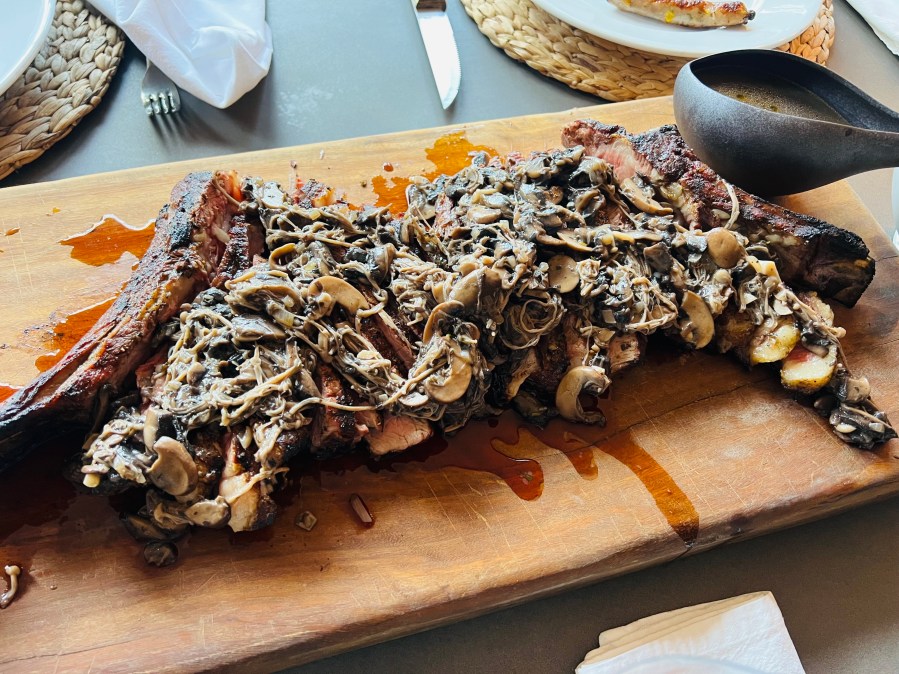
One of our favourite dishes at what was an excellent, local French restaurant – before it closed – was a rib eye, bone-in served smothered with braised mushrooms.
So why not combine the two?
I adjusted this recipe to separate the mushrooms from the Bordelaise sauce and then to reduce the sauce, ready to serve at the side.
My mother joined us from a wonder, late-Autumn French lunch and the tomahawk I cooked over charcoal, with these mushrooms and the Bordelaise sauce was an absolute highlight.
For the rare occasions we do eat beef, this is unquestionably a recipe we will return to.
So rich. So satisfying. Classy!
Ingredients
1 tbsp butter 2 tbsp shallot, minced 1 tsp minced garlic 3 tbsp butter 2 cups, sliced assorted mushrooms 1 c beef broth 1/3 c red wine 1 tbsp Worcestershire sauce 1 bay leaf 1/4 tsp chopped fresh thyme Salt and pepper to taste 1 tbsp cornstarch 2 tbsp cold water
Method
Melt 1 tbsp of butter in a skillet over a medium heat. Stir in the garlic and shallot and cook until the shallot has softened and turned translucent, about 3 minutes. Add the remaining 3 tbsp of butter, then stir in the mushrooms once the butter has melted. Cook and stir the mushrooms until they begin to soften, about 5 minutes.
Pour in the beef broth, wine and Worcestershire sauce; season with the bay leaf and thyme, and bring to a simmer over a medium-high heat. Once simmering, season to taste, reduce the heat to medium-low and continue to cook, uncovered until the sauce reduces slightly, about 30 minutes.
Strain the mushrooms and solids, and set aside, retaining the sauce.
Continuing on a medium-low heat, continue to simmer the sauce for another few minutes. Dissolve the cornstarch in the cold waer and stir into the simmering sauce until thickened.
Serve the mushrooms along the Bordelaise sauce, ready to pour.








 Robby Dog Cooks