Bearnaise Sauce

Serves: 8

There are a million Bearnaise Sauce recipes online and so here is the one millionth and first; oh, and it is Neil Perry’s.

Of course, the heart of Bearnaise Sauce is consistent across all its recipes so don’t get too excited. This Bearnaise will taste as good as any other classically cooked Bearnaise.

This said, I have had better, though I think that has been more about technique than anything. There used to be a restaurant in Crows Nest called La Grillade that my father took us to when we were kids and just how they got their Bearnaise to be so fluffy, I can only imagine.

But I’m not La Grillade and I don’t make Bearnaise for a living so this is Neil Perry’s version and I commend it to you.

Last time I served this was with a 240-day aged Angus fillet, potato gratin and beans with burnt butter and toasted almonds. You can imagine the effect.

Enjoy.

Ingredients

250g unsalted butter, cut into cubes – bring to room temperature
2 eschalots, sliced
2 tarragon sprigs, 2 tablespoons chopped tarragon leaves
5 whole peppercorns
1/2 cup (125ml) white wine
1/2 cup tarragon vinegar (I substitute white wine vinegar)
3 egg yolks

Method

  1. Heat a saucepan over medium-high heat, add eschalots, tarragon sprigs, peppercorns, white wine and tarragon vinegar and reduce until 1/3 cup (80ml) remains.
  2. Put three egg yolks in a bowl that will sit comfortably over a saucepan. Strain the tarragon reduction and pour over the egg yolks, whisking to incorporate.
  3. Put the bowl over the saucepan of barely simmering water and start whisking.
  4. As it approaches the point at which it is fully cooked, the mixture will thicken by doubling or tripling in size.
  5. Once the sauce is thick, start adding three to four cubes of butter at a time, whisking to incorporate.
  6. When all the butter is incorporated, remove the bowl from the heat, add 2 tablespoons freshly chopped tarragon and check the seasoning.
The Tuscan Burger

My last meal? A hamburger of course.

With this Tuscan Burger, read down the ingredients and you can almost taste the pesto with the chargrilled beef and melted bocconcini, the mayonaise and the chargrilled buns.

Hopefully this isn’t your last meal and as my mother is known to say, the recipe shouldn’t kill anyone. But if it does, not a bad way to go.

As always, go for the best, freshest piece of chuck steak you can and get your butcher to mince it on the coarsest cut.

Ingredients

600g freshly ground chuck steak
100g pancetta, rind removed, chopped
1/3 cup (90g) basil pesto
2 small red onions, thickly sliced
2 tbs olive oil
2 small vine-ripened tomatoes, thickly sliced
1/2 cup (150g) whole-egg mayonnaise
3-4 bocconcini, sliced
4 Italian bread rolls, split
50g baby rocket leaves

Method

  1. Place beef, pancetta and 2 tablespoons pesto in a processor. Season with salt and pepper. Pulse until just combined (do not overprocess). Form mixture into 4 patties and chill while you cook the vegetables.
  2. Preheat the oven to 160°C.
  3. Heat a chargrill pan or barbecue over medium heat. Toss onion in a little oil and grill for 1 minute each side or until just cooked. Place in the oven to keep warm.
  4. Brush tomatoes with a little oil and season, then grill for 1 minute each side. Place in the oven to keep warm.
  5. Brush both sides of patties with oil. Cook on chargrill for 2-3 minutes each side until cooked through. Chargrill the bread rolls.
  6. Mix remaining pesto with mayonnaise.
  7. Top patties with cheese and place in oven for 1 minute or until cheese melts.
  8. Spread bread-roll bases with some of the mayonnaise mixture. Top with rocket, patties, onion and tomato. Drizzle with remaining mayonnaise mixture and top with remaining bread-roll halves

Bacon Jam

Yields 2 ¾ cups

I’m on a health kick at the moment, pretty exclusively focused on undoing the impressive, red wine tyres around my tummy and chin.

And whilst, as I get further and further into my regime and more and more committed to it – and cognisant that the calories I am eating are subtracted from the calories I am burning at the park walking the dog – I still have a few vices once in a while. (Including, unfortunately, the culprit whose handiwork got me to where I am now: red wine!).

Another such vice – once a fortnight on a Saturday lunch – is a burger. Starting with Neil Perry’s Burger, I’m slowly making my way through a veritable number of burger recipes and rewarding myself for long walks and cutting back on bread, wine and snacks.

I was up in Newcastle with my good mate Josh and I came across a peanut butter and jelly burger. Aware that this would either be terrible, a none-event or life-changing, I had no choice.

Peanut butter and jelly aren’t the only odd-fellows. The recipe calls for bacon jam, something I hadn’t heard of.

A quick search and Martha Stewart and Nigella are falling over themselves. And so it begins.

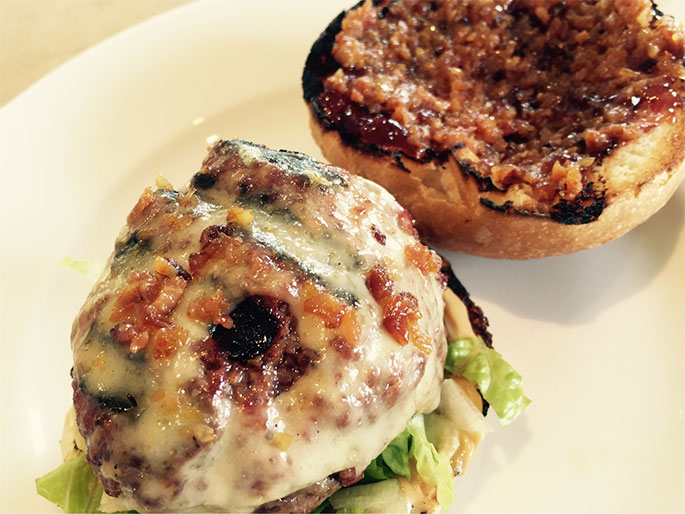
To wrap up, the burger itself was a bit of a non-event. I think that if I had added mayonnaise, it might have been interesting, though as it was, it was dry and slightly dull.

But wow, the bacon jam. Rich, sweet, sour. And spicy, What a relish!

In a sterilised jar, given that bacon is already cured, it should be able to sit on the counter like any jam, though my batch is in the fridge. Given my current, fitness trajectory, I can’t say I will be eating much of it, though when the occasion arises, the bacon jam will be the first to know!

This recipe is Martha Stewarts.

Ingredients

750gm bacon, sliced into 1cm pieces
2 c shallots, finely chopped (3 large or 8 small shallots)
4 small garlic cloves, chopped
1 tsp chilli powder
½ tsp ground ginger
½ tsp ground mustard
½ c bourbon
¼ c maple syrup
1/3 c sherry vinegar
1/3 c packed light-brown sugar

Method

  1. Spread half the bacon in a single layer in a large frypan and cook over a medium heat, stirring frequently, until browned. Around 20 – 25 minutes. Transfer to paper towels to drain. Remove fat, repeat with remaining bacon, reserving browned bits and 1 tbsp fat in pan.
  2. Add shallots and garlic to the pan and cook over medium heat, stirring until translucent: around 5 minutes.
  3. Add chilli powder, ginger and mustard and cook, stirring for 1 minute. Increase the heat to high and add the bourbon and maple syrup. Bring to a boil, scraping up the browned bits.
  4. Add vinegar and brown sugar and return to the boil.
  5. Add reserved bacon and reduce the heat to low. Simmer, stirring occasionally, until liquid reduces to a thick glaze: around 10 minutes.
  6. Transfer the mixture to a food processor and pulse until it has the consistency of a chunky jam. Refrigerate in an airtight container at least 1 hour and up to 4 weeks.

Neil Perry’s ‘Hamburger’

Serves 4

Whilst the 2013/2014/2015 Sydney hamburger craze will probably go the direction of the 2013/2014/2015 Sydney dumpling craze, for me at least, it has given me cause to reconsider the roots of a good – a great burger – and what it is all about.

Because if you have a burger at Chur Burger, or Neil Perry’s Burger Project or Sean Connolly’s Parlour Burger (with the one-day viral wonder, the Black Widow Burger), their core burger is about simplicity and quality of ingredient.

And that is perhaps where I have gone astray.

For years, my signature burger dish has been about two things:

  1. The paddy:
    1. 1kg Beef Mince
    1. 1 egg
    1. (Red) online, diced
    1. Handful of parsley, chopped
    1. A number of really good splashes of Worcestershire Sauce (and therefore the flavour)
    1. A heaped teaspoon of Horseradish
    1. Seasoning
  2. The balance:Grilled (BBQ) slices of white toast
    1. Torn cos lettuce
    1. Sliced tomato
    1. Sliced cheddar cheese to melt on the BBQed paddies
    1. Ketchup (not tomato sauce), good egg mayo and American Mustard

And whilst, if really flame grilled over a high heat and served medium-rare, this is a cracker burger, it isn’t the essence of burger. It is like customising mac and cheese when the purity of proper mac and cheese needs no improvement. It is like adding bacon to a Big Mac. There isn’t necessarily a need.

Worst still, I was using crappy mince from the supermarket. And the mince is where the flavour is!

Indeed, reflecting back on all the burgers I have cooked over the years – including the Tuscan Burger than won me a gong at a Wiliam food day – they have all been about stuffing ingredients into the patty. And using crudolla mince.

This burger recipe by Neil Perry is your classic mac and cheese. It will surprise nobody except that freshness of the meat makes the difference. Here, you MUST instruct your butcher to find his finest, most marbled piece of chuck steak. And then to grind it, fresh, on his coarsest setting.

At which point, you need to sprint home to cook it.

Get back to basics, invest in the meat, buy some really good buns (not that crap at Woolies), open a Corona with some lime and eat this bad boy in the sun. Seriously, this is good!

Oh, and if you can BBQ your buns and especially bacon on the BBQ as well, the taste simply gets even better by a factor of 10: Neil Perry says so himself!

I have slightly adjusted his recipe.

Ingredients

1kg of freshly ground chuck steak
½ – ¾ tsp sea salt
Extra virgin olive oil
4 hamburger buns, split and toasted (ideally grilled on the BBQ)
Ketchup, American Mustard and egg mayonnaise
4 slices gruyere (or sliced cheddar if gruyere not on tap)
8 rashes of good bacon
Lettuce and tomato slices
Sliced, picked cucumber (optional)
Freshly ground pepper

Method

  1. The bacon needs to be really, really crispy and this will take time. Depending on timings, start cooking the bacon in a pan or prepare it ready for the BBQ, ensuring that in either event, it is cooked to the point of snapping in two.
  2. Place the meat in a bowl and sprinkle with salt. Mix gentle and divide into 4. Move each portion between your hands for a minute to make a firm, though not overworked patty. Shape into a ball. Gently flatten to form patties around 3cm thick. (If you are refrigerating, cover in cling wrap and ensure that they are bought back to room temperature prior to cooking).
  3. Heat your BBQ (or pan) to very hot. Grill the burger for 2 minutes on one side, flip and another 3 minutes, placing a slice of cheese on top of each paddy for the final minute of cooking. Let the patties rest for 5 minutes and whilst doing so, grill your buns, taking note of your bacon depending on however you are cooking it.
  4. Assemble your bad boy; bottom of bun, mayo and mustard, patty, lettuce and tomato, bacon, ketchup, grind of pepper, top of bun.
  5. Close your eyes and eat.

Roger Verge’s Rib of Beef with Shallots and Vinegar

Serves 2

My parents cooked this for Nat and me a few months back, remarking that it was simply the finest beef dish around.

And it is.

Its genius is in its simplicity and the beauty of its raw presentation; a cut of rare, primal meat on the bone, the butter and shallots heaped on top, some potato gratin and maybe some sautéed beans or asparagus or Brussel sprouts. This dish talks to why Roger Verge was such a genius chef.

This is a dish – commensurate with the relative cost of the cut of beef as well as the generally wonderful occasion that always surrounds itself around standing rib eye – that demands a very good bottle of red and a doubling of the dish to ensure that there are at least four of you to enjoy it.

I have cooked this for six people and it really is just a matter of multiplying the ingredients as need be.

A worthy note, whilst Haverick Meats (or Vics, or some other good wholesaler) will always be the pick for the finest standing rib eye (and the aged, standing rib eye at Haverick Meats is extraordinary: served at Cut, Chophouse and the finest steak restaurants in Sydney), if you can’t make it there or to another quality butcher, Woolworths now sells rib eye. It is vacuum sealed, two servings per bag and it really quite good and of course, really quite convenient.

Do not stop, do not go to jail, collect $200 and cook this, this weekend.

Ingredients

1 rib of beef weighing 800gm – 1000gm (essentially, a two bone thick cut), cut into individual portions (i.e. one bone per person)
3 finely chopped shallots
2 tbs (red) wine vinegar
2 tbs chopped parsley
70g butter
Salt and pepper

Method

  1. Season the beef with the salt and pepper and rub in the seasoning with the tips of your fingers.
  2. Heat a generous tablespoon of the butter in a frying-pan and when it begins to foam, put in the beef. Lower the heat so that the beef does not acquire a hard crust and cook for 5 – 10 minutes per side, depending on the thickness of the meat and how well done you want it; rare to medium-rare I hope, something you should be able to determine by pressing down on the meat in the traditional method.
  3. Remove the meat and keep it hot. To do this, put it on an upturned plate inside a larger one and cover the whole thing with an upturned bowl. This allows the meat to rest without drowning in its own juices, which would spoil the texture.
  4. Pour away the cooking butter and replace it with the remaining butter, together with the chopped shallots. Return to a medium heat and allow to soften for 5 minutes without allowing the shallots to brown. Add the wine vinegar and cook for another 5 minutes, stirring with a wooden spoon. Season with a few grinds of pepper and salt as necessary. Add the chopped parsley and the juices which have run out of the meat. Mix well and pour into a sauceboat, ensuring it remains hot.
  5. Cut the beef in thick slices, giving each person and equal serving of lean and fat. Serve very hot, accompanied by the shallot sauce.

For what it is worth, Mr Verge goes on to explain that the meat really doesn’t need much more than a ‘salad of curly endive seasoned with a mustardy vinaigrette’. In fact, in his recipe, he ‘promises you splendid meal’ if the ‘wine is cool and fresh’.

No doubt, though I served this with sautéed asparagus and scalloped potatoes (potatoes and cream) and we drank red wine.

And with my approach, I also, can promise a splendid meal and afternoon.

Chophouse’s BBQ Glazed Short Ribs

Serves 4

My favourite source of meat in Sydney is Haverick Meats. They’re the best butcher in town and their Saturday store is borderline theatre; dozens and dozens of customers in the cool room, hundreds of cuts of meat, a non-stop BBQ for the kids.

And the best meat in town.

Peter, their MD has been pushing me to try his Short Ribs since I have known him, though I’ve never really thought of how to cook them and so have always left them on hold.

I found this short rib recipe via Haverick Meats; it is from the Chophouse, one of Haverick Meat’s many restaurant clients. The Chophouse did a cooking presentation at Haverick Meats for selected food bloggers – one of whom kindly reproduced the recipe.

I’ve cooked ribs plenty of times and they’re always a party winner; though just those boring pork and beef ribs you can find at Woolies with a BBQ sauce.

These Short Ribs are simply a different level altogether.

This is restaurant grade stuff. From the cut of meat to the process to the flavour.

Head to Haverick Meats on a Saturday morning, grab the Short Rib and say hello to Saturday night’s dinner and improved friendships/admiration/adoration.

Ingredients

2kg piece short rib (grain fed ideally), trimmed, bone in

Dry Rub Ingredients

2 sticks lemongrass
3 birds eye chilli
100gm ginger (about 2 cups!)
1 bunch coriander

BBQ Sauce Ingredients

200gm tomato paste
300ml apple cider vinegar
20ml sweet chilli sauce
5ml tabasco sauce
7gm ground ginger
10gm hot English mustard
20ml dark soy sauce
40ml light soy sauce
10g ground black pepper
400ml honey
100ml water

Method

  1. Steam the short rib for three hours; I left the ribs in the oven for a few hours after this to cool and as with all cuts of meat like this, the longer the cooking time, the better.
  2. Place the dry rub ingredients in a food processor and blend to a rough paste.
  3. Once the meat has cooled, scrape the excess fat and apply the dry rub to it; allow to marinate in the fridge for at least 6 hours.
  4. For the BBQ sauce, add all the ingredients to a large pot and bring to the boil. Mix regularly to stop the sauce from sticking to the bottom. Reduce to a simmer and continue to stir for 20 minutes. Cool and strain.
  5. Heat an oven to 160c. Scrape the marinade off of the meat and transfer the meat to a baking tray. Pour over the BBQ sauce and slow cook for 30 minutes, basting the meat every 5 or so minutes. Add water to the sauce if it starts to caramelise.
  6. Serve with slaw, baked potato and corn.

Spicy Braised Beef Soup with Hot Bean Paste

Spicy Braised Beef Soup with Hot Bean Paste

Serves 4

I found this recipe on the Rockpool website – I assume it is sourced from Spice Temple.

It is a wonderful and really fresh dish, though spend some time making sure you track down the right pastes. There are dozens and dozens and at the Chinese grocer I went to, they said they had little knowledge of the Korean pastes other than whether they were used in soups or not.

The reason I say to take care is that you want this soup’s spice level dialled to 11; it’s the reason this dish is so good.

Ingredients
700gm piece beef brisket, trimmed
1 star anise
1 tsp Szechuan peppercorns
1 tsp fennel seeds
1 cinnamon quill
4 tbsp vegetable oil
2 cloves garlic, finely sliced
1 tsp finely chopped ginger
2 spring onions, finely sliced into rounds
2 tbsp Korean fermented hot chilli bean paste (gochujang)
2 tbsp Chinese soybean paste (huang jing)
1 tbsp Shaoxing wine
¼ cup light soy sauce
1 tbsp castor sugar
160gm fresh Shanghai noodles
3 Chinese cabbage leaves
1 long red chilli, finely sliced
Handful coriander leaveshandful coriander leaves

Method

  1. Place the beef in a pot covered with plenty of cold water and bring to the boil; when the scum rises, remove the beef and rinse. Cut beef into 2cm pieces.
  2. Dry-roast the spices in a pan for 4-5 mins until fragrant, Allow to cool and wrap in a tied muslin cloth.
  3. In a large pot, put in the beef, spices (in the muslin cloth) and 2 ½ litres; bring to the boil. Reduce heat and simmer for 2 hours. Lift out the beef and the spice bag and reserve including the stock.
  4. Heat oil to hot in a large wok. Stir-fry the garlic, ginger, and spring-onions for 1 minute. Add both the bean pastes and fry until fragrant.
  5. Deglaze with Shaoxing wine, then season with the soy and sugar. Check seasoning.
  6. Add the beef and spice bag and 1 ¼ litres of the beef stock; bring to the boil, reduce the heat and simmer for 15 minutes.
  7. Cook the noodles until al dente; 8 – 10 minutes or according to instructions; I doubled the amount of noodle though this does change the dish to more of a noodle dish than a soup.
  8. Remove the spice bag from the wok and discard; dice the cabbage leaves into 3cm pieces and blanch for a minute in the stock; add the noodles to heat through.
  9. Ladle the soup into four large bowls and garnish with the chilli and coriander.

Gordon Ramsay’s Slow Braised Beef Cheeks (Ragu) with Pappardelle

Serves 6

Credit where credit is due.

This is an amazing dish; an amazing braise. And I didn’t even cook it.

Nat did. For my 36th birthday.

A good ragu is about the length of the cooking time and this is where Nat nailed it. Six hours in, there was a ripple of fear that the beef cheeks hadn’t broken down, still solid and in one piece each; two hours later and a light tap, and they collapsed into moorish, unbelievably tender meat.

And why not keep cooking on a low heat, right up until dinner? Which is what we did. Time is your friend and beef cheeks love to sit and braise away.

During my childhood and teen years, my mother cooked Pork in Milk for my every birthday; it was my annual request and 20 or more years on, I can still taste it.

This ragu has now replaced my annual pork offering and I can’t wait to cook it – or have it cooked for me – again and again and again.

Ingredients

Olive oil, for frying
1kg of beef cheeks (in this instance, don’t substitute another cut of beef; or try lamb shanks if that is all you can get)
1 onion, peeled and roughly cut
2 garlic cloves, peeled and roughly crushed
1 bay leaf (or two dried if you can’t get fresh)
400ml red wine (you can safely use a bit more here)
1x 400gm tin chopped tomatoes
500ml beef stock
500gm dried pappardelle
Handful of parsley, chopped
Salt and pepper

Method

  1. Heat the oil in a heavy pan; season the meat and brown on all sides. Set aside.
  2. In the same pan, brown the onions, garlic and bay leaf until just softened and starting to brown a little.
  3. Return the meat to the pan and add the wine to deglaze.
  4. Allow it to reduce a little and add the stock and tomatoes; season with salt and pepper. Bring to a simmer and then turn the heat down.
  5. Stir occasionally for the next four hours, ensuring the meat is not drying out and adding water as need be. The meat is ready when it falls apart; keep cooking as long as you want. Time is your friend!
  6. Cook the pasta in salted water.
  7. Gently stir through the sauce with the pasta and garnish with parsley.
  8. Happy birthday.

Kofta b’siniyah

With a glass of Pinot and a salad at the side, this is seriously heaven.

Serves 6

This recipe is from a book called ‘Jerusalem’ (Yotam Ottolenghi and Sami Tamimi), bringing together recipes from the city; east and west. The book was a birthday present from our great friends, Woodles and Billy and they swear by it. After cooking this recipe, I do too.

This dish stood out immediately for two reasons.

Firstly, I love mince and anything to do with mince.

Secondly, it was a different sort of mince recipe than I had cooked before; mainly the use of the warmed tahini as a base and the burnt butter whilst serving.

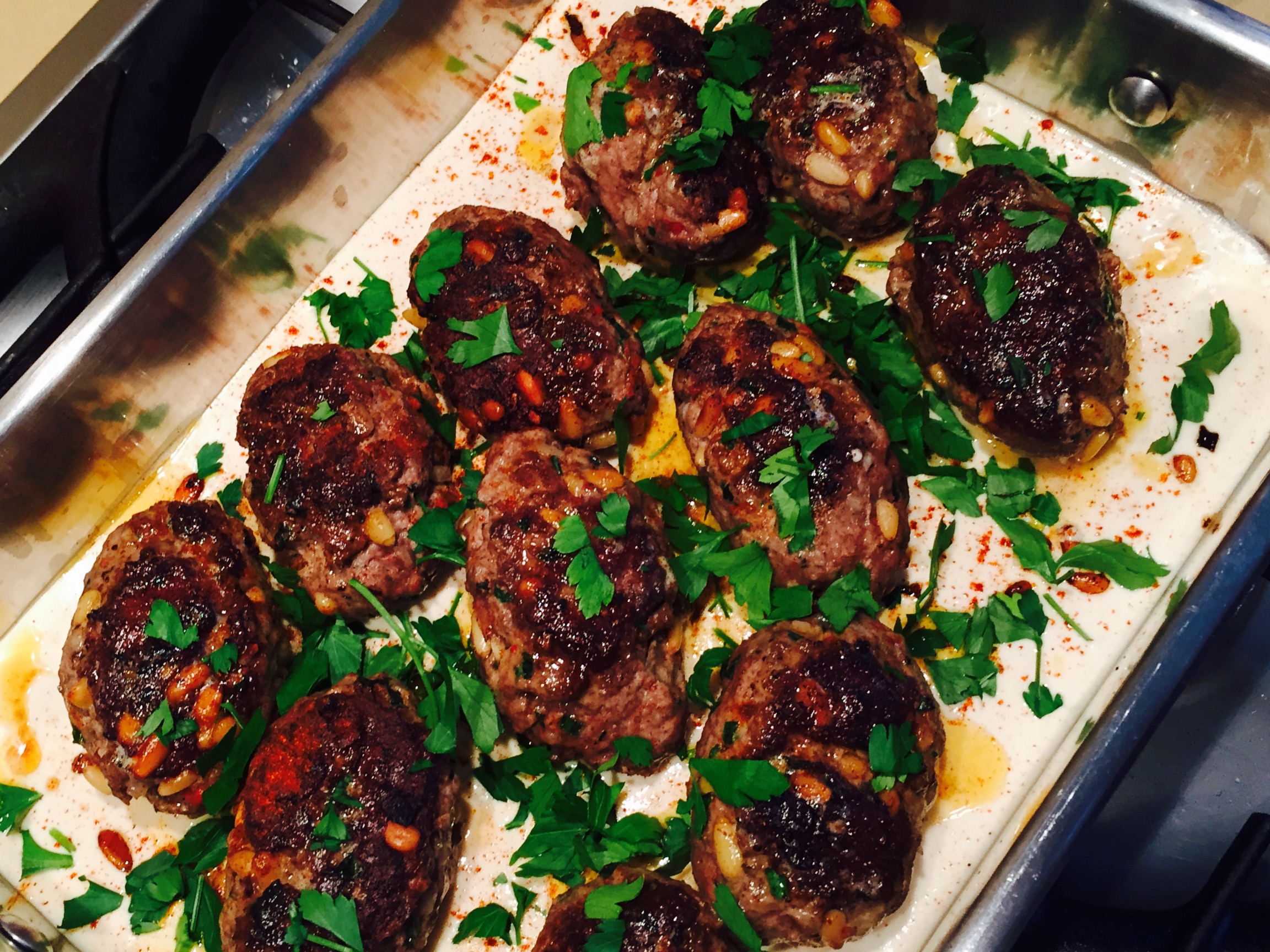
What is really grabbing about it, is the presentation; it is beautiful and dramatic and perfect for a simple Sunday lunch with friends. I served it with a warm potato salad, though it would be well served with a salad of cucumber and tomato and some pita bread at the side.

Ingredients

150gm light tahini paste
3 tbsp lemon juice
120ml water
1 medium garlic clove, crushed
2 tbsp sunflower oil
30gm of unsalted butter (or ghee)
Sweet paprika to garnish
Salt
Chopped flat-leaf parsley

Kofta

400gm minced lamb
400gm minced veal or beef
1 small onion
2 large garlic cloves, crushed
50gm toasted pine nuts, roughly chopped, plus extra whole ones to garnish
30gm finely chopped flat-leaf parsley, plus extra to garnish
1 large red chilli, deseeded and finely chopped
1½ tsp ground cinnamon
1½ tsp ground allspice
¾ tsp grated nutmeg
1½ ground black pepper
1½ tsp salt

Method

  1. Put all the kofta ingredients in a bowl and using your hand, mix well together.
  2. Shape the koftas into long, torpedo-like fingers, roughly 8cm long. Press the mix to compress it and ensure the kofta is tight and keeps it shape. Set aside and refrigerate for up to a day.
  3. Preheat the oven to 200c.
  4. In a bowl, whisk together the tahini paste, lemon juice, water, garlic and ¼ teaspoon of salt; the sauce should be a bit runnier than honey and add one or two tablespoons of water if it is not.
  5. Heat the sunflower oil in a large frying pan (I used a griddle) and sear the kofta over a high heat; do this in batches so they are not cramped. Sear them on all sides until they are golden brown; around six minutes per batch. At this point they should be medium rare.
  6. Transfer the kofta to an oven tray and spoon the tahini sauce around the koftas. Place in the oven for a few minutes, both to cook the koftas a bit further (2 – 4 minutes depending on your preference) and to warm the sauce.
  7. Melt the butter in a small saucepan and allow it to brown a little ensuring it doesn’t burn.
  8. Spoon the butter over the koftas as soon as they come out of the oven; scatter with pine nuts and parsley and finely sprinkle paprika on top.

Neil Perry’s beef tagine with fried cauliflower

Neil Perry’s beef tagine with fried cauliflower

Serves 4

Holy shit, this is a great dish. The beef is so hot and intense, it is also a revelation and much more than your bog standard apricot and beef tagine in stock. It should surprise nobody that for me, Neil Perry is one of the best chefs around.

I thought about adding apricots to the dish to give it sweetness, though the raisins in the cous cous were more than ample. (I should have slightly adapted this recipe to be as I made it.)

Sprinkle with some toasted, slivered almonds and a handfuls of coriander and this is one of those meals where few words will be said.

Ingredients

1.2kg beef chuck, cut into 2.5cm dice
5 tbsp extra-virgin olive oil
1 x 400g tin peeled, chopped tomatoes
1 small cauliflower, broken into florets
½⁄ tsp freshly ground black pepper
Good handful of roasted almonds
Chopped coriander

Chermoula

1 medium Spanish onion, peeled and roughly chopped
4 garlic cloves
Sea salt
1/2 tsp ground turmeric
5 tbsp extra-virgin olive oil
1 tbsp ras-el-hanout
1 tsp sweet paprika
1 tsp ground ginger
1 tsp ground cumin
2 tbsp coriander leaves
2 tbsp flat leaf parsley
1 tsp crushed dried chillies
Juice of 1 lemon

Cous Cous

Cous Cous
Chicken Stock
Raisins

Method

  1. To make the chermoula, puree all the ingredients together in a food processor until relatively smooth.
  2. Marinate the diced beef in the chermoula paste for one hour.
  3. Heat three tablespoons of extra-virgin olive oil in a saucepan big enough to fit all the beef. When just smoking, add the beef (shaking off as much marinade as you can, though reserving the marinade) and quickly saute to colour and seal well on all sides.
  4. Add the chopped tomatoes and a cup of water to the bowl the beef was previously marinating in, mix well and add to the saucepan. Bring to the boil then turn down to a simmer, cover with a tight-fitting lid and cook gently for about two to two-and-a-half hours or until beef is tender.
  5. Toast the almonds and prepare the cous cous with the stock and the raisins.
  6. When the beef is nearly ready, bring a pot of salted water to the boil, add the cauliflower florets and cook for one minute. Drain the cauliflower well, allow to dry then shallow-fry the cauliflower in a small saucepan with the remaining olive oil.
  7. To serve, spoon the cous cous into bowls, ladle the beef on-top, sprinkle with the browned cauliflower, give a good grind of pepper and sprinkle with the coriander and almonds.